- Plants
- ›Vascular Plants
- ›flowering plants
- ›Dicots
- ›proteas, lotuses, planes, and allies
- ›Protea family
- ›Primitive Proteas
- ›Persoonieae
- ›Persoonia
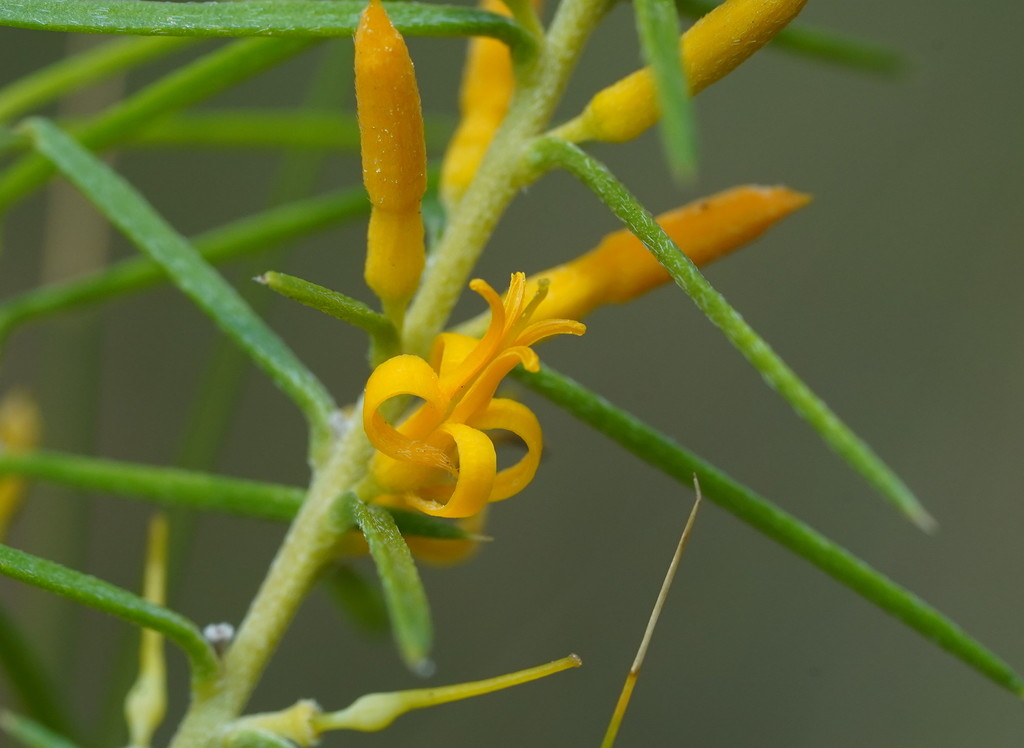
Prickly Geebung
Persoonia juniperina
Persoonia juniperina, commonly known as the prickly geebung, is a shrub native to south-eastern Australia. It was first collected in Tasmania, and described by French naturalist Jacques Labillardière in 1805. Within the genus Persoonia, P. juniperina is classified in the lanceolata group, a group of 54 closely related species with similar flowers but very different foliage. These species will often interbreed with each other where two members of the group occur. The species itself is variable...
From the article Persoonia juniperina on Wikipedia (CC BY-SA), quoted section by section
Description
Persoonia juniperina is an erect to low-lying shrub that typically grows to a height of 0.3–2 m (1 ft 0 in – 6 ft 7 in) with smooth bark and hairy young branchlets. The leaves are linear, 8–35 mm (0.31–1.38 in) long and 0.7–1.5 mm (0.028–0.059 in) wide. The flowers are borne singly or in groups of up to forty on a rachis up to 150 mm (5.9 in) long that grows into a leafy shoot after flowering, each flower on a hairy pedicel 0.8–3 mm (0.031–0.118 in) long. The tepals are yellow, sometimes hairy on the outside, 7–11 mm (0.28–0.43 in) long with yellow anthers. Flowering occurs from December to February and the fruit is an oval, yellowish green to purplish drupe about 10 mm (0.39 in) long and 8 mm (0.31 in) wide.
Range & habitat
Persoonia juniperina is found across Tasmania and from Green Cape on the New South Wales far south coast, south through Victoria and into southeastern South Australia as far west as Adelaide. The habitat is sclerophyll forest and heath to an altitude of 700 m (2,300 ft).
Wikipedia: “Distribution and habitat”
What it does
A field study manipulating pollination showed P. juniperina was partly self-compatible but cross-pollination led to greater fruit production.
== References ==
Wikipedia: “Ecology”
Where it lives
Recorded sightings
—
geo-referenced records in GBIF, from museums, herbaria and field observers.
Drag the globe to turn it. Dots are where records exist, not a range map; darker means more records.
In the stacks
Searching the stacks…
Every page naming Persoonia juniperina in the Biodiversity Heritage Library →
This page is assembled live from iNaturalist, GBIF, Wikipedia, the Source Library and the Internet Archive. It is not yet part of the hand-edited codex. iNaturalist taxon 323847.