- Plants
- ›Vascular Plants
- ›flowering plants
- ›Dicots
- ›Mallows, Rock Roses, and Allies
- ›Mallow and Hibiscus Family
- ›Byttnerioideae
- ›Lasiopetalum
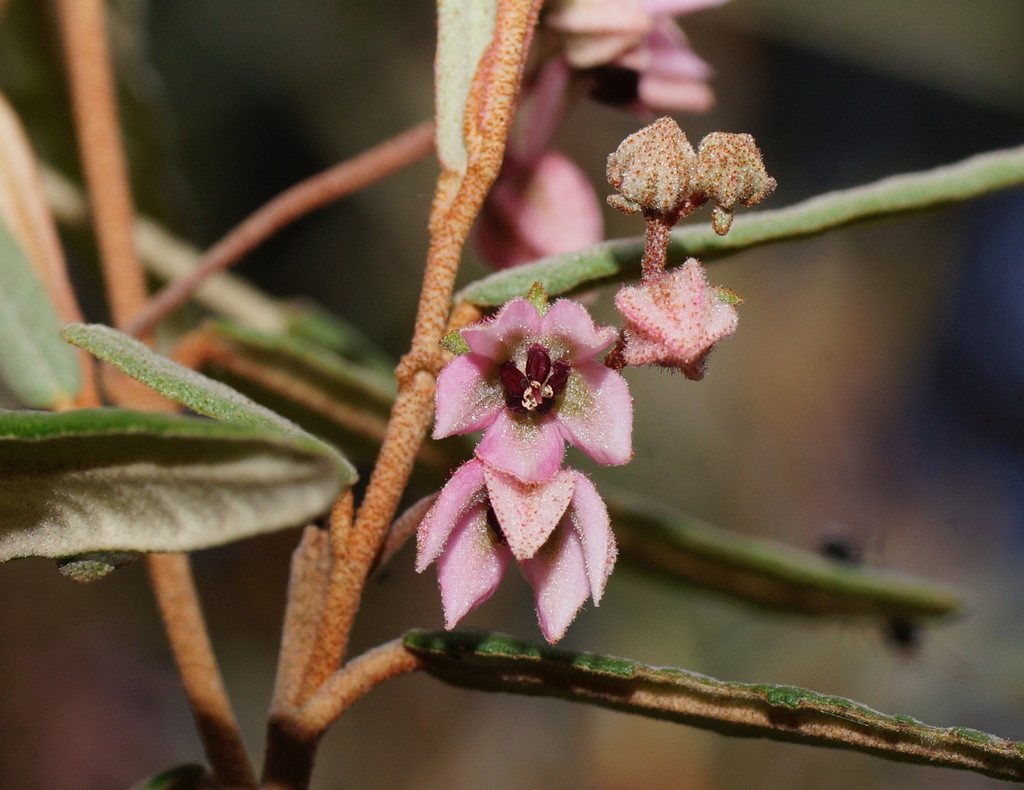
slender velvet-bush
Lasiopetalum baueri
Lasiopetalum baueri, commonly known as slender velvet bush, is a species of flowering plant in the family Malvaceae and is endemic to south-eastern Australia. It is a small, greyish shrub with more or less linear to narrowly oblong or narrowly elliptic leaves and groups of white or pink flowers.
From the article Lasiopetalum baueri on Wikipedia (CC BY-SA), quoted section by section
Description
Lasiopetalum baueri is a greyish, densely foliaged, spreading shrub 0.3–1.5 m (12–59 in) high and 1–2.5 m (3.3–8.2 ft) wide, its new growth prominently covered with red-brown hair. The leaves are linear to narrowly oblong or narrowly elliptic, 15–80 mm (0.59–3.15 in) long and 2–12 mm (0.079–0.472 in) wide on a petiole 2–4 mm (0.079–0.157 in) long, the margins flat or turned downwards. Hairy below, they become smooth above over time. The flowers are arranged in sometimes crowded groups of two to six with three bracteoles 1.4–3.0 mm (0.055–0.118 in) long at the base. The sepals are 3.4–5.7 mm (0.13–0.22 in) long and usually pink or white with a green base, the outer surface densely covered with star-shaped hairs. The petals are less than 1 mm (0.039 in) long and the anthers are reddish-brown and about 1.5 mm (0.059 in) long. Flowering occurs from September to November and the fruit is a densely hairy capsule 4–8 mm (0.16–0.31 in) in diameter.
Range & habitat
Slender velvet bush is found in southern South Australia, central and western Victoria, and southwestern New South Wales where it is confined to the vicinity of Rankins Springs, and in the north-east of Tasmania. It grows in mallee communities or coastal cliffs on sandy soil over limestone, the top layer of soil often neutral to acidic, while the subsoil is highly alkaline.
Wikipedia: “Distribution and habitat”
How it is grown
Lasiopetalum baueri can be readily grown in dryer climates in well-drained soils and sunny aspects, and is used as a windbreak or hedge. It responds well to being pruned. It was introduced into cultivation in England in 1868. The dried flowers are long-lasting and have potential as a cut flower.
== References ==
Wikipedia: “Use in horticulture”
Where it lives
Recorded sightings
—
geo-referenced records in GBIF, from museums, herbaria and field observers.
Drag the globe to turn it. Dots are where records exist, not a range map; darker means more records.
In the stacks
Searching the stacks…
Every page naming Lasiopetalum baueri in the Biodiversity Heritage Library →
This page is assembled live from iNaturalist, GBIF, Wikipedia, the Source Library and the Internet Archive. It is not yet part of the hand-edited codex. iNaturalist taxon 323886.