- Plants
- ›Vascular Plants
- ›flowering plants
- ›Dicots
- ›pinks, cactuses, and allies
- ›didierea family
- ›Portulacaria
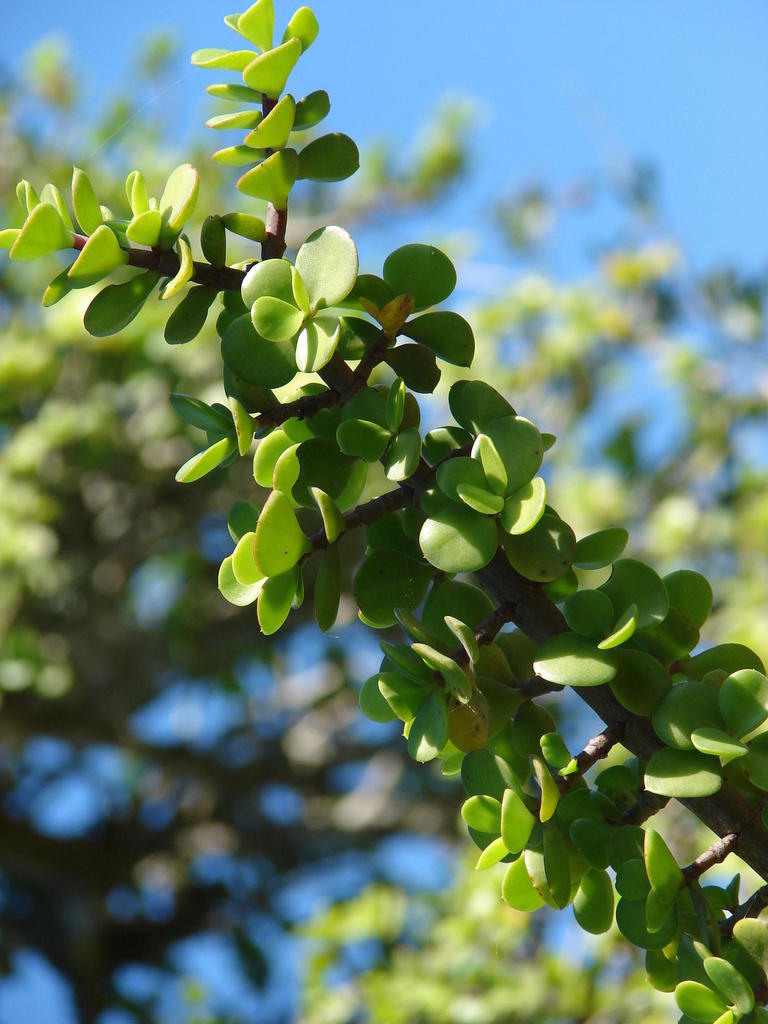
Elephant bush
Portulacaria afra
Portulacaria afra (known as elephant bush, porkbush, purslane tree, dwarf jade and spekboom in Afrikaans) is a small-leaved succulent plant found in South Africa. These succulents commonly have a reddish stem and green leaves, but a variegated cultivar is often seen in cultivation. They are simple to care for and make easy houseplants for a sunny location. In frost-free regions they may be used in outdoor landscaping.
From the article Portulacaria afra on Wikipedia (CC BY-SA), quoted section by section
Description
It is a soft-wooded, semi-evergreen upright shrub or small tree, usually 2.5–4.5 metres (8–15 ft) tall. P. afra has smaller and rounder pads and more compact growth (shorter internodal spaces, down to 1.5 millimetres (0.059 in)). It is much hardier, faster growing, more loosely branched, and has more limber tapering branches than Crassula once established. The genus Portulacaria has been shown to be an outlier, relatively unrelated to the other genera in the family, which are all restricted to small ranges in the arid far west of Southern Africa.
Range & habitat
It is very widespread in the east of South Africa (as well as Eswatini). In this moist climate, it is relatively rare, and tends to favour dryer rocky outcrops and slopes. It is also found in much denser numbers in the dryer southern Cape. Here it occurs from the Little Karoo of the Western Cape, eastwards up until the thicket vegetation of the Eastern Cape. Spekboom is found most prolifically in the Albany thickets, a woodland ecoregion, which locally is often called noorsveld, after the high number of succulent Euphorbia species, which are often called noors plants. In these environments, P. afra is a source of food for multiple large herbivores, such as the black rhinoceros and the African elephant. Although it is not the primary food source for these animals, it still makes up a significant portion of their diet. P. afra is considered a keystone species in the shrubland thicket subregions of the Albany thickets due to its resistance to drought, flood, and fire. When it is not the dominant species, spekboom borders shrubland thickets and protects interior growth. Its growth rate is not dependent on water availability, and spekboom is able to accumulate biomass in excess of what would be predicted by rainfall levels in the area. …
Wikipedia: “Distribution and habitat”
At the table
In the wilds of South Africa, large plants do survive the winter frosts by growing dense enough to provide their own natural cover. Drought-tolerant and fire-resistant, it will endure desert sun and heat once established, which the jade plant will not. P. afra is a common landscape plant in Phoenix, Arizona, and southern California, growing in USDA plant hardiness zones 9–11. Cuttings root very easily in most potting media.
Ornamental. It is popular as a specimen for bonsai, and as a hardy xeriscaping plant. Several varieties exist – some bred in cultivation, others naturally occurring:
"Limpopo": A variety with much larger leaves. It is the natural form from the far north of the species' range. "Prostrata": A low-lying, decumbent form that is frequently used as a groundcover. "Aurea": A compact, upright form with rounded leaves that go bright yellow in the sun. "Foliis variegatus": A variegated form. "Medio-picta": Variegated with a lighter centre.
Culinary. In Southern Africa it is commonly eaten, usually as one component of a salad or a soup. It should not be confused with the jade plant, which is mildly toxic. P. afra is also used to feed livestock during periods of drought due to its succulent nature. Most commonly used for cattle and goats, these plants also act as a supplemental source of water on top of their nutritional benefits for livestock.
Medicinal. …
Wikipedia: “Cultivation and uses”
Where it lives
Recorded sightings
—
geo-referenced records in GBIF, from museums, herbaria and field observers.
Drag the globe to turn it. Dots are where records exist, not a range map; darker means more records.
In the stacks
Searching the stacks…
Every page naming Portulacaria afra in the Biodiversity Heritage Library →
This page is assembled live from iNaturalist, GBIF, Wikipedia, the Source Library and the Internet Archive. It is not yet part of the hand-edited codex. iNaturalist taxon 326086.