- Plants
- ›Vascular Plants
- ›flowering plants
- ›Dicots
- ›Sunflowers, Bellflowers, Fanflowers, and Allies
- ›Sunflowers, Daisies, Asters, and Allies
- ›Asteroideae
- ›paper daisies
- ›cudweeds, everlastings, and pussytoes
- ›Leontopodium
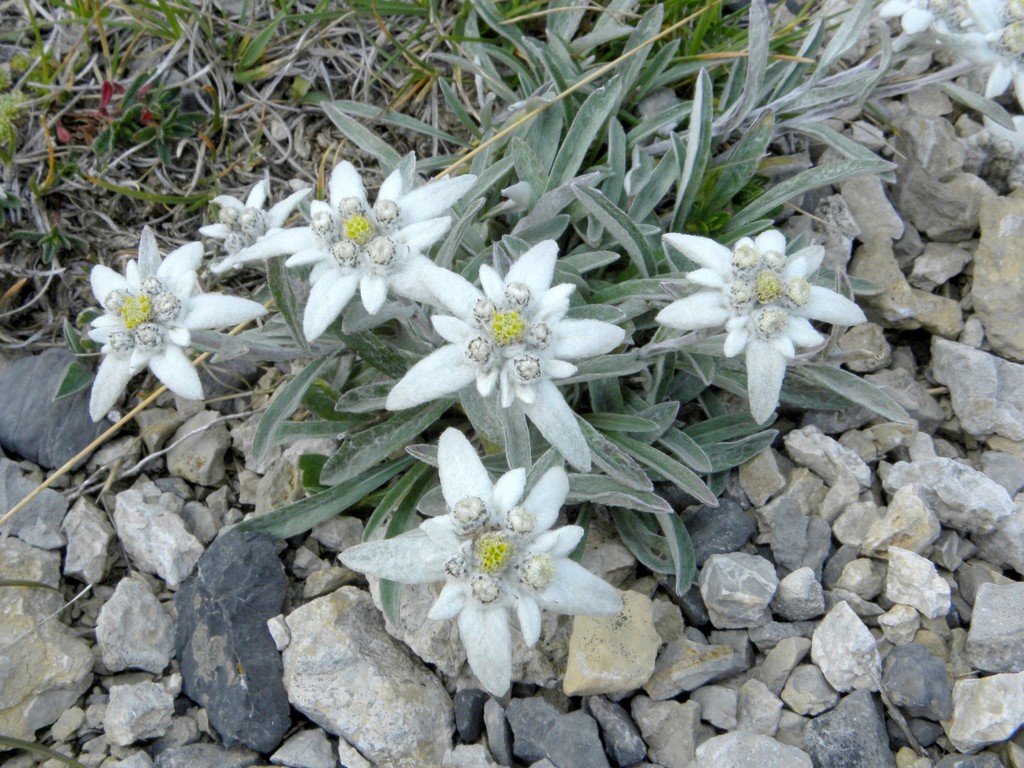
Edelweiss
Leontopodium nivale
Leontopodium nivale, commonly called edelweiss (lit. 'noble white') (English: AY-dəl-vyss; German: Edelweiß [ˈeːdl̩vaɪs] or Alpen-Edelweiß), is a mountain flower belonging to the daisy or sunflower family Asteraceae. The plant prefers rocky limestone places at about 1,800–3,400 metres (5,900–11,200 ft) altitude. It is a non-toxic plant. Its leaves and flowers are covered with dense hairs, which appear to protect the plant from cold, aridity, and ultraviolet radiation. The filamentary wool (tomentum) has sub-micrometer internal structure that contributes to scattering and absorption of near-ultraviolet radiation, which is interpreted as an adaptive trait for high-altitude UV exposure. It is a scarce, short-lived flower found in remote mountain areas and has been used as a symbol for alpinism, for rugged beauty and purity associated with the Alps and Carpathians. It is a national symbol of several countries, specifically Bulgaria, Austria, Slovenia, Switzerland, and Italy. In Romania it was declared a "monument of nature" in 1931. Edelweiss Day is celebrated on the 5th of March. According to folk tradition, giving this flower to a loved one is a promise of dedication.
From the article Edelweiss on Wikipedia (CC BY-SA), quoted section by section
Description
The plant's leaves and flowers are covered with white hairs, and appear woolly (tomentose). Flowering stalks of edelweiss can grow to a size of 3–20 centimetres (1–8 in) in the wild, or, up to 40 cm (16 in) in cultivation. Each bloom consists of five to six small yellow clustered spikelet-florets (5 mm, 3⁄16 in) surrounded by fuzzy white "petals" (technically, bracts) in a double-star formation. The flowers bloom between July and September.
Range & habitat
Leontopodium nivale prefers rocky limestone locations in the Alps, Pyrenees Mountains, and the Italian Apennines at about 1,800–3,400 metres (5,900–11,200 ft) altitude.
Range and substrate. The species is native to European mountains with a distribution centred on the Alps and extending westwards to the Pyrenees and eastwards into parts of the Balkans and the Apennines. Populations are typically restricted to exposed, calcareous (limestone and dolomite) scree and rocky cliffs, often on north-facing slopes where microclimate and substrate reduce competition from taller vegetation. Modern taxonomic resources (World Flora Online, Kew) map the species and its subspecies across central and southern European mountain ranges.
Altitude and ecology. Typical elevations are approximately 1,800–3,400 m (6,000–11,000 ft), although local populations may occur slightly outside this range depending on exposure and substrate. Plants are adapted to high UV, strong winds, wide temperature fluctuations and thin soils; the woolly hairs on leaves and bracts reduce water loss and block or scatter harmful ultraviolet wavelengths.
Wikipedia: “Habitat and distribution”
At the table
In the 19th century, the edelweiss became a symbol of the rugged purity of the Alpine region and of its native inhabitants. The passion for edelweiss, which had previously been neglected, began in the middle of the 19th century. The focus is on an incident from 1856, when the Austrian Emperor Franz Joseph I went on a mountain hike to the Pasterzen Glacier on the Großglockner with his wife Sisi. There the emperor picked his wife an edelweiss from the steep rock with the words "The first in my life that I picked myself". The affection for edelweiss was a common feature of the famous couple and this well-known story raised people's attention to this alpine plant. The plant became known as a symbol of the Austrian Empress Elisabeth. A portrait by the painter Franz Xaver Winterhalter painted in 1865 shows Empress Elisabeth with nine artificial edelweiss stars braided in her hair. The jewelry made of precious metal and diamonds was designed in the years after 1850 by the then court and chamber jeweler Alexander Emanuel Köchert. With the rise of mountain tourism at the end of the 19th century, the edelweiss became the badge and symbol of alpinists and mountaineers. In order to prevent the extinction of the often picked symbolic species, it was placed under nature protection early on. The edelweiss was soon adopted as a symbol in the logo of numerous alpine clubs and associations. …
Wikipedia: “Symbolic uses”
How it is grown
Leontopodium nivale is grown in gardens for its interesting inflorescence and silver foliage. It grows in the end of May The plants are short lived and can be grown from seed.
Growing requirements and propagation. Edelweiss is best cultivated in rock gardens or well-drained gritty substrates that mimic its natural calcareous scree habitat. It requires full sun, excellent drainage, and low to moderate fertility; poorly drained soils or heavy fertilization quickly reduce plant vigor and longevity. Plants are generally short-lived perennials in cultivation but can be maintained by regular sowing from seed or by lifting and dividing clumps where permitted. Propagation is most commonly by seed (cold stratification improves germination), and some horticultural varieties have been selected for compact habit or longer flowering. Because wild collection was historically a threat, responsible horticulture relies on nursery-propagated stock and seed provenance records.
Wikipedia: “Cultivation”
Where it lives
Recorded sightings
—
geo-referenced records in GBIF, from museums, herbaria and field observers.
Drag the globe to turn it. Dots are where records exist, not a range map; darker means more records.
In the old herbals & bestiaries


In the stacks
Searching the stacks…
Every page naming Leontopodium nivale in the Biodiversity Heritage Library →
This page is assembled live from iNaturalist, GBIF, Wikipedia, the Source Library and the Internet Archive. It is not yet part of the hand-edited codex. iNaturalist taxon 326185.