- Animals
- ›Arthropods
- ›Hexapods
- ›Insects
- ›Winged and Once-winged Insects
- ›Beetles
- ›Water, Rove, Scarab, Long-horned, Leaf, and Snout Beetles
- ›Cucujiform Beetles
- ›Longhorn Beetles and Allies
- ›Longhorn Beetles
- ›Round-necked Longhorn Beetles
- ›Clytini
- ›Chlorophorus
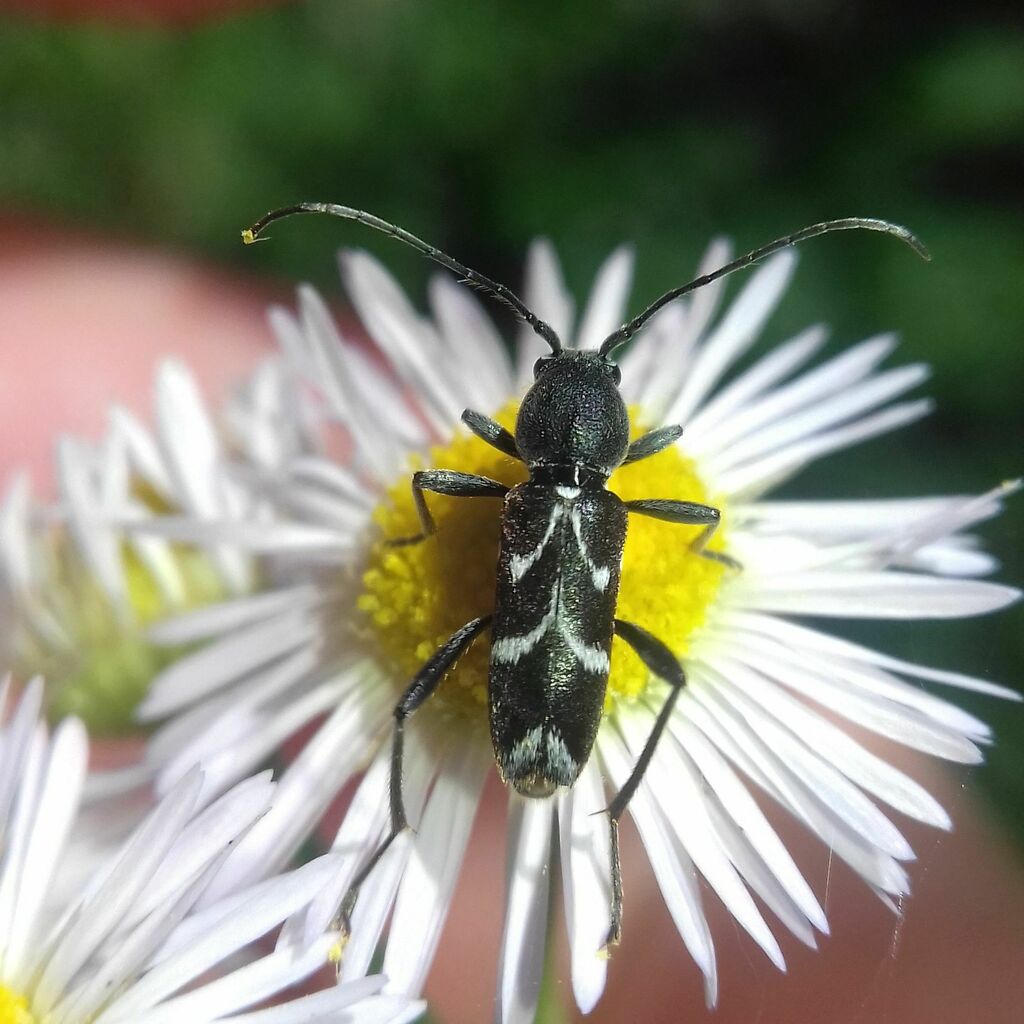
Chlorophorus sartor
Chlorophorus sartor is a species of round-necked longhorns belonging to the family Cerambycidae, subfamily Cerambycinae.
From the article Chlorophorus sartor on Wikipedia (CC BY-SA), quoted section by section
Description
Chlorophorus sartor can reach a length of 6–10 millimetres (0.24–0.39 in). Head, pronotum and elytra are black or brownish and the elytrae show three light stripes and dots. This species is rather similar to Chlorophorus pelleteri.
Range & habitat
This widespread and common beetle is present in most of Europe (Albania, Austria, Belarus, Bosnia and Herzegovina, Bulgaria, Croatia, Czech Republic, France, Germany, Greece, Hungary, Italy, Montenegro, North Macedonia, Poland, Portugal, Romania, Russia, Serbia, Slovakia, Slovenia, Spain, and Switzerland), in the eastern Palearctic realm, and in the Near East.
Wikipedia: “Distribution”
In human culture
The genus name Chlorophorus derives from the Greek word chlorós meaning green and phorós meaning wearing, while the species name sartor means tailor.
Wikipedia: “Etymology”
Listen
Looking for field recordings…
Where it lives
Recorded sightings
—
geo-referenced records in GBIF, from museums, herbaria and field observers.
Drag the globe to turn it. Dots are where records exist, not a range map; darker means more records.
In the stacks
Searching the stacks…
Every page naming Chlorophorus sartor in the Biodiversity Heritage Library →
This page is assembled live from iNaturalist, GBIF, Wikipedia, the Source Library and the Internet Archive. It is not yet part of the hand-edited codex. iNaturalist taxon 326419.