- Animals
- ›Arthropods
- ›Hexapods
- ›Insects
- ›Winged and Once-winged Insects
- ›Flies
- ›Brachyceran Flies
- ›Cyclorrhaphan Flies
- ›Schizophoran Flies
- ›Acalyptrate Flies
- ›Fruit, Signal, and Picture-winged Flies
- ›Fruit Flies
- ›Cucurbit Fruit Flies
- ›Dacini
- ›Bactrocera
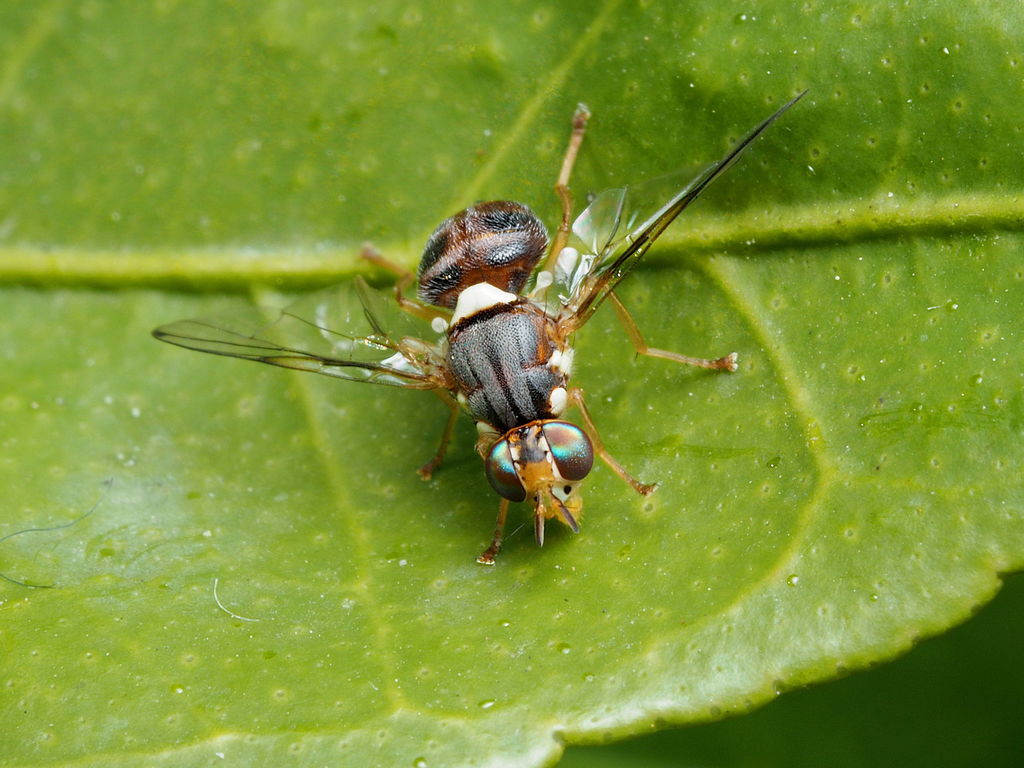
olive fruit fly
Bactrocera oleae
The olive fruit fly (Bactrocera oleae) is a species of fruit fly which belongs to the subfamily Dacinae. It is a phytophagous species whose larvae feed on the fruit of olive trees, hence the common name. It is considered a serious pest in the cultivation of olives.
Until 1998, the fly had not been detected in the United States, and its range coincided with the range of the olive tree in the Eastern Hemisphere: northern, eastern, and southern Africa, Southern Europe, the Canary Islands, India, and western Asia. In the Western Hemisphere, it is currently restricted to California, Baja California, and Sonora. The olive fruit fly was first detected in North America infesting olive fruits on landscape trees in Los Angeles County in November 1998. It can now be found throughout the state of California.
From the article Olive fruit fly on Wikipedia (CC BY-SA), quoted section by section
Description
The egg is around 0.7 to 1.2 mm long, elongated, and slightly flattened in its stomach, with a small, white microfleece nodule, which is important for the respiration of the embryo. The larva is vermiform and has a conical-cylindrical, narrow front. It develops through three stages (larva, first, second and third stage). The mature larva is 6–7 mm long, white-yellowish in colour, elongated, and subconical. The front sensors are bipolar and the second conic feature, the rear sensor, has eight sensilla. The cephalopharyngeal skeleton has very short dorsal and ventral apodemes, the hypostomal scleritis is triangular. It lacks a subhypostomal and the jaws are hooked. The oral lobes have 10–12 indents, preceded on each side by a sensory plate similar to the larva of the Ceratitis capitata. The frontal stigmas have 9–10 lobes. The three larval stages can be distinguished in different ways by their cephalopharyngeal structures. The different shapes of the frontal stigmas allow determination of the larvae of the second and third stages, while the larva at its first stage is metapneustic, equipped with one pair of posterior stigmas.
The pupal stage takes place inside the puparium, an elliptical shell formed by the last exuvial transformation of the larva. The puparium is 3.5 to 4.5 mm long, varying in colour from creamy white to yellow-brown, when it is dry. …
Wikipedia: “Morphology”
Range & habitat
This species is associated with plants of the genus Olea. It is found throughout the Mediterranean basin and in South Africa. Since the late 1990s, it has also been present in California and may have spread throughout the area of olive cultivation in the Nearctic region. It is considered the most serious pest of olives in regions where it lives, significantly affecting both the amount and quality of production in most olive-growing areas. The impact of its attacks tends to worsen in the more humid and cooler growing areas, with significant variations depending on the variety grown, where it affects olive cultivars and areas that have hot summers and less drought.
Wikipedia: “Distribution and importance”
What it does
The females lay their eggs in the summer when the olive is at least 7–8 mm in diameter. Egg-laying is done by making a puncture with the ovipositor into the skin of the olive, leaving only one egg in the hollow below. The bite has a characteristic triangular shape due to an optical effect. A puncture has a dark green colour, whilst older bites have a yellowish-brown colour as a result of wound healing. Hatching occurs over a variable period depending on weather conditions: from 2–3 days in summer, to about 10 days in autumn. The newly hatched larva initially digs a tunnel on the surface, but later moves deeper into the flesh to the core, which is not affected in any way. During larval development, two changes occur, which in turn increase the size of the larva.
Around the third change, larvae at their third stage move toward the surface and prepare the exit hole for the adult, gnawing at the flesh to leave a thin surface layer. During this phase, the olive clearly shows signs of the attack because its appears darker in conjunction with the tunneling. On the surface, a circular hole due to the remaining residual skin becomes apparent. The pupae remain dormant in the hollow below, protected within the exuviae produced by the mature larvae. At maturity, the adult breaks the exuvia and emerges from the pupa. …
Wikipedia: “Life cycle”
In human culture
In the final years of the 18th century, Italian scientist Giuseppe Maria Giovene (1753–1837), in his work Avviso per la distruzione dei vermi che attaccano la polpa delle olive (1792), provided some suggestions for peasants to effectively destroy the fly musca oleae, which infested the pulp of olive trees.
Wikipedia: “History”
Listen
Looking for field recordings…
Where it lives
Recorded sightings
—
geo-referenced records in GBIF, from museums, herbaria and field observers.
Drag the globe to turn it. Dots are where records exist, not a range map; darker means more records.
In the stacks
Searching the stacks…
Every page naming Bactrocera oleae in the Biodiversity Heritage Library →
This page is assembled live from iNaturalist, GBIF, Wikipedia, the Source Library and the Internet Archive. It is not yet part of the hand-edited codex. iNaturalist taxon 326609.