- Animals
- ›Arthropods
- ›Hexapods
- ›Insects
- ›Winged and Once-winged Insects
- ›Flies
- ›Brachyceran Flies
- ›Cyclorrhaphan Flies
- ›Schizophoran Flies
- ›Calyptrate Flies
- ›Bot Flies, Blow Flies, and Allies
- ›Blow Flies
- ›Nose Flies
- ›Rhiniini
- ›Stomorhina
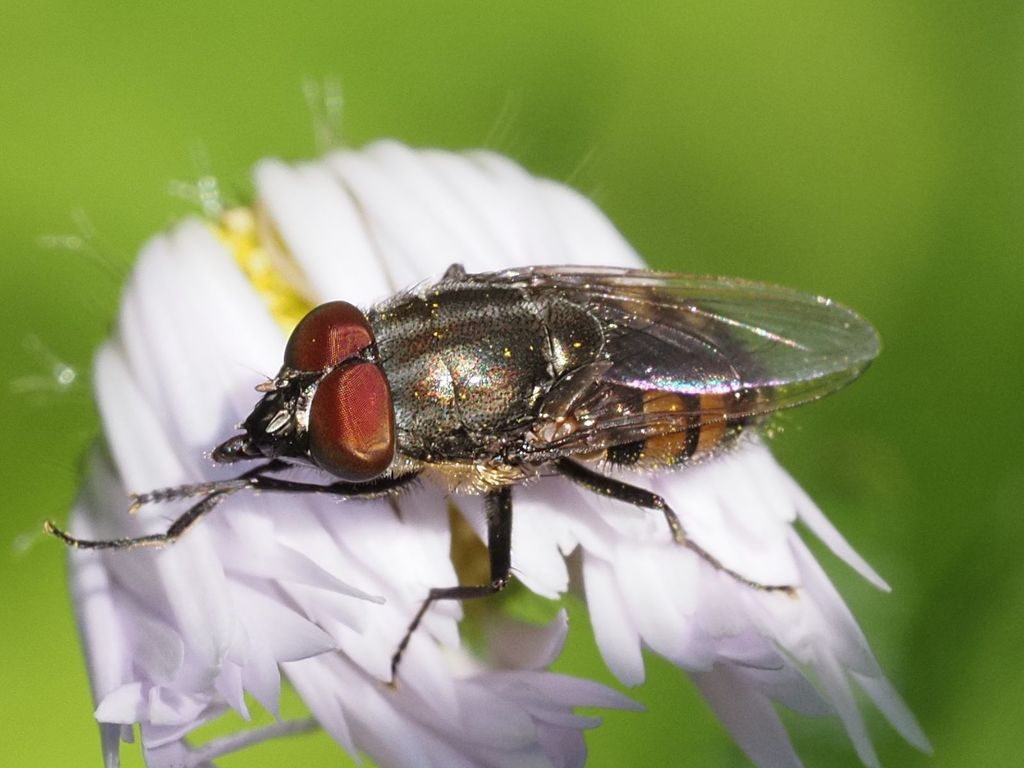
Locust Blowfly
Stomorhina lunata
Stomorhina lunata is a species of fly in the family Calliphoridae, often misidentified because of the unusual band pattern in the abdomen, typical of hoverflies. S. lunata is an important egg predator of some major African agricultural pests, the South African Brown locust (Locustana pardalina), the more widespread Desert locust (Schistocerca gregaria), and the migratory locust (Locustana migratoria).
From the article Stomorhina lunata on Wikipedia (CC BY-SA), quoted section by section
Description
Stomorhina lunata can reach a length of 5–9 millimetres (0.20–0.35 in) and a wingspan of 13–16 millimetres (0.51–0.63 in). These distinctive, medium-sized blowflies are rather similar to the house flies, but they have a characteristic prominent proboscis, a longitudinally striped thorax and an abdomen with yellow and black bands. Males have large orange patches on the sides of tergites 3 and 4, while females only show grey dust patches. This distinctively marked species is often misidentified because of the unusual band pattern in the abdomen, typical of hoverflies.
Range & habitat
This species is present in most of Europe, the Afrotropical realm, the eastern Palearctic realm, the Near East and North Africa, the Indomalayan realm, and the Nearctic realm. These flies usually inhabit meadows.
Wikipedia: “Distribution and habitat”
Listen
Looking for field recordings…
Where it lives
Recorded sightings
—
geo-referenced records in GBIF, from museums, herbaria and field observers.
Drag the globe to turn it. Dots are where records exist, not a range map; darker means more records.
In the stacks
Searching the stacks…
Every page naming Stomorhina lunata in the Biodiversity Heritage Library →
This page is assembled live from iNaturalist, GBIF, Wikipedia, the Source Library and the Internet Archive. It is not yet part of the hand-edited codex. iNaturalist taxon 326655.