 NL·0222
Herbarium of the Nature Library
- Name
- Gyps rueppelli
- Family
- Accipitridae
- Native to
- Sahel and East Africa, from Senegal to Ethiopia and Tanzania
- Habitat
- Savanna, Mountain cliffs, Semi-desert scrub
On eBird ↗
Rüppell's Griffon
Live sightings near you, the range map, bar charts of when it is seen, and Macaulay Library photos and recordings.
Rüppell's vulture
Gyps rueppelli
Also calledVautour de Rüppell (French)
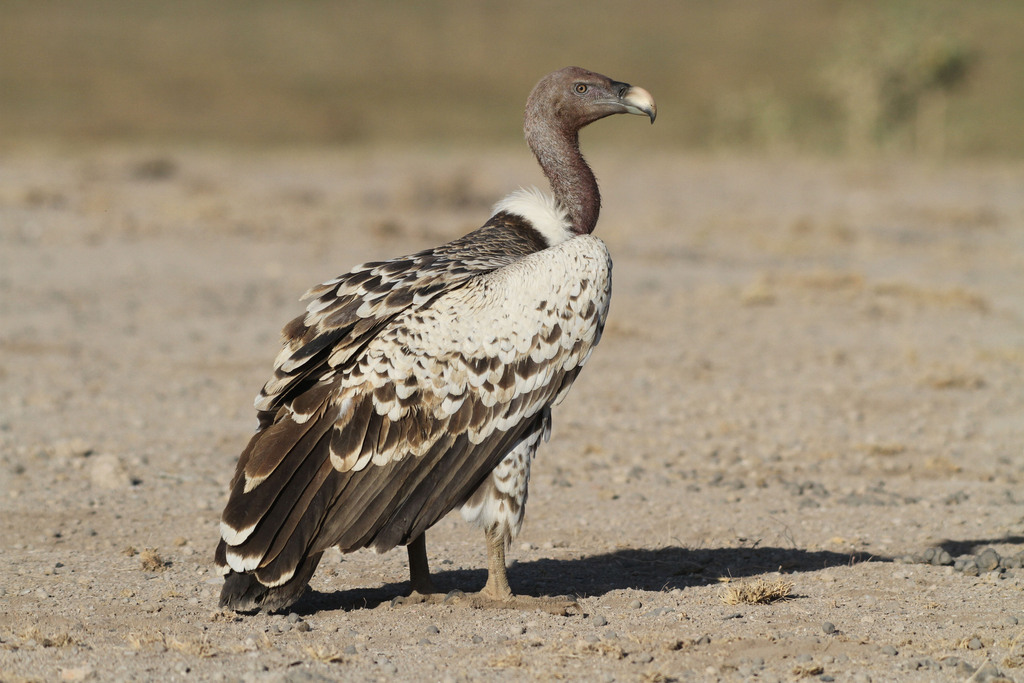
A large griffon vulture of the Sahel and East Africa and the highest-flying bird on record. Specialist haemoglobin lets it breathe at altitudes where a human would lose consciousness.
Rüppell's vulture, also called Rüppell's griffon vulture or Rüppell's griffon, a species of vulture named after Eduard Rüppell, is a large, resident bird of prey, mainly native to the Sahel region and East Africa. It is considered to be the highest-flying bird, with confirmed evidence of a flight at an altitude of 11,300 m (37,000 ft), where the average temperature is about −56 °C (−69 °F). The former population of 22,000 individuals has been decreasing due to loss of habitat, incidental poisoning, and other factors. It is therefore listed as Critically Endangered on the IUCN Red List. Wikipedia
What it can do
- iStruck an airliner at 11,300 m over Côte d'Ivoire in 1973, the highest-flying bird recorded
- iiHas a haemoglobin variant that binds oxygen well at low pressure
- iiiClears carcasses fast, limiting the spread of disease
- ivSoars on thermals for hours while searching for food
In the field
Field marks
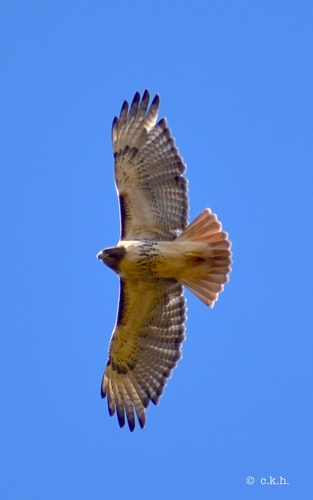
- aDark brown body with every feather edged creamy-white, giving a scaly, mottled look
- bYellowish to horn-coloured bill
- cPale yellow eye
- dWhite neck ruff
- eIn flight, thin white lines across the underwing
- Voice
- Hissing, squealing and grunting at carcasses; otherwise silent.
- Not to be confused with
- White-backed vulture has plainer, less scaled brown plumage, a dark bill and dark eye, and a white rump in flight. Lappet-faced vulture is larger with a bare pink head and wrinkled lappets.
- Where to see it
- Serengeti, Maasai Mara, Simien Mountains (Ethiopia), Gol Mountains (Tanzania) for cliff colonies
- When
- Resident; moves to follow migratory herds
Listen
Looking for field recordings…
Life & habits
- Diet
- Carrion, especially soft tissue of large mammals
- Habitat
- Open savanna and grassland, nesting on cliffs
- Size
- 85–107 cm long; wingspan 2.3–2.6 m; 6.5–9 kg
Colonies breed on high cliffs and forage over vast areas, often travelling 150 km from the nest.
Where it lives
Recorded sightings
—
geo-referenced records in GBIF, from museums, herbaria and field observers.
Native range
Sahel and East Africa, from Senegal to Ethiopia and Tanzania
Drag the globe to turn it. Dots are where records exist, not a range map; darker means more records.
In the old herbals & bestiaries
No plate in the Source Library names this exact species, so these show its closest relatives as the old naturalists drew them: same genus, or the same kind of animal. Click a plate to read the page it came from, with translation.

Jan Jonston — Naeukeurige beschryving van de natuur der viervoetige dieren (1660)
Relative · Jan Jonston · 1660 · p.285

Jan Jonston — Naeukeurige beschryving van de natuur der viervoetige dieren (1660)
Relative · Jan Jonston · 1660 · p.31

François Bouchard — Recueil de cent-trente-trois oiseaux des plus belles especes (1775)
Relative · François Bouchard · 1775 · p.26

Garden of Health
Relative · 1507 · p.547

History of Animals, Book I: On Viviparous Quadrupeds
Relative · Conrad Gessner · 1554 · p.934

History of Animals, Book I: On Viviparous Quadrupeds
Relative · Conrad Gessner · 1554 · p.379

Historiae Animalium Liber III: De Avium Natura
Relative · Conrad Gesner · 1555 · p.789

Historiae Animalium Liber III: De Avium Natura
Relative · Conrad Gesner · 1555 · p.790

Florentine Codex, Vol. 3 (Books 10-12)
Relative · Bernardino de Sahagún · 1577 · p.714

Ornithology
Relative · Ulisse Aldrovandi · 1599 · p.252
In the stacks
Searching the stacks…
Every page naming Gyps rueppelli in the Biodiversity Heritage Library →
Marginalia
It is named after the German explorer Eduard Rüppell, who collected in north-east Africa in the 1820s. Vulture parts are used in African traditional medicine and divination, which drives poaching.
Curiosity
Its population dropped by an estimated 97% in three generations, mostly through poisoning, including poachers lacing elephant carcasses so circling vultures won't reveal them.
Kinship


Photographs: iNaturalist contributors under the licences shown. Records: GBIF.org. Historical plates: Source Library (CC BY-SA 4.0; originals public domain). Summary text: Nature Library editors and Wikipedia (CC BY-SA). Medicinal and edibility notes are historical and educational, not advice. iNaturalist taxon 327608.