- Plants
- ›Vascular Plants
- ›flowering plants
- ›Dicots
- ›myrtles, evening primroses, and allies
- ›myrtle family
- ›Myrtoideae
- ›Myrteae
- ›Eugeniinae
- ›Eugenia
- ›Eugenia
- ›Pilothecium
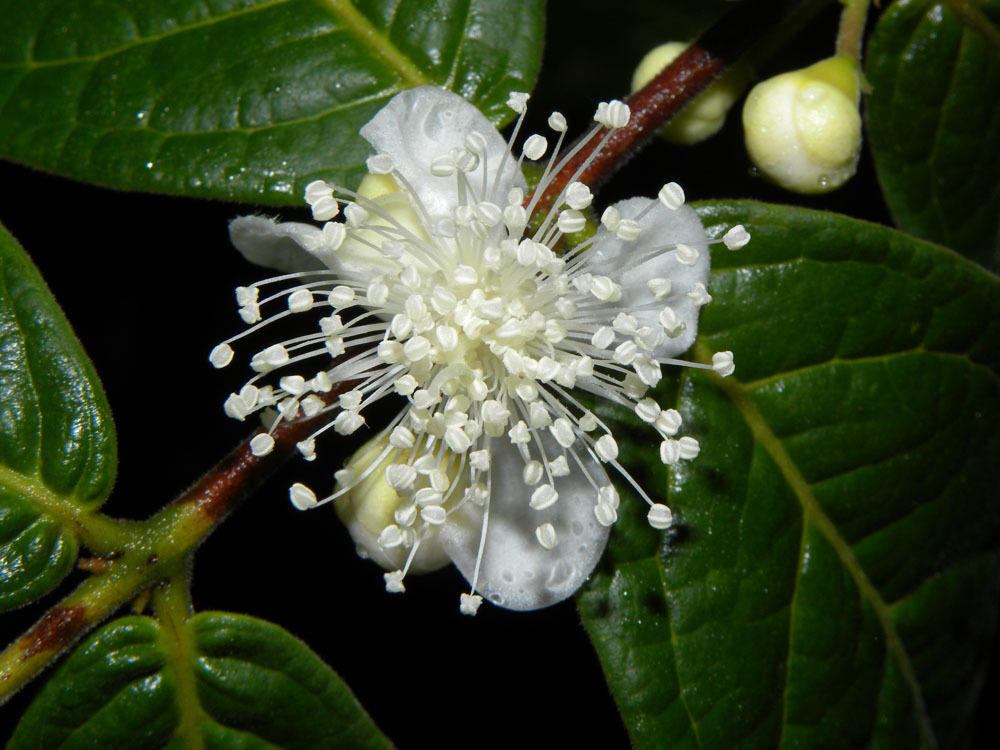
Eugenia stipitata
Eugenia stipitata (Araza, Portuguese common names araçá, araçá-boi Portuguese pronunciation: [ɐɾɐˈsa ˈboj], Spanish common name arazá, from Guarani arasa; also known as membrillo in Ecuador) is a fruit tree native to the Amazon rainforest in Brazil, Colombia, Peru and Ecuador.
From the article Eugenia stipitata on Wikipedia (CC BY-SA), quoted section by section
Description
Arazá originated in the western part of Amazonia. This plant is a lesser-known and underutilized crop, which have certain attractive properties for further agricultural development. Although the fruit is very acidic when eaten directly from the tree, it can be processed into juices, nectars, marmalades, ice-creams, and other foods with a refreshing taste. The species is believed to have its origin in the extreme west of the Amazon basin, perhaps in the Peruvian Amazon. Most of the wild populations are found on old, non-floodable terraces in tropical, white, highly leached podzolic soils, which are distributed specifically within the area between the Marañón and Ucayali Rivers and where the Amazon begins and as far as Iquitos (ssp. sororia) and in Brazilian state Acre (ssp. Stipitata). It is only found in the western Amazon and does not appear to have been widely spread by the indigenous people, although some of the best varieties appear to have been selected by the indigenous people of Peru around Iquitos. The reason is that within the locally cultivated material, there occur varieties 12 cm in diameter and 740 g in weight, compared with the wild populations which do not exceed 7 cm in diameter and 30 g in weight. Less frequently, species may be found also in Bolivia, Brazil, Colombia. …
At the table
This climacteric fruit contains a high level of acidity, averaging pH 2.4 for the juice, and that confers to it a good quality for processing. Moreover, it contains a high level of nitrogen and potassium. The dry weight contains 8-10% of proteins, 5–6.5% of fibre, 65–72% of other carbohydrates and a small amount of calcium, 0.16–0.21%, 10-12ppm of zinc and also some phosphorus, potassium and magnesium. For 100g of fruit, there is approximately 775 mg of vitamin A, 9.84 mg of vitamin B1, 768 mg of vitamin C (which is double that of an orange). The pulp of the fruit contains 4% of dry matter, 11.9% of proteins, 49.2% of sugars (glucose 3.1%, fructose 33.9%, sucrose 17.2%), 4% of ash, 39% of total dietary fibres amino acids and minerals. The main constituents of the oil of the fruit of E. stipitata are sesquiterpenes which the main component is germacrene B and which confers an antioxidant activity at the fruit. Furthermore, ethanolic extract of the fruit showed antimutagenic and antigenotoxic properties which suggest that this fruit could work as preventive agent against cancer.
Wikipedia: “Nutritional values and phytochemicals”
How it is grown
During the first, and in some cases also second or third, year it can be intercropped with annual cultures. The tree is useful for agroforestry systems and growth in the shade of taller trees appeared to be higher than under less intense shade. The propagation is done by seed, which is common in most fruit trees. The seeds have the best germination rate when they are extracted from the completely mature fruits. The success of germination stays in 80% up to 60 days when the seeds are kept in water. Pruning of young trees are recommended looking for the formation of three four heavy branches. Also, annual pruning and general clean up should be done. The seeds are recalcitrant. After 40 days in cold storage, they lose more than 70 percent of their viability. Consequently, seed beds must be established in the first five days after the seeds have been harvested. The seed beds are kept completely in the shade; the seeds are planted 2 cm apart and only lightly covered, as greater coverings inhibit germination. As a seed bed, partly decomposed softwood is recommended while the use of earth is not advised. Germination is not uniform and may take up to 80 days; in the conditions described, the germination rate may reach around 100 percent. The seedlings are kept in the seed bed until they reach a height of 7 to 10 cm. …
Wikipedia: “Cultivation”
Where it lives
Recorded sightings
—
geo-referenced records in GBIF, from museums, herbaria and field observers.
Drag the globe to turn it. Dots are where records exist, not a range map; darker means more records.
In the stacks
Searching the stacks…
Every page naming Eugenia stipitata in the Biodiversity Heritage Library →
This page is assembled live from iNaturalist, GBIF, Wikipedia, the Source Library and the Internet Archive. It is not yet part of the hand-edited codex. iNaturalist taxon 327819.