 NL·0338
Herbarium of the Nature Library
- Name
- Trioceros jacksonii
- Family
- Chamaeleonidae
- Native to
- Highlands of Kenya and northern Tanzania; introduced to Hawaii (1970s) and California
- Habitat
- Montane forest, Highland gardens, Shrubland
Jackson's chameleon
Trioceros jacksonii
Also calledThree-horned chameleon · Kinyonga (Swahili, chameleon)
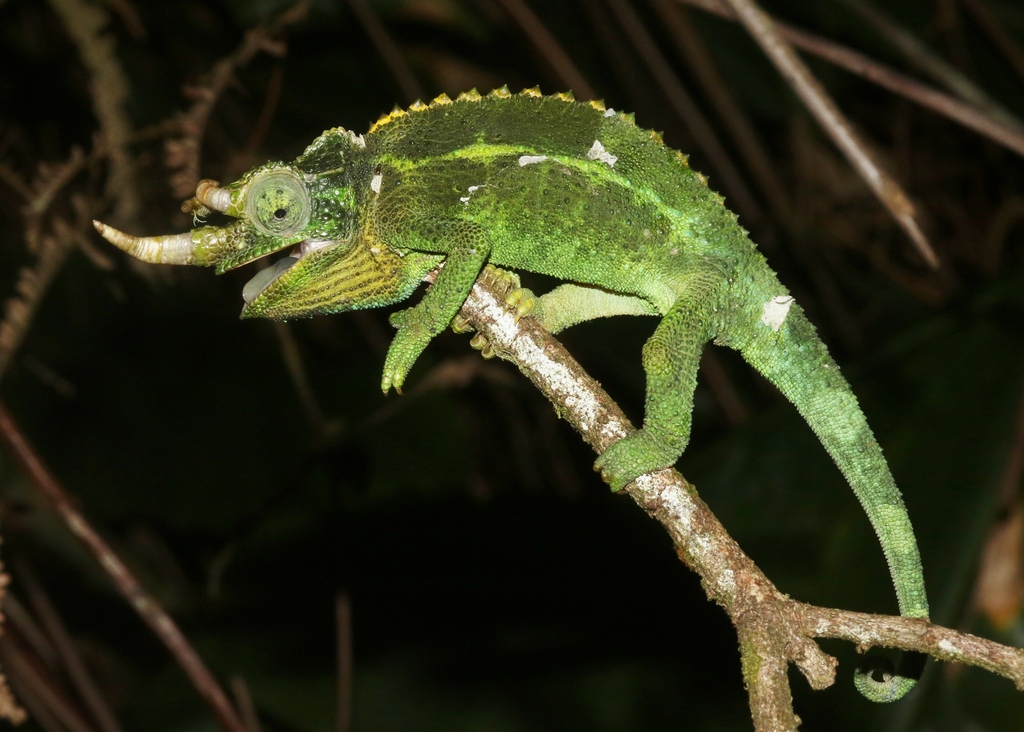
A green chameleon of the cool East African highlands; males carry three forward-pointing horns like a miniature Triceratops. It gives birth to live young instead of laying eggs, which suits its chilly mountain home.
Jackson's chameleon, also known commonly as Jackson's horned chameleon, the three-horned chameleon, and the Kikuyu three-horned chameleon, is a species of chameleon, a lizard in the family Chamaeleonidae. The species is native to East Africa, and introduced to Hawaii, Florida, and California. There are three recognized subspecies. Wikipedia
What it can do
- iBears live young, up to ~30 in a litter, after a pregnancy of about 5–6 months
- iiEyes move independently and lock together on prey
- iiiShoots out a sticky tongue longer than its body to catch insects
- ivMales use their horns in pushing contests
In the field
Field marks
- aMales have three long horns, one on the snout and one above each eye; females have none or small ones
- bBright green with yellow, blue or brown patches
- cSaw-toothed crest along the back
- dGrasping tail and tong-like feet
- Not to be confused with
- Johnston's chameleon (T. johnstoni) also has three horns in males but lives in the Albertine Rift mountains far to the west. Other Kenyan highland chameleons have one horn or none.
- Where to see it
- Gardens and forest of Nairobi and the Aberdare and Mount Kenya foothills; in Hawaii, upland gardens of Maui and the Big Island
- When
- Resident
Life & habits
- Diet
- Insects, spiders, snails
- Habitat
- Moist montane forest, shrubs and gardens at about 1,500–3,000 m
- Size
- Up to ~30 cm including tail
- Lifespan
- ~5–10 years
Slowly stalks insects among leaves, rocking back and forth like a leaf in the wind. Colour changes reflect mood and temperature.
Where it lives
Recorded sightings
—
geo-referenced records in GBIF, from museums, herbaria and field observers.
Native range
Highlands of Kenya and northern Tanzania; introduced to Hawaii (1970s) and California
Drag the globe to turn it. Dots are where records exist, not a range map; darker means more records.
In the old herbals & bestiaries
No plate in the Source Library names this exact species, so these show its closest relatives as the old naturalists drew them: same genus, or the same kind of animal. Click a plate to read the page it came from, with translation.

The Great Art of Light and Shadow
Relative · Athanasius Kircher · 1671 · p.99

Garden of Health
Relative · Jacob Meydenbach · 1491 · p.528

Garden of Health
Relative · 1507 · p.430

Treasury of Medical Matters of New Spain
Relative · Francisco Hernández · 1651 · p.770

Commentaries on the Six Books of Pedanius Dioscorides on Medical Matter
Relative · Pietro Andrea Mattioli · 1565 · p.537
In the stacks
Searching the stacks…
Every page naming Trioceros jacksonii in the Biodiversity Heritage Library →
Marginalia
George Albert Boulenger named it in 1896 after Frederick John Jackson, a British naturalist and colonial administrator in East Africa.
Curiosity
Jackson's chameleons were brought to Hawaii in the 1970s for the pet trade and now live wild on several islands, where they eat native snails and insects.
Kinship





Photographs: iNaturalist contributors under the licences shown. Records: GBIF.org. Historical plates: Source Library (CC BY-SA 4.0; originals public domain). Summary text: Nature Library editors and Wikipedia (CC BY-SA). Medicinal and edibility notes are historical and educational, not advice. iNaturalist taxon 32807.