- Animals
- ›Molluscs
- ›Cephalopods
- ›Octopuses, Squids, and Cuttlefishes
- ›Squids and Cuttlefishes
- ›Pelagic Squids
- ›Cranch Squids and Flying Squids
- ›Flying Squids
- ›Ommastrephinae
- ›Sthenoteuthis
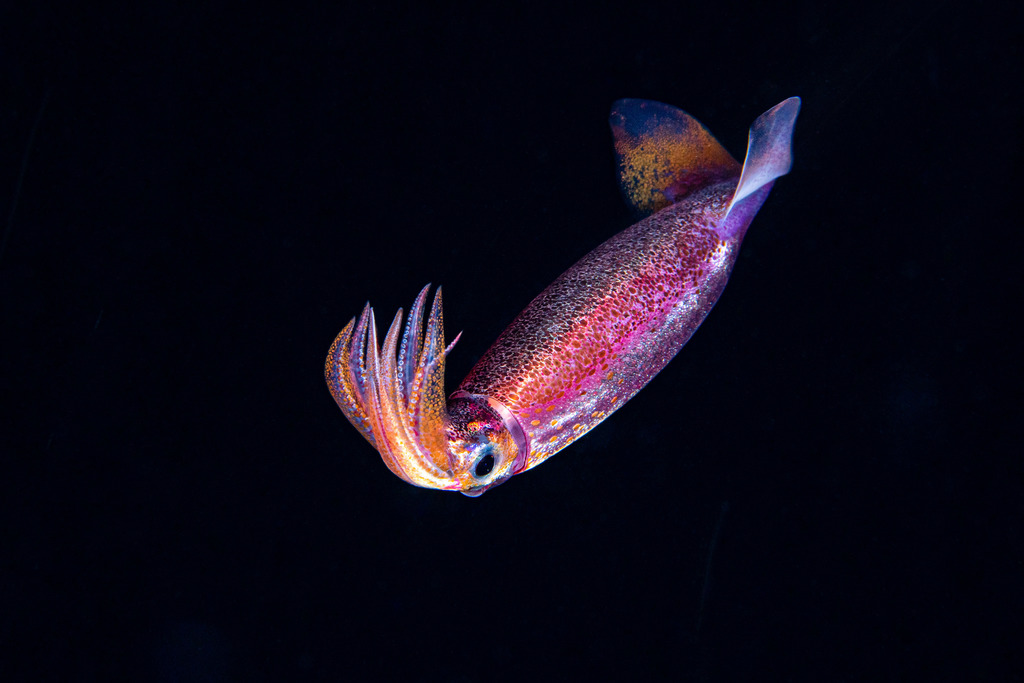
Purpleback Squid
Sthenoteuthis oualaniensis
The purpleback flying squid or purpleback squid (Sthenoteuthis oualaniensis) is a species of cephalopod in the family Ommastrephidae, occurring in the Indo-Pacific. It is considered one of the most abundant large squids.
From the article Sthenoteuthis oualaniensis on Wikipedia (CC BY-SA), quoted section by section
Description
S. oualaniensis are sexually dimorphic where the females tend to grow larger than the males in most cases. Dimorphism differentiation occurs in the sucker ring dentition in which different sizes occur which suggests that a feeding spectrum occurs among male and female individuals. The species has a complex population structure, comprising three major and two minor forms with different morphology, anatomy, geographical distribution, and period of spawning. These forms include a giant form, a medium form with a double lateral axis on the gladius, a medium form with a single lateral axis on the gladius, a dwarf form, and a smaller earlier maturing form. The medium form is characterized by a dorsal photophore patch and fused mantle locking apparatus, it is the most common or “typical” form, and has the largest geographical distribution divide with a deeper vertical distribution when compared to the dwarf form. The dorsal mantle length (ML) of sexually mature adult males and females is 120 – 150 mm and 190 – 250 mm respectively. The smaller forms include a dwarf from an early maturing form, these two forms can be classified under the same category due to significant similarities as there is some disagreement in the literature. …
Range & habitat
Sthenoteuthis oualaniensis occurs in a diverse range of environments in the tropical and subtropical Indo-Pacific, often at depths of over 600 m (1,969 ft) deep, though they ascend to 20–25 m (66–82 ft) at night. Total species biomass has been estimated at between 8-11 million tonnes; the Arabian Sea from November–January is thought to contain one of the highest concentrations (12 to 42 t km−2) of these squids due to population dynamics. In October 2020, during a seafloor mapping survey in a then-unexplored area of the Gulf of Aqaba in the Northern Red Sea Region, a team of oceanographers and other scientists with OceanX encountered a lone specimen of S. oualaniensis with their remotely-operated underwater vehicle (ROV); while investigating the sunken remains of the Egyptian cargo ship "Pella", which sunk in 2011 (with one reported fatality), OceanX was able to capture clear, full-body images of the squid as it swam in front of the ROV.
Wikipedia: “Distribution and habitat”
What it does
Purpleback flying squids, which are thought to be both predators and prey, are considered both because throughout their life they are constantly changing, with continuous body-size increases allowing them to fulfill different trophic levels on the taxonomic and ecological spectrum in consideration of their food organisms, enemies and parasites. They feed utilizing a beak, which is a hard structure that contains composites of proteins and chitin fibres. Beaks are an important morphological characteristic; they can be used to identify and classify a species as they are easy to see with the naked eye and do not break down in the stomachs of predators. This feeding organ tears up and bites food, and throughout the squid's life, the characteristics of a beak can change as a result of ontogenetic states. The wing of the beak undergoes pigmentation that is related to the stiffness or hardness of the beak; the more tanned regions are harder than the untanned regions, and this pigmentation is directly linked with growth and changes in the diet. Purpleback flying squids are highly active predators that can move through the water at high speeds, easily manoeuvre and respond swiftly to changes in their environment. …
Wikipedia: “Feeding habits”
Where it lives
Recorded sightings
—
geo-referenced records in GBIF, from museums, herbaria and field observers.
Drag the globe to turn it. Dots are where records exist, not a range map; darker means more records.
In the stacks
Searching the stacks…
Every page naming Sthenoteuthis oualaniensis in the Biodiversity Heritage Library →
This page is assembled live from iNaturalist, GBIF, Wikipedia, the Source Library and the Internet Archive. It is not yet part of the hand-edited codex. iNaturalist taxon 328459.