- Animals
- ›Molluscs
- ›Gastropods
- ›Caenogastropods
- ›Littorinimorpha
- ›Cowries and Allies
- ›Cowries
- ›Erosariinae
- ›Monetaria
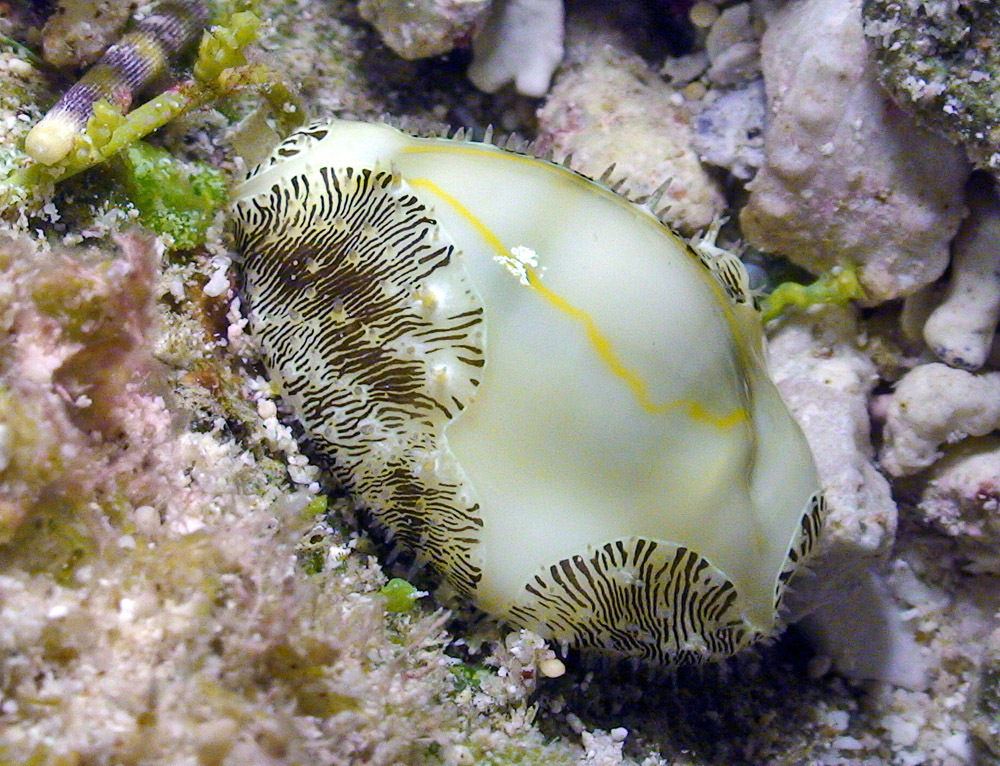
Money Cowry
Monetaria moneta
Monetaria moneta, common name the money cowrie, is a species of small sea snail, a marine gastropod mollusk in the family Cypraeidae, the cowries.
This species is called "money cowrie" because the shells were historically widely used in many Pacific and Indian Ocean countries as shell money before coinage was in common usage.
From the article Monetaria moneta on Wikipedia (CC BY-SA), quoted section by section
Description
It is a quite small cowry, up to 3 cm (1.2 in), irregular and flattened, with very calloused edges and roughly subhexagonal. The colour is pale (from white to dirty beige), but the dorsum seems transparent, often greenish grey with yellowish margins, with sometimes darker transverse stripes and a delicate yellow ring. The opening is wide and white, with pronounced denticules. The mantle of the live animal is mottled with black and off-white. The shell of Monetaria moneta varies widely in shape and colour, with some of these varieties having been described as full species. As a result, this species has numerous taxonomic synonyms.
Wikipedia: “Description and characteristics”
Range & habitat
This is a very common species which is found widely in Indo-Pacific tropical waters. It is present in numerous regions, including East and South Africa, Madagascar, the Red Sea and the Persian Gulf, Maldives, eastern Polynesia, Galapagos, Clipperton and Cocos islands off Central America, southern Japan, Midway and Hawaii, and northern New South Wales and Lord Howe Island.
Wikipedia: “Distribution”
At the table
The shell is used in jewellery and in other decorative items such as baskets and wall hangings.
As money. Shells of this cowrie were commonly used as a medium of exchange in many areas of Africa, Asia, and the Pacific islands until the late 19th century. The Maldives provided the main source of cowrie shells, throughout Asia and parts of the East African coast. Huge amounts of Maldivian cowries were introduced into Africa by slave traders. It was also traded to Native Americans by European settlers.
For divination. The shell is used in divination rituals in some African religions. In the State of Kerala, in India, special money cowrie shells (which are known in Malayalam as കവിടി Kavidi) are used for divination as a practice of Hindu astrology known as prasnam. During Prasnam, the astrologer draws shells of Monetaria moneta while reciting mantras and prayers. The number of cowries drawn is tied to a planet, and its astrological position provides an answer to a given question or the basis to a prediction.
Wikipedia: “Human uses”
Where it lives
Recorded sightings
—
geo-referenced records in GBIF, from museums, herbaria and field observers.
Drag the globe to turn it. Dots are where records exist, not a range map; darker means more records.
In the stacks
Searching the stacks…
Every page naming Monetaria moneta in the Biodiversity Heritage Library →
This page is assembled live from iNaturalist, GBIF, Wikipedia, the Source Library and the Internet Archive. It is not yet part of the hand-edited codex. iNaturalist taxon 328541.