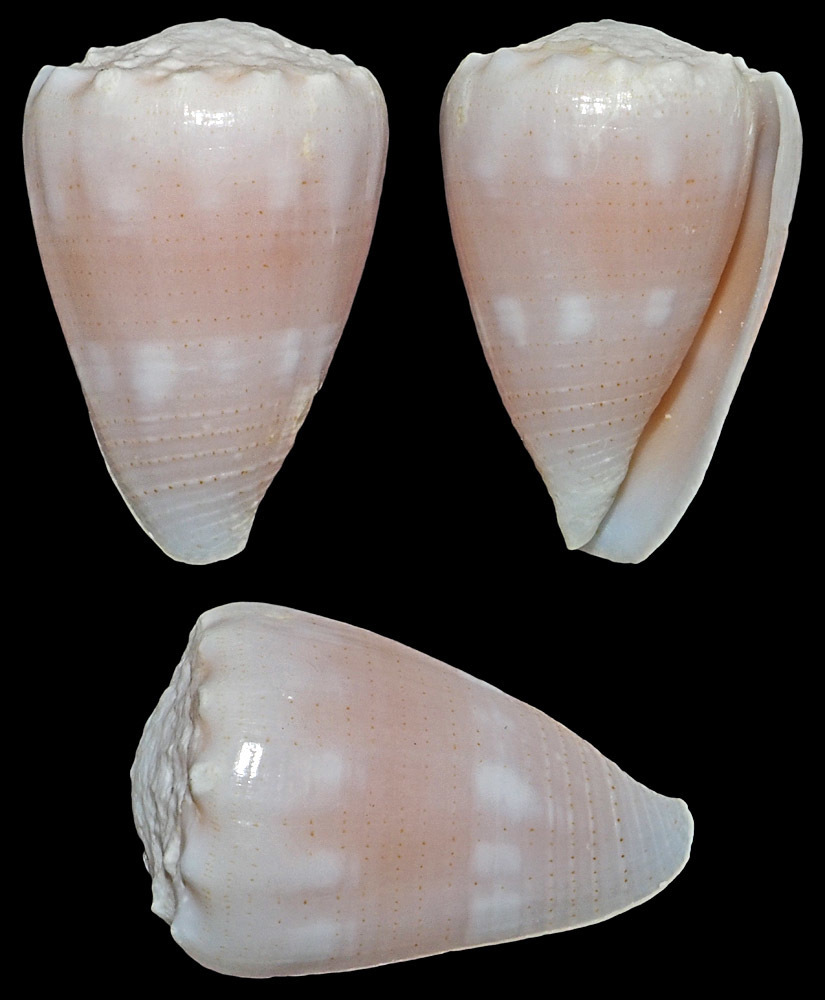
Thousand-spot Cone
Conus miliaris
Conus miliaris, common name the thousand-spot cone, is a species of sea snails, marine gastropod molluscs in the family Conidae, the cone snails and their allies.
Like all species within the genus Conus, these snails are predatory and venomous. They are capable of stinging humans, therefore live ones should be handled carefully or not at all.
From the article Conus miliaris on Wikipedia (CC BY-SA), quoted section by section
Description
The size of an adult shell varies between 12 mm and 43 mm. The spire is more or less raised, striate or sometimes nearly smooth, with or without tubercles The body whorl is striate, the stride usually grannlous towards the base, and sometimes throughout. The color of the shell is yellowish or light chestnut or grayish, variously clouded with darker chestnut or olive, often irregularly light-banded at the middle, and below the spire, and encircled with chestnut spots on the striae. The interior is chocolate, with a central white band. There is considerable variation in the height and coronation of the spire, as well as in the color and pattern of the markings.
Range & habitat
Conus miliaris is a species of wide distribution, and apparently everywhere common. It occurs in tropical to subtropical shallow water environments from the Red Sea and eastern shores of Africa in the western Indian Ocean (Aldabra, Chagos, Kenya, Madagascar, the Mascarene Basin, Mauritius, Mozambique and Tanzania) to Easter Island and Sala y Gómez in the southeastern Pacific (but not off the Galapagos Islands, the Marquesas Islands and Hawaii).; off Australia (New South Wales, Northern Territory, Queensland, Western Australia).
Wikipedia: “Distribution”
What it does
These snails are predatory and venomous. They are capable of stinging humans, therefore live ones should be handled carefully or not at all. Presumably in response to the relative absence of congeners at Easter Island, Conus miliaris has undergone ecological release: it preys on a more diverse assemblage of prey at Easter Island and is more abundant at Easter Island than at other localities in its range. Conus miliaris from most areas in the Indo-West Pacific, where it co-occurs with as many as 36 congeners, preys almost exclusively on three species of eunicid polychaetes (Eunicidae). But at Easter Island its diet is considerably broader and includes additional species of eunicids as well as several species of nereids, an onuphid and members of seven other polychaete families. Its prey on Easter Island include: Eunicidae includes Lysidice collaris, Nematonereis unicornis, Eunice afra, Eunice cariboea and Palola siciliensis; Nereididae includes Perinereis singaporensis; Onuphidae includes Onuphis sp.
Wikipedia: “Feeding habits”
Where it lives
Recorded sightings
—
geo-referenced records in GBIF, from museums, herbaria and field observers.
Drag the globe to turn it. Dots are where records exist, not a range map; darker means more records.
In the stacks
Searching the stacks…
Every page naming Conus miliaris in the Biodiversity Heritage Library →
This page is assembled live from iNaturalist, GBIF, Wikipedia, the Source Library and the Internet Archive. It is not yet part of the hand-edited codex. iNaturalist taxon 328683.