- Animals
- ›Arthropods
- ›Crustaceans
- ›Typical Crustaceans
- ›Barnacles and Copepods
- ›Copepods
- ›Neocopepoda
- ›Gymnoplea
- ›Calanoid Copepods
- ›Rhincalanidae
- ›Rhincalanus
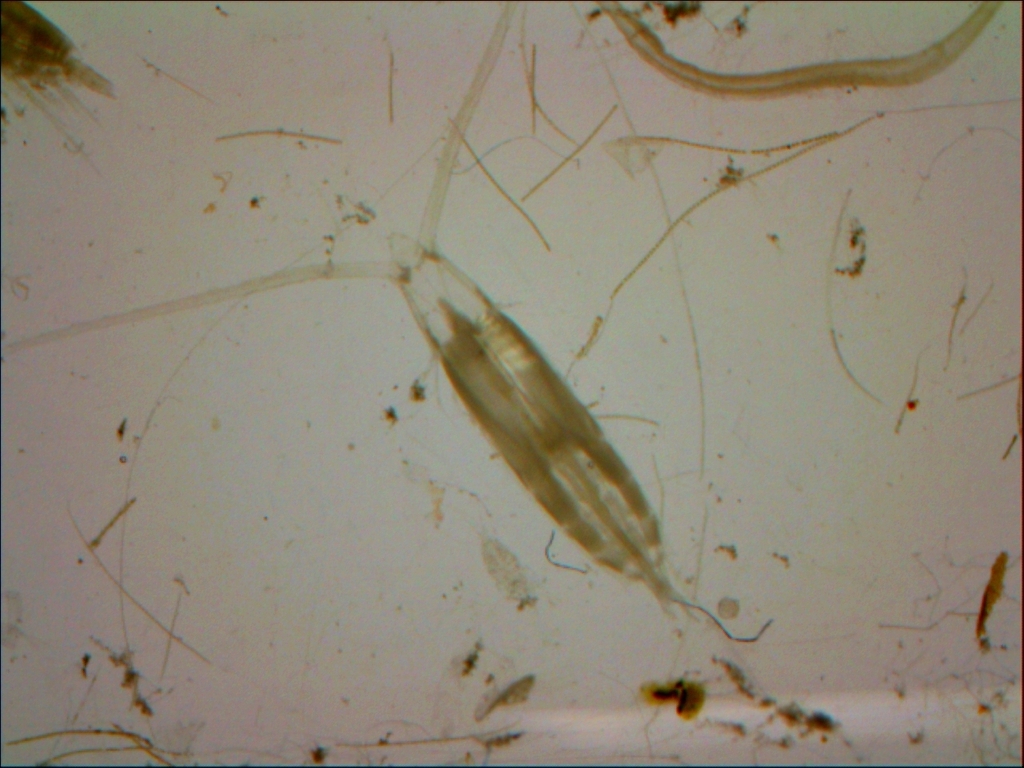
Rhincalanus nasutus
Rhincalanus nasutus is a copepod in the family Rhincalanidae.
From the article Rhincalanus nasutus on Wikipedia (CC BY-SA), quoted section by section
Description
The female of R. nasutus ranges anywhere from about 2.8 to 6.1 millimetres (0.11 to 0.24 in) in length, and the male is generally between about 2.7 and 4.5 millimetres (0.11 and 0.18 in).
Range & habitat
Rhincalanus nasutus is found in waters across the globe, primarily in the open ocean and continental shelf and slope waters.
Wikipedia: “Distribution”
What it does
Rhincalanus nasutus is seasonal in terms of the timing of reproduction. Off of the waters of southern California, it generally reproduces from February to April, and it also can reproduce in late summer, as late as June. This reproduction is likely to be limited by food, as evidenced by this copepod failing to breed in the absence of food. Copepodite stages I through IV are usually found in the surface waters (from sea level to 200 metres (660 ft) in depth). The abundance of individuals in the surface, however, varies seasonally: they are most abundant during the spring, and are not present during summer and autumn. Stage V copepodites and adults are generally distributed below 200 metres (660 ft) in depth, and especially below 500 metres (1,600 ft). In seasonal waters, such as the Gulf of Aqaba, stage V copepodites go into diapause to moult into females. During this time, they also rapidly accumulate wax esters, possibly for future reproduction.
== References ==
Wikipedia: “Life cycle and reproduction”
Where it lives
Recorded sightings
—
geo-referenced records in GBIF, from museums, herbaria and field observers.
Drag the globe to turn it. Dots are where records exist, not a range map; darker means more records.
In the stacks
Searching the stacks…
Every page naming Rhincalanus nasutus in the Biodiversity Heritage Library →
This page is assembled live from iNaturalist, GBIF, Wikipedia, the Source Library and the Internet Archive. It is not yet part of the hand-edited codex. iNaturalist taxon 329024.