- Animals
- ›Arthropods
- ›Hexapods
- ›Insects
- ›Winged and Once-winged Insects
- ›Flies
- ›Brachyceran Flies
- ›Cyclorrhaphan Flies
- ›Schizophoran Flies
- ›Calyptrate Flies
- ›Bot Flies, Blow Flies, and Allies
- ›Blow Flies
- ›Chrysomyinae
- ›Chrysomya
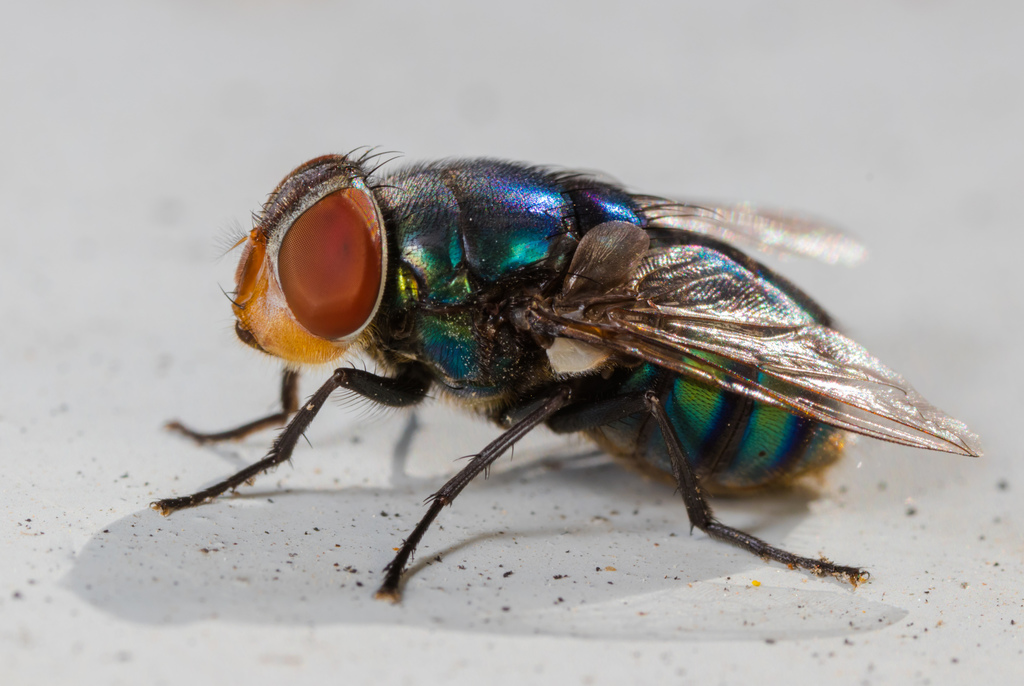
Oriental Latrine Fly
Chrysomya megacephala
Chrysomya megacephala, more commonly known as the oriental latrine fly or oriental blue fly, is a member of the family Calliphoridae (blowflies). It is a warm-weather fly with a greenish-blue metallic box-like body. The fly infests corpses soon after death, making it important to forensic science. This fly is implicated in some public health issues; it can be the cause of myiasis, and also infects fish and livestock.
From the article Chrysomya megacephala on Wikipedia (CC BY-SA), quoted section by section
Description
Chrysomya megacephala's eggs are "oval with one flat face and another convex". Adult flies reflect a metallic blue-green color on their thorax and abdomen and have yellow gena, or cheeks. Larvae vary in size according to instar and are shaped more thickly towards the rear. C. megacephala have large red eyes, those of males being close together, and those of females farther apart. The cercus of the male is longer than that of the female.
Range & habitat
Chrysomya megacephala has a wide geographical distribution. It is most common in the Oriental and Australasian realms. It is also found in Japan and the Palearctic realm. The range of C. megacephala has grown since the 1970s, with the species expanding into New Zealand and Africa, along with South, Central, and North America. C. megacephala entered the United States through harbors and airports. The fly has been found in California, as well as Texas, Louisiana, and Hawaii. C. megacephala exists in two forms, the normal and the derived. Tropical forests on the Pacific Islands, such as Samoa, are home to the normal form; the normal is considered to be the plesiomorphic form of C. megacephala. The derived form is thought to have emerged from Papua New Guinea and is said to be synanthropic, or ecologically associated with humans.
Wikipedia: “Distribution and habitat”
What it does
The developmental stages of C. megacephala include egg, larva and pupa. A female fly may lay as many as 200 to 300 eggs, often in human feces, meat or fish. Larval stages include first, second and third instals or growth periods. The eggs take approximately one day to develop, while the larvae take 5.4 days and the pupae 5.3 days. Population numbers as well as body size are greatly influenced by temperature. The adult lifespan of the fly is approximately seven days. The development of C. megacephala is linked to the length of time spent feeding in the larval stage, as well as to temperature; the lower the temperature, the more slowly the larvae develop. In laboratory studies conducted at 27 °C., eggs hatch in 18 hours; the first molt occurs in 30 hours; the second molt in 72 hours; pupation after 144 hours; and the adult emerges after approximately 234 hours. These intervals vary depending on geographical location; other environmental factors also can determine how long flies will stay in the larval stage. Males tend to emerge two or three hours ahead of the females. The reproduction and survival rates of C. megacephala are closely related to developmental factors, including the amount of available food, and competition from larvae of other species, such as C. rufifacies. In the presence of competing larvae, those of C. …
Wikipedia: “Reproduction”
Toxicity
In any part of the world that uses organophosphates, C. megacephala could prove to be beneficial. Organophosphate compounds are used in agriculture and are highly toxic. Organophosphate poisoning often causes death, and in many cases, by evaluating the body tissue and fluids, the toxin can be identified as the source of the poisoning. However, it is somewhat difficult to evaluate the body tissue in a body that is exceedingly decomposed. Nevertheless, a medical examiner in Hawaii worked on a case in which poisoning by malathion, an organophosphate insecticide, was thought to be the cause of death. The victim's stomach contents and body fat were examined and found to have contained malathion. The fly larvae of Chrysomya megacephala and Chrysomya rufifacies were also present at the scene on the body and were tested for malathion. Both of these species did contain malathion, but there had been no previous record of organophosphates in their larvae. Studying larvae from decomposed remains may provide an effective method of determining the presence of these toxins in a body that is extremely decayed.
Wikipedia: “Larval-state poisoning detection”
Listen
Looking for field recordings…
Where it lives
Recorded sightings
—
geo-referenced records in GBIF, from museums, herbaria and field observers.
Drag the globe to turn it. Dots are where records exist, not a range map; darker means more records.
In the stacks
Searching the stacks…
Every page naming Chrysomya megacephala in the Biodiversity Heritage Library →
This page is assembled live from iNaturalist, GBIF, Wikipedia, the Source Library and the Internet Archive. It is not yet part of the hand-edited codex. iNaturalist taxon 329781.