- Animals
- ›Arthropods
- ›Hexapods
- ›Insects
- ›Winged and Once-winged Insects
- ›True Bugs, Hoppers, Aphids, and allies
- ›True Hoppers
- ›Planthoppers
- ›Delphacoidea
- ›Delphacid Planthoppers
- ›Delphacinae
- ›Delphacini
- ›Peregrinus
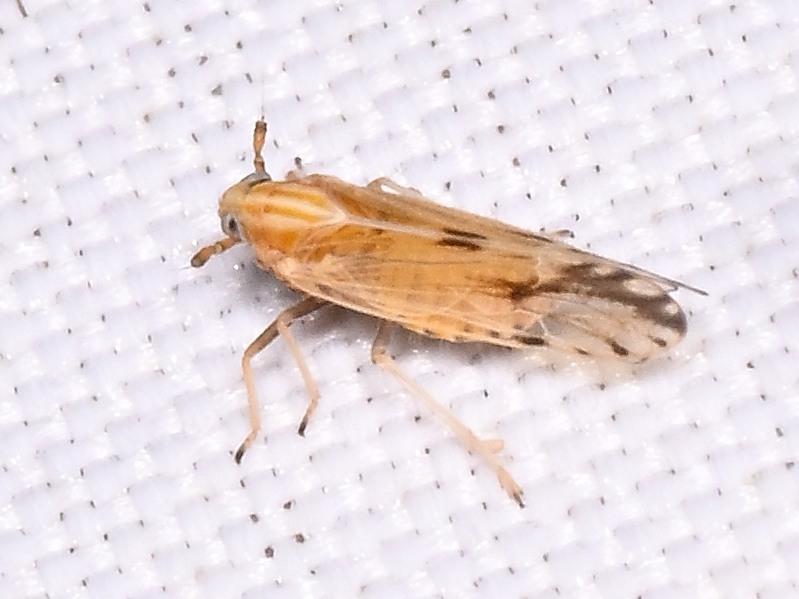
Corn Delphacid
Peregrinus maidis
Peregrinus maidis, commonly known as the corn planthopper or shoot bug, is a species of insect in the order Hemiptera and the family Delphacidae. It is widespread throughout most tropical and subtropical regions on earth, including southern North America, South America, Africa, Australia, Southeast Asia and China. P. maidis are a commercially important pest of maize and its relatives. In addition to physical plant damage, P. maidis is the vector for several species-specific maize viruses, including maize stripe virus, maize mosaic virus and the non-pathogenic Peregrinus maidis reovirus.
From the article Peregrinus maidis on Wikipedia (CC BY-SA), quoted section by section
Description
Peregrinus maidis demonstrate sexual dimorphism in body size between males and females. Males have a body length of 2mm with a 6mm wingspan, whereas females are slightly larger at 3mm long and 7mm wingspan. The species is mainly yellow with dark brown to black markings, but colouration ranges from greenish-yellow to brownish-yellow. The forewings are longer than the body. The hind tibiae possess multiple spines and a large movable spur.
Range & habitat
Peregrinus maidis are found in most tropical and subtropical regions throughout the world including the southeast United States, Hawaii, Central and South America, Africa, Australia, Southeast Asia and southern China. The species thrives in low elevation, high humidity locations and populations will decrease at altitudes above 800m. It is suspected that P. maidis cannot move into higher latitudes due to an inability to overwinter. Peregrinus maidis are thought to have originated in Australia as a pest of sorghum but quickly spread with the widespread cultivation of the closely related sugarcane and maize plants. This specificity to feed on a single tribe of plants results in P. maidis being classified as an oligophagous herbivore. Attempts to rear the species on other host plants has resulted in decreased fecundity, body size, life span, and slower nymph development.
Wikipedia: “Distribution and habitat”
What it does
Females lay 20-30 eggs within the midribs of their host-plant's leaves. Under normal conditions, development from hatchling to adult takes approximately 20 days. However, development of P. maidis nymphs is highly temperature dependent. Normal development occurs between 20-27 °C and has five juvenile instar stages. Extreme temperatures (below 10 °C and above 30 °C) result in a loss of the fifth instar and a direct molt from fourth instar to adult, but full development is extended dramatically to 74 days. Rearing at a temperature of 15 °C results in an extra, sixth, instar and a 65-day development time. P. maidis occupies warm climates and is able to reproduce year round, but development is affected by temperature changes. Another factor that affects development is nutrient availability. Increased levels of nitrogen fertilizers in plant tissues result in shorter development times, more eggs produced, and increases in juvenile survival rates and adult body size. Similar to other planthoppers, two different types (morphs) of adult P. maidis can develop depending on environmental conditions. The first, brachypterous, have short, underdeveloped wings and most often develop as a response to high quality host plants, low conspecific density, and no need for dispersal. …
Wikipedia: “Life cycle”
Listen
Looking for field recordings…
Where it lives
Recorded sightings
—
geo-referenced records in GBIF, from museums, herbaria and field observers.
Drag the globe to turn it. Dots are where records exist, not a range map; darker means more records.
In the stacks
Searching the stacks…
Every page naming Peregrinus maidis in the Biodiversity Heritage Library →
This page is assembled live from iNaturalist, GBIF, Wikipedia, the Source Library and the Internet Archive. It is not yet part of the hand-edited codex. iNaturalist taxon 330085.