- Animals
- ›Arthropods
- ›Hexapods
- ›Insects
- ›Winged and Once-winged Insects
- ›True Bugs, Hoppers, Aphids, and allies
- ›Plant-parasitic Hemipterans
- ›Aphids and Allies
- ›Aphidoidea
- ›Aphids
- ›Aphidinae
- ›Aphidini
- ›Rhopalosiphina
- ›Rhopalosiphum
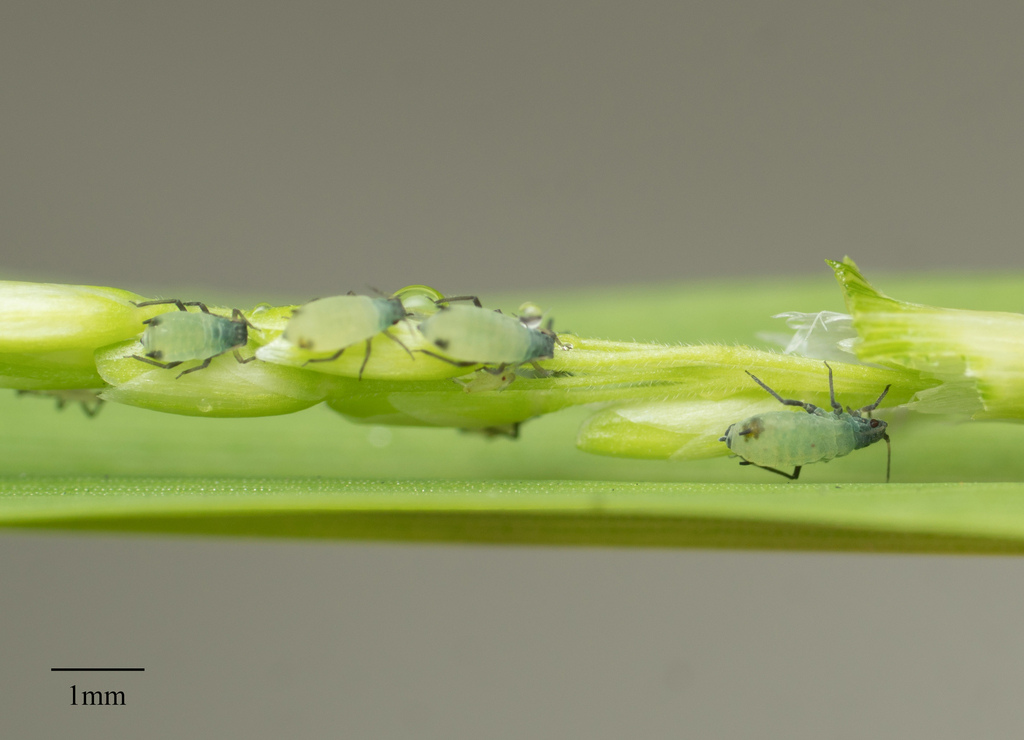
Corn Leaf Aphid
Rhopalosiphum maidis
Rhopalosiphum maidis, common names corn leaf aphid and corn aphid, is an insect, and a pest of maize and other crops. It has a nearly worldwide distribution and is typically found in agricultural fields, grasslands, and forest-grassland zones. Among aphids that feed on maize, it is the most commonly encountered and most economically damaging, particularly in tropical and warmer temperate areas. In addition to maize, R. maidis damages rice, sorghum, and other cultivated and wild monocots.
From the article Rhopalosiphum maidis on Wikipedia (CC BY-SA), quoted section by section
Description
The bodies of wingless parthenogenetic females are green or whitish-green. The head, antennae, legs, cornicles, tail, and transverse bands on the abdomen are black-brown. The body has sparse short hairs. The length of the antennae is less than half the length of the body. Cornicles are not longer than the finger-like tail. In winged females, the head and thoracic section are black-brown and the cornicles are shorter than in the wingless females. Most R. maidis populations are anholocyclic, i.e. reproduction occurs entirely by parthenogenesis. However, sexual reproduction has been reported in Pakistan and Korea, with Prunus ssp. as the primary host. In populations in Japan and Kenya, males but not sexually reproducing females have been found.
What it does
In winter, winged parthenogenetic females and larvae survive on wild-growing monocots, from which they move to agricultural fields in the spring. Fields populate gradually, starting from the edges to the center. Reproduction is rapid, with up to twelve generations per year. The aphid population reaches a maximum late in the summer. Dense populations of R. maidis on maize (Zea mays) can cause direct damage through the removal of photosynthates. Large amounts of honeydew that is deposited by aphid feeding on maize tassels can prevent pollen shed and decrease yield by up to 90%. Several damaging maize viruses, including Maize yellow dwarf virus, Barley yellow dwarf virus, Sugarcane mosaic virus, and Cucumber mosaic virus, are transmitted by R. maidis. In addition to feeding on maize, R. maidis infests a variety of cultivated grasses, including wheat, barley, oat, rye, sorghum, sugarcane, and rice. Barley is a particularly suitable host for R. maidis, though there also is considerable within-species variation in resistance.
Wikipedia: “Agricultural interactions”
Listen
Looking for field recordings…
Where it lives
Recorded sightings
—
geo-referenced records in GBIF, from museums, herbaria and field observers.
Drag the globe to turn it. Dots are where records exist, not a range map; darker means more records.
In the stacks
Searching the stacks…
Every page naming Rhopalosiphum maidis in the Biodiversity Heritage Library →
This page is assembled live from iNaturalist, GBIF, Wikipedia, the Source Library and the Internet Archive. It is not yet part of the hand-edited codex. iNaturalist taxon 330189.