- Animals
- ›Arthropods
- ›Hexapods
- ›Insects
- ›Winged and Once-winged Insects
- ›True Bugs, Hoppers, Aphids, and allies
- ›Plant-parasitic Hemipterans
- ›Scale Insects
- ›Soft scales
- ›Coccinae
- ›Saissetia
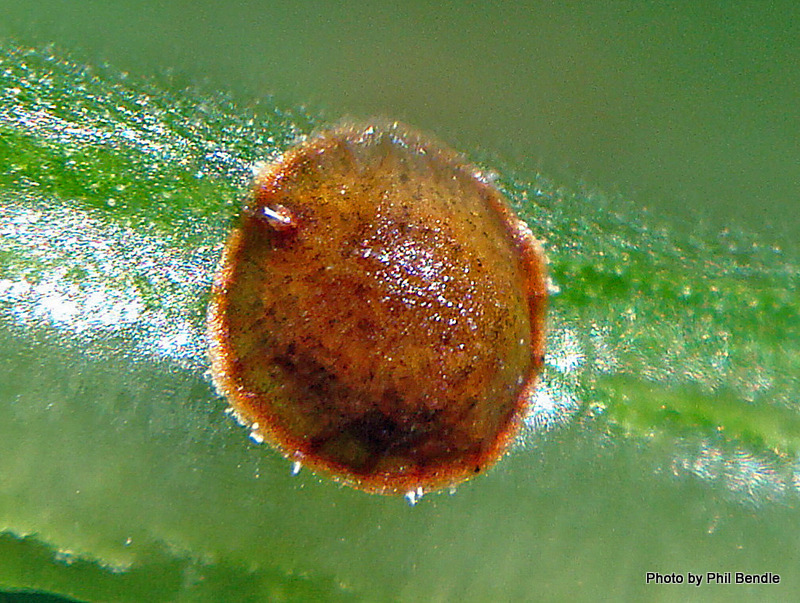
Hemispherical Scale
Saissetia coffeae
Saissetia coffeae, known generally as hemispherical scale, is a species of soft scale insect in the family Coccidae. Other common names include the helmet scale and coffee brown scale.
From the article Saissetia coffeae on Wikipedia (CC BY-SA), quoted section by section
Description
The adult scale varies in diameter from about 2 mm (0.08 in) to 4.5 mm (0.18 in), largely depending on the identity of the host plant. It is smooth, shiny and brown and closely adpressed to a stem or leaf, resembling a miniature military helmet. Young scales often have a slightly ridged surface, sometimes in the form of a "H". Like other scale insects, the hemispherical scale has no limbs and is immobile, piercing the plant tissues with its mouthparts and feeding on sap.
Range & habitat
Saissetia coffeae is present in West, Central and East Africa, Madagascar, tropical and subtropical Asia, North, Central and South America and the Caribbean region.
Wikipedia: “Distribution”
What it does
All hemispherical scale insects are female, and breeding occurs by parthenogenesis. The eggs are pinkish-beige, oblong and about 0.7 mm (0.03 in) long. Up to a thousand eggs are laid, and they remain concealed under the scale husk, the parent dying soon after they are laid. The eggs hatch into first instars known as "crawlers", the only mobile phase in this species, which leave the shelter of the mother's scale to disperse. They have short antennae and limbs, a pair of red eyespots, and a pair of long setae (bristles) at the back. When they have reached a suitable spot, they plunge their mouthparts into the plant, shed their skin and develop into second instar nymphs. There is a further instar stage before the adult stage is reached, the whole development period taking forty days or more. There may be several generations each year.
Wikipedia: “Life cycle”
Listen
Looking for field recordings…
Where it lives
Recorded sightings
—
geo-referenced records in GBIF, from museums, herbaria and field observers.
Drag the globe to turn it. Dots are where records exist, not a range map; darker means more records.
In the stacks
Searching the stacks…
Every page naming Saissetia coffeae in the Biodiversity Heritage Library →
This page is assembled live from iNaturalist, GBIF, Wikipedia, the Source Library and the Internet Archive. It is not yet part of the hand-edited codex. iNaturalist taxon 330210.