- Fungi Including Lichens
- ›Basidiomycete Fungi
- ›Higher Basidiomycetes
- ›Mushrooms, Bracket Fungi, Puffballs, and Allies
- ›Auriculariales
- ›Auriculariaceae
- ›Auricularia
- ›Auricularia mesenterica
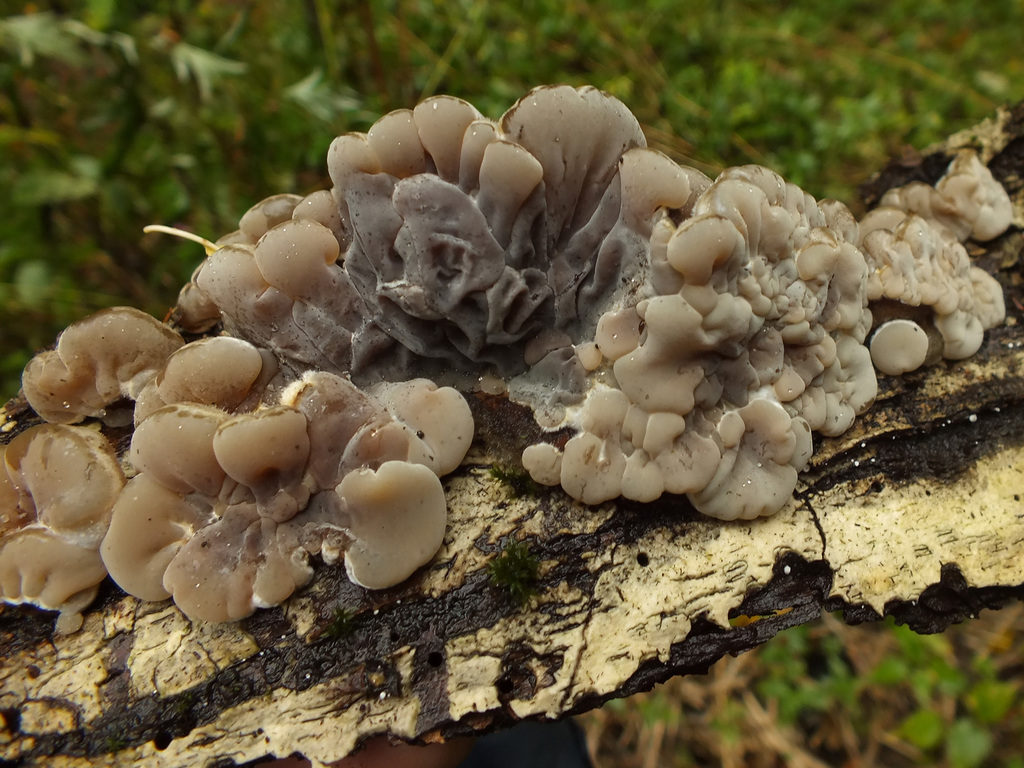
Tripe Fungus
Auricularia mesenterica
Auricularia mesenterica, commonly known as the tripe fungus, is a species of fungus in the family Auriculariaceae. Basidiocarps (fruit bodies) are gelatinous and typically formed in coalescing tiers on stumps and logs. They are partly pileate, with hirsute, zoned caps, and partly resupinate, with smooth to wrinkled undersurfaces that spread over the wood. Auricularia mesenterica is a saprotroph on dead deciduous trees and shrubs. The species is restricted to Europe and Central Asia.
From the article Auricularia mesenterica on Wikipedia (CC BY-SA), quoted section by section
Description
This species forms bracket-like fruit bodies that first appear pale, rubbery, and button-like, expanding to typically 3 to 7 cm (1.2 to 2.8 in) across and hardening with age. The fruit bodies often merge into compound structures sometimes running along fallen trunks and branches for more than a metre (3.3 ft). The upper surface is grey to brown or buff, tomentose to hispid with concentric zones, while the underside is thickly gelatinous, irregularly folded radially and reddish brown. The spore print is white. Microscopically the basidia are auricularioid (tubular with three lateral septa) and the basidiospores are allantoid (sausage-shaped), 14 to 17 by 4.5 to 5 μm.
Range & habitat
Originally described from England, the species is known to occur throughout Europe and into Central Asia as far as Uzbekistan. Basidiocarps are formed on various deciduous tree stumps and logs.
Wikipedia: “Distribution and habitat”
At the table
Before the fruit body fully matures and hardens, young specimens are said to be edible, but in some local populations, these fungi tend to bioaccumulate high levels of heavy metals from their environment. A. mesenterica has shown to have high levels of phenols, flavonoids, and antioxidant activity, having potential as antitumor agent.
== References ==
Wikipedia: “Uses”
In human culture
Auricularia mesenterica was described from England in 1785 by James Dickson as Helvella mesenterica and transferred to the genus Auricularia by Christiaan Hendrik Persoon in 1822. The species was considered to be cosmopolitan and was subsequently applied to collections from America, Asia, and Australia as well as Europe. Molecular research, based on cladistic analysis of DNA sequences, has however shown that Auricularia mesenterica (as previously understood) is a complex of related species and that A. mesenterica sensu stricto is confined to Europe and Central Asia, with superficially similar but distinct species occurring elsewhere. The specific epithet is a Latin adjective formed from the Ancient Greek word μεσεντέριον (mesentérion), "middle intestine", from μεσο- (meso-, "middle, center") and ἔντερον (énteron, "intestine"), referring to its shape.
Wikipedia: “Taxonomy and etymology”
Where it lives
Recorded sightings
—
geo-referenced records in GBIF, from museums, herbaria and field observers.
Drag the globe to turn it. Dots are where records exist, not a range map; darker means more records.
In the old herbals & bestiaries

In the stacks
Searching the stacks…
Every page naming Auricularia mesenterica in the Biodiversity Heritage Library →
This page is assembled live from iNaturalist, GBIF, Wikipedia, the Source Library and the Internet Archive. It is not yet part of the hand-edited codex. iNaturalist taxon 332467.