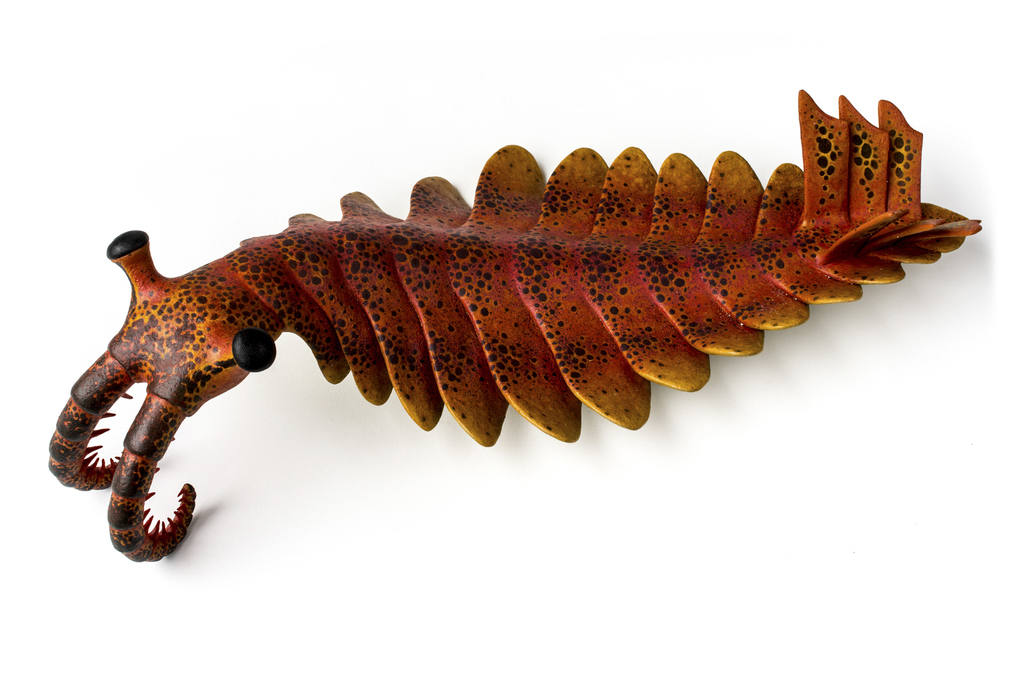
Anomalocaris canadensis
Anomalocaris (from Ancient Greek ανώμαλος, meaning "anomalous", and καρίς, meaning "shrimp", with the intended meaning "unlike other shrimp") is an extinct genus of radiodont, an order of early-diverging stem-group marine arthropods. It is best known from the type species A. canadensis, found in the Stephen Formation (particularly the Burgess Shale) of British Columbia, Canada. The other named species A. daleyae is known from the somewhat older Emu Bay Shale of Australia. Other unnamed Anomalocaris species are known from China and the United States.
Like other radiodonts, Anomalocaris had swimming flaps running along its body, large compound eyes densely packed with lenses, and a single pair of segmented, frontal appendages, which in Anomalocaris were used to grasp prey. Estimated to reach 34.2–37.8 cm (13.5–14.9 in) long excluding the frontal appendages and tail fan, Anomalocaris is one of the largest animals of the Cambrian, and thought to be one of the earliest examples of an apex predator, though others have been found in older Cambrian lagerstätten deposits.
From the article Anomalocaris on Wikipedia (CC BY-SA), quoted section by section
Description
Anomalocaris was gigantic in comparison to contemporary animals. A complete specimen of A. canadensis, ROMIP 51211, is measured up to 20.5 cm (8.1 in) long (17.4 cm (6.9 in) long when excluding the frontal appendages and tail fan). The largest frontal appendage is measured up to 18 cm (7.1 in) long when extended, and this specimen of A. canadensis would have reached up to 34.2–37.8 cm (1.12–1.24 ft) in body length excluding the frontal appendages and tail fan.Dryad data 04 Previous body length estimation up to 1 m (3.3 ft) is unlikely based on the ratio of body parts (body length measured only about 2 times the length of frontal appendage in A. canadensis) and the size of largest frontal appendage. A. daleyae (formerly A. cf. canadensis or A. aff. canadensis) from the Emu Bay Shale of Australia is larger than A. canadensis, with the largest known appendage measuring up to 18.3 cm (7.2 in) long, which would have belonged to an individual between 34.8–51.2 cm (1.14–1.68 ft) long.
Anomalocaris propelled itself through the water by undulating the flexible flaps on the sides of its body. Each flap sloped below the one more posterior to it, and this overlapping allowed the lobes on each side of the body to act as a single "fin", maximizing the swimming efficiency. …
What it does
Specimens of Anomalocaris have been found worldwide spanning from Cambrian Stage 3 to the Guzhangian. Aside from the Burgess Shale and Emu Bay Shale, fossils have been found in the Chengjiang Biota, Hongjingshao Formation, Balang Formation and the Kaili Formation of China, as well as the Eagar Formation and Weeks Formation in the United States. Anomalocaris canadensis lived in the Burgess Shale in relatively great numbers. In the Burgess Shale, Anomalocaris is more common in the older sections, notably the Mount Stephen trilobite beds. However, in the younger sections, such as the Phyllopod bed, Anomalocaris could reach much greater sizes—roughly twice the size of its older, trilobite bed relatives. These rare giant specimens have previously been referred to a separate species, Anomalocaris gigantea; however, the validity of this species has been called into question, and is currently synonymized to A. canadensis. Other unnamed species of Anomalocaris live in vastly different environments. For example, Anomalocaris cf. canadensis (JS-1880) lived in the Maotianshan Shales, a shallow tropical sea or river delta in what is now Eastern Yunnan in modern China. Anomalocaris daleyae (Emu Bay Shale) lived in a comparable environment; the shallow, tropical waters of Cambrian Australia. …
Wikipedia: “Paleoecology”
In human culture
From the start, Anomalocaris fossil was misidentified, followed by a series of misidentifications and taxonomic revisions. As Stephen Jay Gould, who popularised the Cambrian explosion in his 1989 book Wonderful Life, explained:[The story of Anomalocaris is] a tale of humor, error, struggle, frustration, and more error, culminating in an extraordinary resolution that brought together bits and pieces of three "phyla" in a single reconstructed creature, the largest and fiercest of Cambrian organisms.Anomalocaris fossils were first collected in 1886 by Richard G. McConnell of the Geological Survey of Canada (GSC). Having been informed of rich fossils at the Stephen Formation in British Columbia, McConnell climbed Mount Stephen on 13 September 1886. He found abundant trilobites, along with two unknown specimens. In August 1891, Henri-Marc Ami, Assistant Palaeontologist at GSC, collected many trilobites and brachiopod fossils, along with 48 more of the unknown specimens. The fifty specimens were examined and described in 1892 by GSC paleontologist Joseph Frederick Whiteaves. Whiteaves interpreted them as the abdomens of phyllocarid crustaceans, and gave the full scientific name Anomalocaris canadensis. …
Wikipedia: “History of research”
Where it lives
Recorded sightings
—
geo-referenced records in GBIF, from museums, herbaria and field observers.
Drag the globe to turn it. Dots are where records exist, not a range map; darker means more records.
In the stacks
Searching the stacks…
Every page naming Anomalocaris canadensis in the Biodiversity Heritage Library →
This page is assembled live from iNaturalist, GBIF, Wikipedia, the Source Library and the Internet Archive. It is not yet part of the hand-edited codex. iNaturalist taxon 333149.