- Plants
- ›Vascular Plants
- ›flowering plants
- ›monocots
- ›Agaves, Orchids, Irises, and Allies
- ›Aloe family
- ›Aloes and allies
- ›Haworthia
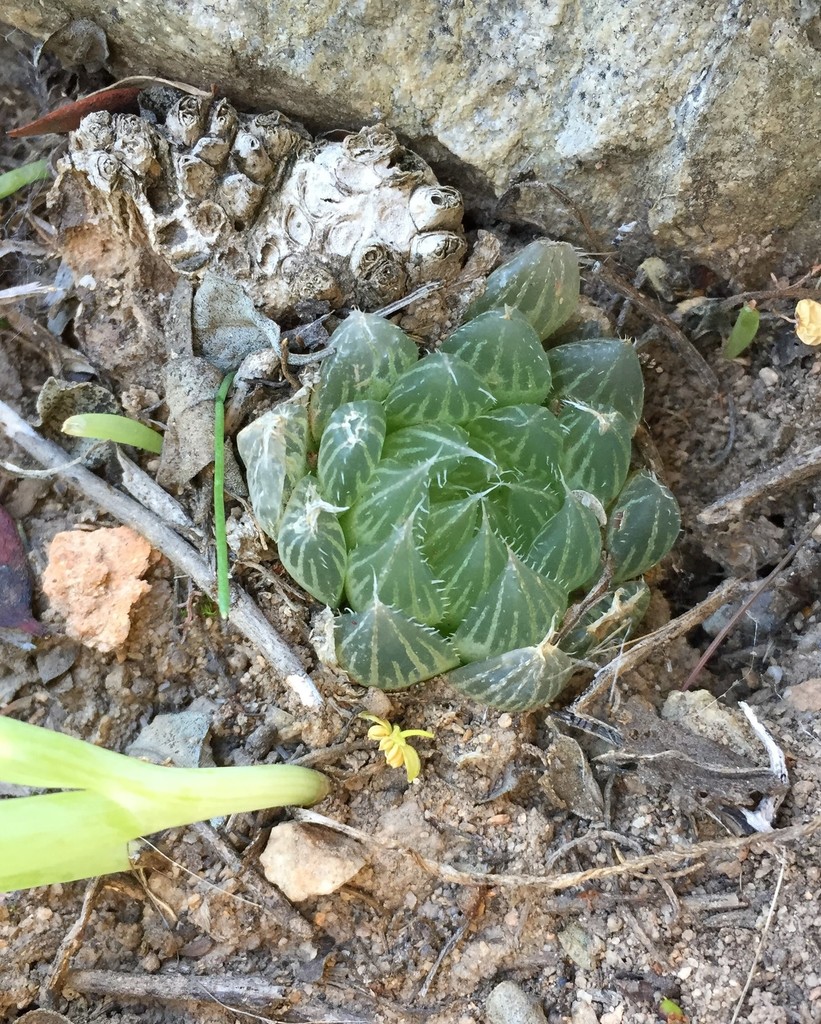
Bristle Haworthia
Haworthia cooperi
Haworthia cooperi is a diverse and varied species of the genus Haworthia in the family Asphodelaceae, endemic to the Eastern Cape Province in South Africa.
From the article Haworthia cooperi on Wikipedia (CC BY-SA), quoted section by section
Description
Plants grow in clumps of small rosettes of tiny, fleshy, light green leaves. As one of the soft green group of Haworthias it is frequently confused with its relatives (e.g. Haworthia cymbiformis, Haworthia mucronata and Haworthia marumiana). A distinctive feature is the slight bristley "awn" on the margins of the leaves of most varieties. In some, the leaves terminate in a long bristle or thread. Its leaves are not recurved like the "retuse" Haworthias (e.g. Haworthia mirabilis or Haworthia retusa). Another feature is that the leaves have transparent streaks around their tips. With some varieties, the entire leaf tip is transparent. In the wild, the sun is very bright, and the plant grows mostly buried by sand with only these transparent tips above the ground.
Range & habitat
The natural range of this species is in the Eastern Cape Province, South Africa. Here it occurs roughly between Port Elizabeth and East London in the east. This range closely matches that of its relative, Haworthia cymbiformis, and the two species interact, with H. cymbiformis growing on the cliffs, and H. cooperi growing on the lowland plains. At certain points, the two species merge. This is a summer rainfall region. This is also a highly variable species, with several different varieties.
Wikipedia: “Distribution and habitat”
Where it lives
Recorded sightings
—
geo-referenced records in GBIF, from museums, herbaria and field observers.
Drag the globe to turn it. Dots are where records exist, not a range map; darker means more records.
In the stacks
Searching the stacks…
Every page naming Haworthia cooperi in the Biodiversity Heritage Library →
This page is assembled live from iNaturalist, GBIF, Wikipedia, the Source Library and the Internet Archive. It is not yet part of the hand-edited codex. iNaturalist taxon 333713.