- Plants
- ›Vascular Plants
- ›flowering plants
- ›Dicots
- ›Sunflowers, Bellflowers, Fanflowers, and Allies
- ›Sunflowers, Daisies, Asters, and Allies
- ›Thistles and Allies
- ›Cardueae
- ›Carlininae
- ›Carlina
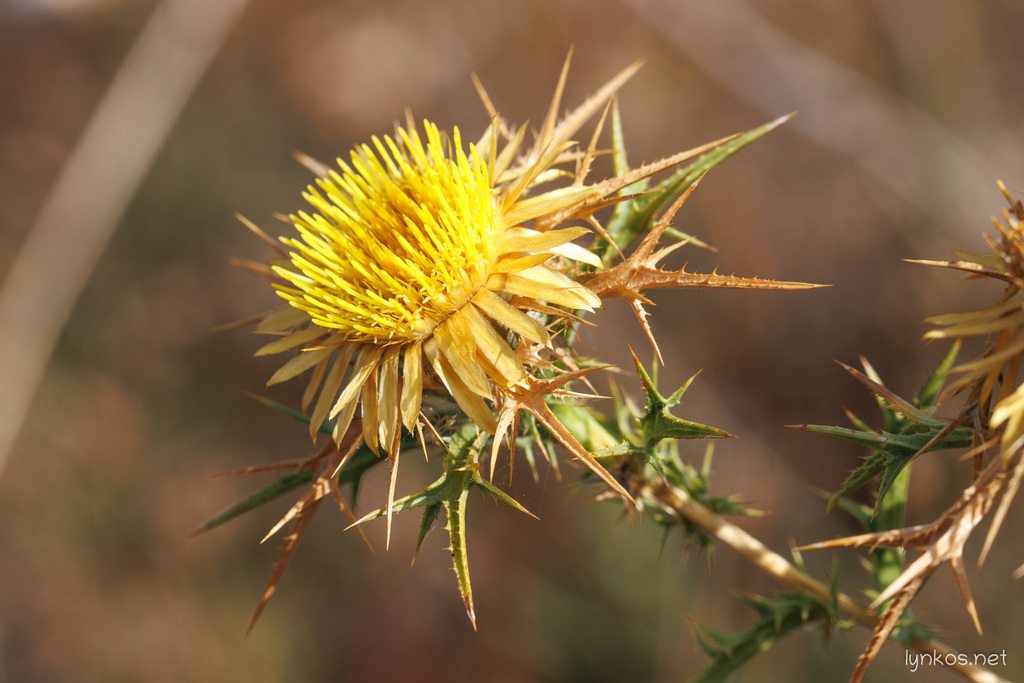
Clustered Carline-thistle
Carlina corymbosa
Carlina corymbosa, common name clustered carline thistle, is a herbaceous perennial plant in the genus Carlina, belonging to the family Asteraceae.
From the article Carlina corymbosa on Wikipedia (CC BY-SA), quoted section by section
Description
Carlina corymbosa reaches on average 10–90 centimetres (4–35 in) in height. This plant has rhizomatous roots, overwintering buds situated just below the soil surface (hemicryptophyte) and an almost leafless stalk growing directly from the ground (scapose). The stem is green to whitish, thick and erect. The leaves are alternate, sessile or amplexicaul and lobed with spines on the margins. The yellow flowers are terminal, 2.0–3.5 cm (0.8–1.4 in) in diameter and surrounded by thorny bracts. The outer bracts are similar to leaves, while the inner bracts surrounding the disk florets are membranous and stiff, with a golden color. The flowering period extends from June through August. The flowers are hermaphrodite and are pollinated by insects (usually bees, wasps and butterflies) (entomogamy). The fruits are achenes 2.5 millimetres (0.1 in) long, each with a feathery yellow pappus. Seed dispersal is by wind (anemochory).
Range & habitat
This plant is native to the Mediterranean and it is present in Albania, Balearic Islands, Bulgaria, Corsica, Crete, France, Greece, Spain, Italy, former Jugoslavia, Sardinia, Sicily and Turkey.
Wikipedia: “Distribution”
Where it lives
Recorded sightings
—
geo-referenced records in GBIF, from museums, herbaria and field observers.
Drag the globe to turn it. Dots are where records exist, not a range map; darker means more records.
In the stacks
Searching the stacks…
Every page naming Carlina corymbosa in the Biodiversity Heritage Library →
This page is assembled live from iNaturalist, GBIF, Wikipedia, the Source Library and the Internet Archive. It is not yet part of the hand-edited codex. iNaturalist taxon 333723.