- Fungi Including Lichens
- ›Basidiomycete Fungi
- ›Higher Basidiomycetes
- ›Mushrooms, Bracket Fungi, Puffballs, and Allies
- ›Agaricomycetidae
- ›boletes and allies
- ›boletes
- ›Boletoideae
- ›Boletus
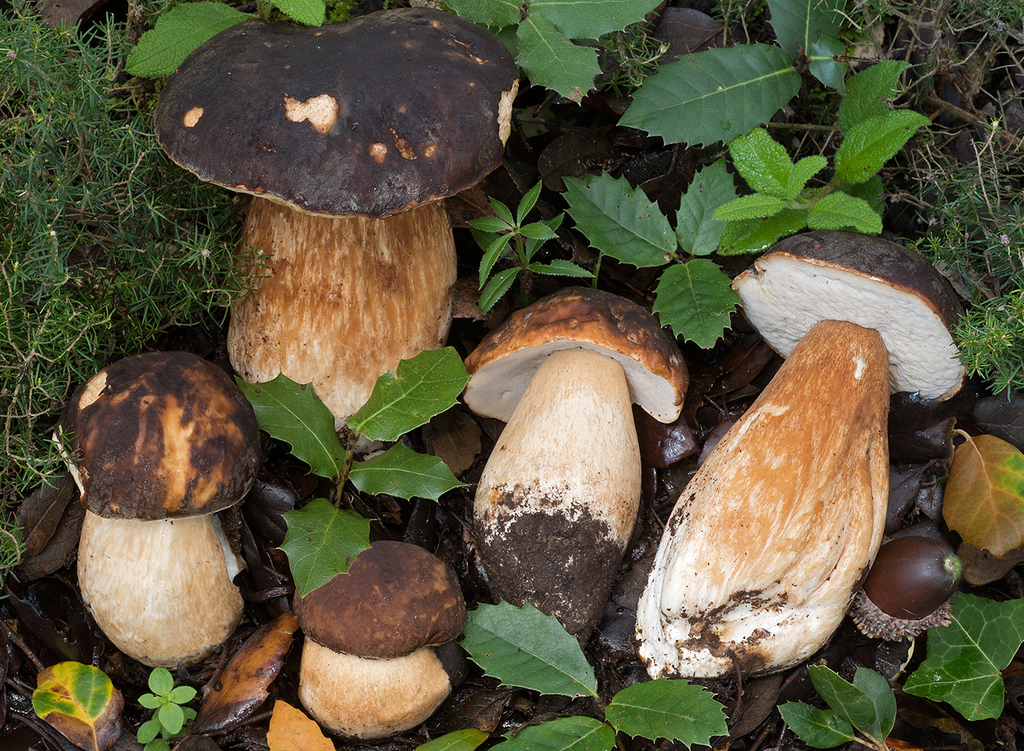
Bronze Bolete
Boletus aereus
Boletus aereus, commonly known as the queen bolete, dark cep, or bronze bolete, is a species of fungus in the family Boletaceae. Described in 1789 by French mycologist Pierre Bulliard, it is closely related to several other European boletes, including B. reticulatus, B. pinophilus, and the popular B. edulis. Some populations in North Africa have in the past been classified as a separate species, B. mamorensis, which has been shown to be phylogenically conspecific to B. aereus and is now regarded as a synonym.
The fungus produces spore-bearing fruit bodies above ground in summer and autumn. The fruit body has a large dark brown cap, which can reach 30 cm (12 in) in diameter. Like other boletes, B. aereus has tubes extending downward from the underside of the cap, rather than gills. The spores escape at maturity through the tube openings, or pores. The pore surface of the fruit body is whitish when young, but ages to a greenish-yellow. The squat brown stipe, or stem, is up to 15 cm (6 in) tall and 10 cm (4 in) thick and partially covered with a raised network pattern, or reticulation.
From the article Boletus aereus on Wikipedia (CC BY-SA), quoted section by section
Description
The cap is hemispherical to convex, reaching 15–20 cm (6–8 in) in diameter, although specimens of 40 cm (16 in) have been found in some cases. Slightly velvety, it is dark brown when young, greyish-brown, violet brown, or purple brown, often with copper, golden, or olivaceous patches. The stipe is 5–15 cm (2–6 in) long and 2–5 cm (3⁄4–2 in) thick, usually shorter than the cap diameter, initially barrel shaped but gradually becoming club shaped and tapering at the base. The stipe is white then brown, chestnut, or reddish brown in colour, covered in a brown or concolorous reticulation. As with other boletes, there are tubes rather than gills on the underside of the cap. The tube openings—known as pores—are small and rounded. Whitish when young, they slowly become yellowish or greenish yellow at maturity, and can turn wine coloured with bruising. The tubes themselves are initially white, later becoming yellowish or olivaceous. The thick flesh is white, exudes a robust and pleasant smell reminiscent of hazelnuts, and has a mild sweet taste. The spores are spindle shaped and measure 10.5–19 by 4–7 μm. The pileipellis is a trichodermium of interwoven septate hyphae, with long cylindrical cells.
Similar species. Boletus reticulatus is very similar to B. aereus, also occurring during the summer months under broad-leaved trees. …
Range & habitat
The distribution and abundance of Boletus aereus varies greatly. Found mainly in central and southern Europe as well as north Africa, this species is rare in colder climates such as England. It is classified as a vulnerable species in the Czech Republic and has been placed on a provisional Red List of endangered species of Montenegro. Nevertheless, the fungus can be locally abundant; it is the most common bolete in the woodlands of Madonie Regional Natural Park in northern Sicily. Boletus aereus has been reported from several other island ecosystems across the Mediterranean, such as Corsica, Cyprus, Lesvos, and Naxos. Mushrooms are mostly found during hot spells in summer and autumn, growing in mycorrhizal association with various broad-leaved trees and sclerophyllous shrubs, especially oak (Quercus), beech (Fagus), chestnut (Castanea), strawberry trees (Arbutus), treeheath (Erica), and rockrose (Cistus), showing a preference for acidic soils. Roadsides and parks are common habitats. The cork oak in particular is an important symbiont, and the distribution of B. aereus aligns with the tree across Europe and North Africa. The ectomycorrhizae that B. aereus forms with sweet chestnut (Castanea sativa) and downy oak (Quercus pubescens) have been described in detail. …
Wikipedia: “Distribution and habitat”
At the table
A choice edible species, B. aereus is highly appreciated in Southern Europe for its culinary qualities and is considered by many to be gastronomically superior to B. edulis. In the vicinity of Borgotaro in the Province of Parma of northern Italy, the four species B. edulis, B. aereus, B. reticulatus (formerly known as B. aestivalis), and B. pinophilus have been recognised for their superior taste and officially termed Fungo di Borgotaro. Here, these mushrooms have been collected and exported commercially for centuries. Throughout Spain, it is one of the wild edible fungi most commonly collected for the table, particularly in Aragon, where it is harvested for sale in markets. It is also popular in Navarre, Spain, Basque Country, France, and Greece. When collected, the skin of the cap is left intact, and dirt is brushed off the surface. Pores are left unless old and soft. Boletus aereus is especially suited for drying, a process which enhances its flavour and aroma. Like other boletes, the mushrooms can be dried by being sliced and strung separately on twine, then hung close to the ceiling of a kitchen. Alternatively, the mushrooms can be dried by cleaning with a brush (washing is not recommended), and then placed in a wicker basket or bamboo steamer on top of a boiler or hot water tank. Once dry, they are kept in an airtight jar. …
Wikipedia: “Uses”
Where it lives
Recorded sightings
—
geo-referenced records in GBIF, from museums, herbaria and field observers.
Drag the globe to turn it. Dots are where records exist, not a range map; darker means more records.
In the stacks
Searching the stacks…
Every page naming Boletus aereus in the Biodiversity Heritage Library →
This page is assembled live from iNaturalist, GBIF, Wikipedia, the Source Library and the Internet Archive. It is not yet part of the hand-edited codex. iNaturalist taxon 333772.