- Plants
- ›Vascular Plants
- ›flowering plants
- ›Dicots
- ›Roses, Elms, Figs, and Allies
- ›buckthorn family
- ›Colletieae
- ›Discaria
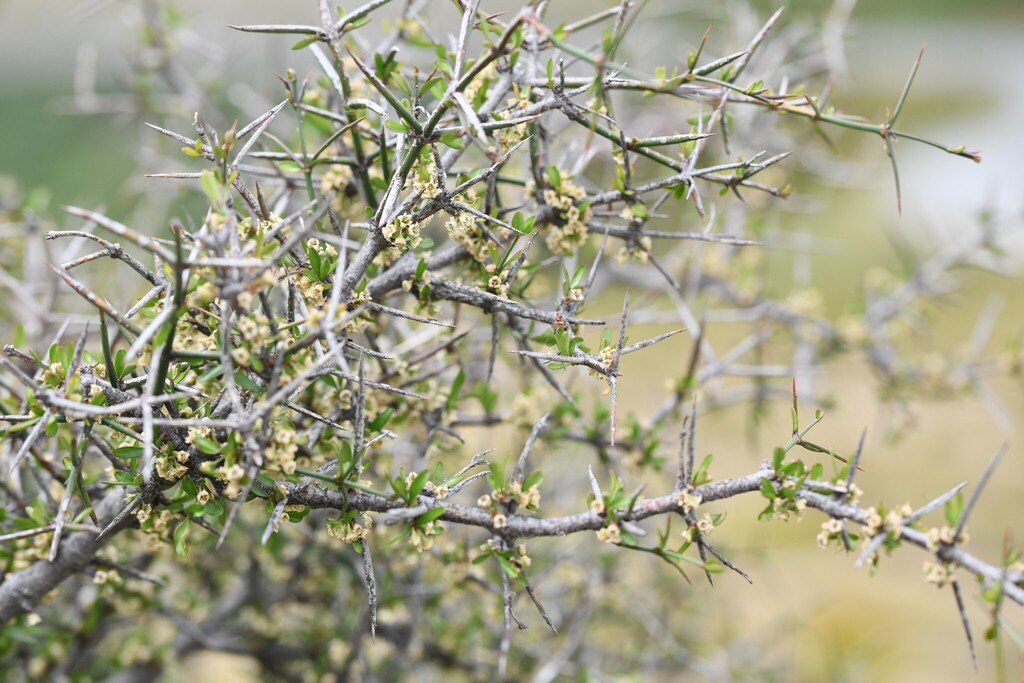
Matagouri
Discaria toumatou
Discaria toumatou, commonly called matagouri, is a tangle-branched thorny plant endemic to New Zealand. An alternative but less used name for the plant is "wild Irishman". The name matagouri is how speakers of English heard the South Island pronunciation of the Māori name "matakoura". It is also known as tūmatakuru.
From the article Discaria toumatou on Wikipedia (CC BY-SA), quoted section by section
Description
Matagouri is a tangle-branched, extremely spiny, divaricating shrub; sometimes it can grow to be a small tree up to five metres tall with rough grey bark. It is deciduous and has very small leathery leaves mostly in spring and early summer. The glossy green leaves arise at the bases of the spines, which can be several centimetres long. The spines are green when young, later turning grey. Matagouri is the only New Zealand native plant that has spines of this kind. The flowers are tiny, scented, and white with no petals, only 4–5 triangular petal-like sepals. They appear in October–December, followed in January–March by small three-lobed green to brown fruits.
Range & habitat
Matagouri is common in the eastern South Island and in Chatham Island, and is found in a few coastal localities in the North Island south from the mouth of the Waikato River. It commonly forms thickets in lowland to montane tussock grassland, stony areas, sand dunes, and river beds, and occasionally in subalpine scrubland.
Wikipedia: “Distribution”
What it does
As with other Discaria species, matagouri fixes nitrogen from the atmosphere with the help of symbiotic bacteria of the genus Frankia in its roots, and so can grow in nutrient-poor habitats. It often grows in association with mingimingi (Coprosma propinqua), porcupine shrub (Melicytus alpinus, an alpine mahoe), native brooms (Carmichaelia species) and the introduced weed sweet briar (Rosa rubiginosa). Matagouri grows slowly, and plants in undisturbed areas can be over 100 years old.
Wikipedia: “Ecology”
At the table
Matagouri spines were used by Māori for tattooing when no better tool was available. In 1997 matagouri, along with other Wellington coastal species, was planted in traffic islands in Petone Esplanade in Lower Hutt.
Wikipedia: “Cultural uses”
In human culture
The English name matagouri is another corruption of tūmatakuru. Other names in the Māori language include tūmatakuri and tūturi. Another name is "wild Irishman"; the English writer Samuel Butler in 1863 recalled "…a very uncomfortable prickly shrub, which they call Irishman, and which I do not like the look of at all."
Wikipedia: “Etymology”
Where it lives
Recorded sightings
—
geo-referenced records in GBIF, from museums, herbaria and field observers.
Drag the globe to turn it. Dots are where records exist, not a range map; darker means more records.
In the stacks
Searching the stacks…
Every page naming Discaria toumatou in the Biodiversity Heritage Library →
This page is assembled live from iNaturalist, GBIF, Wikipedia, the Source Library and the Internet Archive. It is not yet part of the hand-edited codex. iNaturalist taxon 333825.