- Plants
- ›Vascular Plants
- ›flowering plants
- ›Dicots
- ›saxifrages, stonecrops, and allies
- ›peony family
- ›Paeonia
- ›Paeonia
- ›Corallinae
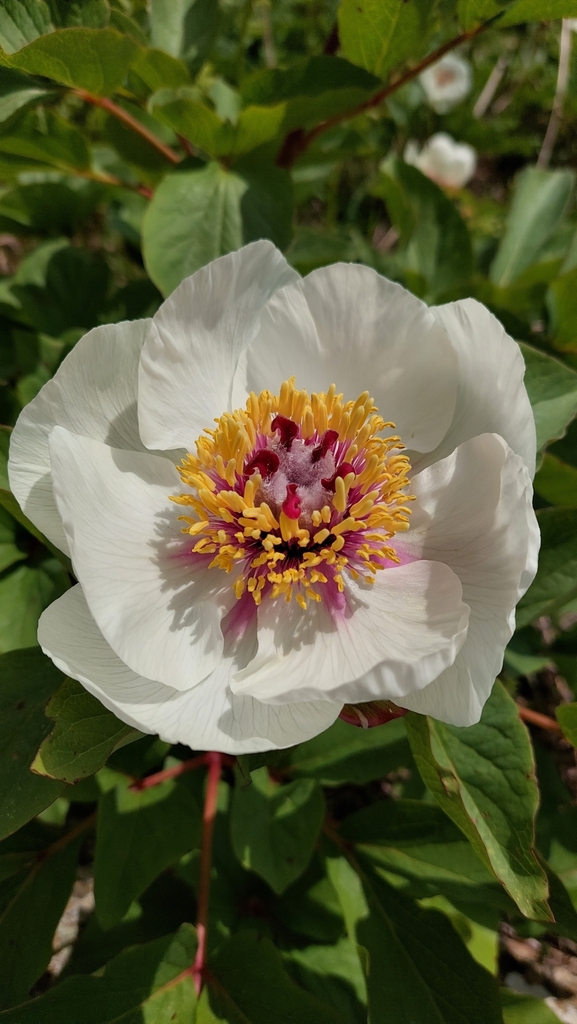
Wild Peony
Paeonia mascula
Paeonia mascula is a species of peony. It is a herbaceous perennial 0.5–1.5 m (1.6–4.9 ft) tall, with leaves that are divided into three segments, and large red flowers in late spring and early summer. Native to Syria, Spain, France, Italy, Croatia, Bosnia and Herzegovina, Serbia, Cyprus, Montenegro, Bulgaria Greece, Turkey, Iraq, Lebanon and Israel, this wild peony has become naturalised on two small islands in the UK.
From the article Paeonia mascula on Wikipedia (CC BY-SA), quoted section by section
Range & habitat
Paeonia mascula is at risk in its natural environment due to the demand from private collectors and there is a significant trade in wild P. mascula from Turkey. Ideal conditions are light (sandy) soils although and most peonies can grow in heavy clay soil. The Wild Peony prefers acid and neutral soils, can grow in semi-shade and tolerates drought. The wild peony was introduced to the island of Steep Holm in the Bristol Channel, possibly by monks. 37 plants were taken to nearby Flat Holm island by Frank Harris, the farmer at the time, in the 1930s, many of which died during the World War II occupation and fortification of the island. One remaining plant was reintroduced by the Flat Holm Warden in 1982 and is protected by fencing near the path to the lighthouse. A few plants grown from seed also survive in the farmhouse garden.
Wikipedia: “Distribution and habitat”
At the table
The roots of P. mascula were ground to a powder and used to treat colds and sore throats.
== References ==
Wikipedia: “Uses”
Where it lives
Recorded sightings
—
geo-referenced records in GBIF, from museums, herbaria and field observers.
Drag the globe to turn it. Dots are where records exist, not a range map; darker means more records.
In the stacks
Searching the stacks…
Every page naming Paeonia mascula in the Biodiversity Heritage Library →
This page is assembled live from iNaturalist, GBIF, Wikipedia, the Source Library and the Internet Archive. It is not yet part of the hand-edited codex. iNaturalist taxon 333843.