- Animals
- ›Arthropods
- ›Hexapods
- ›Insects
- ›Winged and Once-winged Insects
- ›True Bugs, Hoppers, Aphids, and allies
- ›True Bugs
- ›Pentatomomorph Bugs
- ›Stink Bugs, Shield Bugs, and Allies
- ›Shield Bugs
- ›Acanthosomatinae
- ›Elasmucha
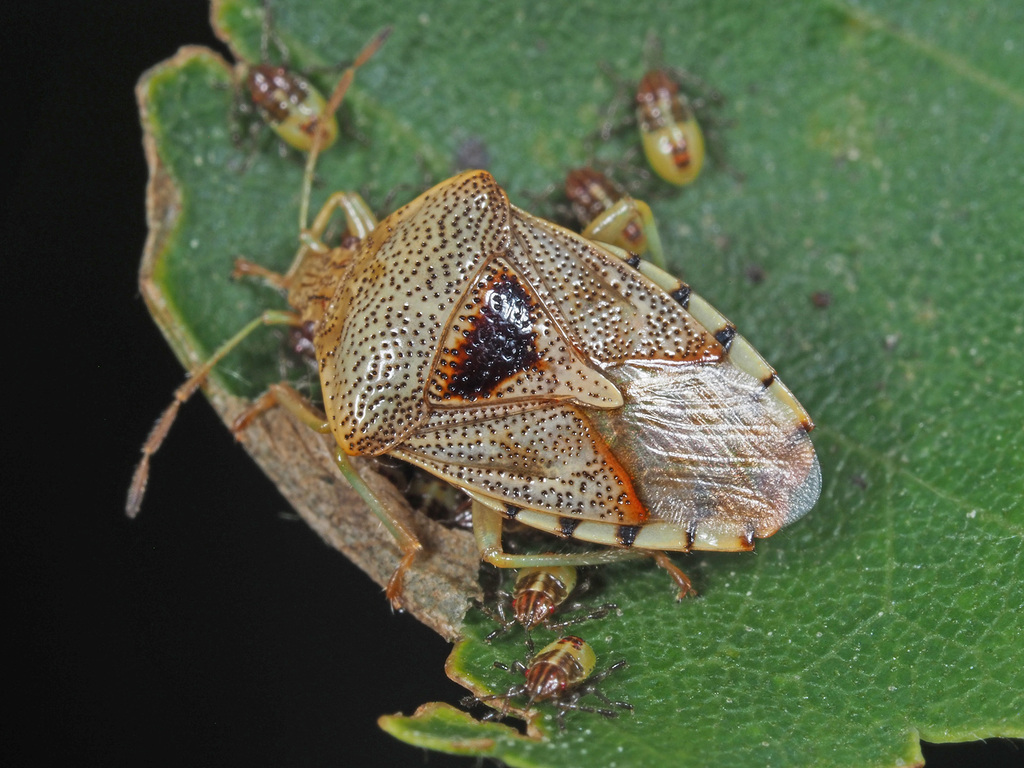
Parent Bug
Elasmucha grisea
Elasmucha grisea, common name parent bug, is a species of shield bugs or stink bugs belonging to the family Acanthosomatidae. The term parent bugs includes also the other species of the genus Elasmucha and some species of the family Acanthosomatidae.
From the article Parent bug on Wikipedia (CC BY-SA), quoted section by section
Description
Elasmucha grisea can reach a length of 6.5–8.8 millimetres (0.26–0.35 in). Males are smaller than females. These medium-sized shield bugs are usually brown-reddish, but there are also gray (hence the Latin species name grisea) and green-brown specimens. The connexiva are black and white. The upper side is covered with several dark dots. The scutellum usually shows an evident black patch. The ventral face is largely punctuated with black. The lateral corners of the pronotum are simply beveled. The front corners of the pronotum show a more pronounced tooth. Antennae are blackish in the male, dark brown in the female. This species, like other parent bugs, possesses metathoracic and abdominal glands, which discharge a foul smelling secretion. This secretion is used to deter potential enemies and is sometimes released when the bug is disturbed.
Range & habitat
Elasmucha grisea is a rather common and widespread species present in most of Europe.
Wikipedia: “Distribution”
What it does
Adults of E. grisea can be found all year around. In fact, this species overwinters as an adult. Mating occurs in the spring and new adults can be found in August. These shield bugs feed on various woody plants, preferably on birch (Betula sp.), but also on alder (Alnus sp.), beech (Fagus sp.), holly (Ilex sp.), spruce (Picea sp.), etc. Like most shield bugs, E. grisea and other parent bugs suck plant sap and require symbiotic bacteria for their digestion. They obtain symbionts at an early age: the mother covers her eggs with bacteria so that the nymphs ingest them as they feed on the egg case. Both adults and nymphs readily feed on developing seeds, and breeding individuals can be observed on host plants with many young catkins. However, they seem to avoid trees with a high predation risk.
Wikipedia: “Life cycle”
Listen
Looking for field recordings…
Where it lives
Recorded sightings
—
geo-referenced records in GBIF, from museums, herbaria and field observers.
Drag the globe to turn it. Dots are where records exist, not a range map; darker means more records.
In the stacks
Searching the stacks…
Every page naming Elasmucha grisea in the Biodiversity Heritage Library →
This page is assembled live from iNaturalist, GBIF, Wikipedia, the Source Library and the Internet Archive. It is not yet part of the hand-edited codex. iNaturalist taxon 334551.