- Fungi Including Lichens
- ›Basidiomycete Fungi
- ›Higher Basidiomycetes
- ›Mushrooms, Bracket Fungi, Puffballs, and Allies
- ›Agaricomycetidae
- ›boletes and allies
- ›Sclerodermatineae
- ›Gyroporaceae
- ›Gyroporus
- ›Gyroporus
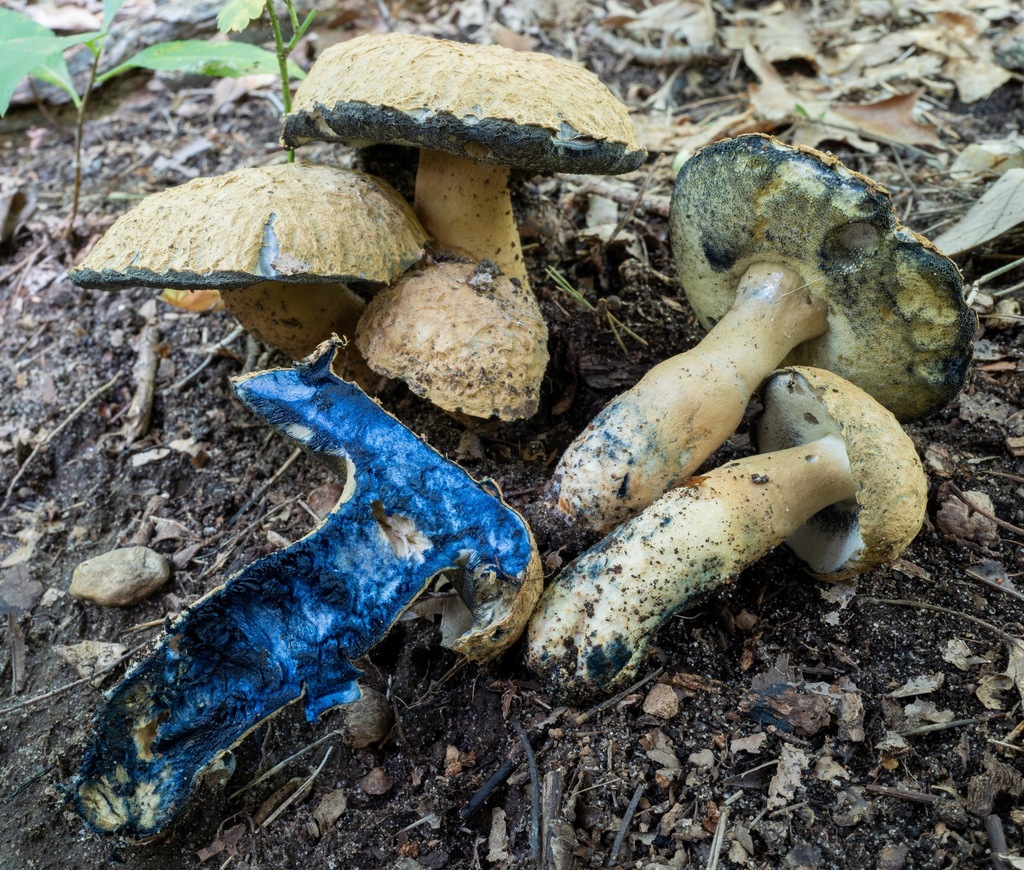
Cornflower Bolete
Gyroporus cyanescens
Gyroporus cyanescens, commonly known as the bluing bolete or the cornflower bolete, is a species of bolete fungus in the family Gyroporaceae. First described from France in 1788, the species is found in Eurasia, Australia, and eastern North America, where it grows on the ground in coniferous and mixed forests.
The yellowish to buff cap surface is fibrous and roughened, and reaches up to 12 cm (4.7 in) in diameter. The thick stem, roughly the same color as the cap or lighter, is hollowed out into chambers. All parts of the mushroom turn an intense blue color within a few moments of bruising or cutting. The mushroom is edible, despite its hard stem. A less common variety occurs where the color change is to deep violet rather than blue. The bluing reaction results from the enzymatic oxidation of a chemical called gyrocyanin.
From the article Gyroporus cyanescens on Wikipedia (CC BY-SA), quoted section by section
Description
The cap of G. cyanescens is initially convex, but flattens out in maturity, sometimes becoming shallowly depressed; it reaches a diameter of 4–12 cm (1+1⁄2–4+3⁄4 in). The cap is dry, and ranges in color from buff to yellowish to pale olive, occasionally with darker streaks of color. Its surface is uneven, sometimes with wrinkles and pits. The cap margin is initially curved inward, and sometimes splits in maturity. The flesh is whitish to pale yellow, and has a brittle texture. On the underside of the cap, the pore surface is white to yellowish, sometimes with olive or tan tinges. There are roughly two circular pores per millimeter, and the tubes that comprise the pores are 5–10 mm (1⁄4–3⁄8 in) deep, but depressed around the top of the stem. Injury to the pores will cause them to stain first greenish yellow, then greenish blue or blue. The stem is 4–12 cm (1+1⁄2–4+3⁄4 in) long by 1–2.5 cm (1⁄2–1 in) thick, and is either roughly equal in width throughout its length, or has a basal or middle swelling. The stem tissue is hard and brittle; it is initially stuffed with a soft pith that develops cavities, or becomes entirely hollow in maturity. Roughly the same color as the cap or lighter, the stem surface is dry and lacks reticulations. It is initially covered in coarse hairs that tend to disappear in maturity to leave a relatively smooth surface. …
Range & habitat
Gyroporus cyanescens is an ectomycorrhizal species that has a broad host range. Fruit bodies of G. cyanescens grow singly or scattered on the ground in deciduous and mixed forests. Often found in association with birch and poplar, the fungus tends to prefer sandy soil, and also frequents road banks and woodland edges. Fruiting occurs in summer and early autumn. Fruit bodies can be parasitized by the mold Sepedonium ampullosporum. Infection results in necrosis of the mushroom tissue, and a yellow color caused by the formation of large amounts of pigmented aleurioconidia (single-celled conidia produced by extrusion from the conidiophores). Gyroporus cyanescens is found in Europe, Asia, Australia, and North America (July–September). In China, it is known from Guangdong and Yunnan. The fungus appears in eucalypt woodland in Australia. In North America, it is widespread east of the Rocky Mountains. The geographical distribution ranges from eastern Canada to Florida, and west to Minnesota, although it has been occasionally reported from the Pacific Northwest, and one collection has been made in the Sky Islands of southern Arizona. G. cyanescens var. violaceotinctus has been reported from Japan.
Wikipedia: “Ecology and distribution”
At the table
Gyroporus cyanescens is edible, and considered "choice" by several sources. The fruit bodies, even if mature, are typically free of insect larvae. Specimens collected in sandy soil, however, are difficult to clean, but cleaning may be facilitated by washing the fruit bodies in a bowl of water so that the sand sinks to the bottom. The blue color largely disappears after two minutes of sautéing. Cooked mushrooms have a meaty texture, and mild nutty flavor that is enhanced if fried to crispness. Drying the mushrooms strengthens the taste. The variety violaceotinctus is used in mushroom dyeing, and produces a light yellow, beige, gold, or brownish-orange color depending on the mordant used.
Wikipedia: “Uses”
Where it lives
Recorded sightings
—
geo-referenced records in GBIF, from museums, herbaria and field observers.
Drag the globe to turn it. Dots are where records exist, not a range map; darker means more records.
In the stacks
Searching the stacks…
Every page naming Gyroporus cyanescens in the Biodiversity Heritage Library →
This page is assembled live from iNaturalist, GBIF, Wikipedia, the Source Library and the Internet Archive. It is not yet part of the hand-edited codex. iNaturalist taxon 335276.