- Animals
- ›Arthropods
- ›Hexapods
- ›Insects
- ›Winged and Once-winged Insects
- ›True Bugs, Hoppers, Aphids, and allies
- ›Plant-parasitic Hemipterans
- ›Scale Insects
- ›Cochineal Insects
- ›Dactylopius
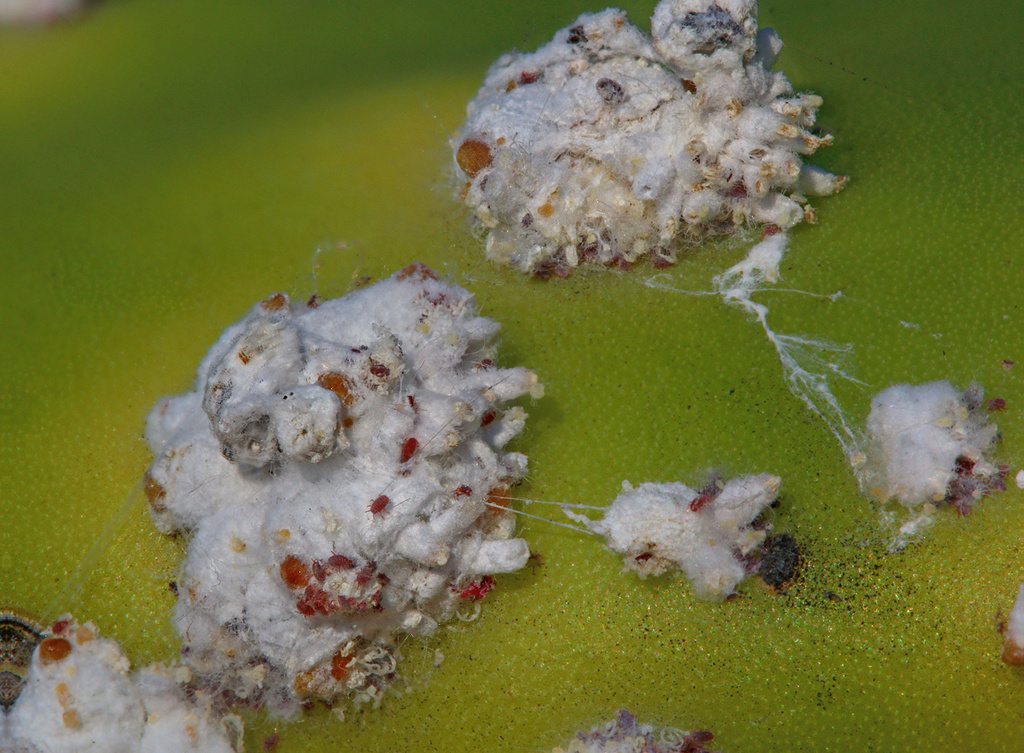
Cactus Scattered Cochineal
Dactylopius opuntiae
Dactylopius opuntiae, also known as the prickly pear cochineal, is a species of scale insect in the family Dactylopiidae.
From the article Dactylopius opuntiae on Wikipedia (CC BY-SA), quoted section by section
Description
All species of the family Dactylopiidae have females with an oval-shaped body that is purple-red in color and covered in a white, cotton-like wax. This wax protects the body of the cochineal from heat, cold, and predators. Adult females are sessile and form colonies of up to a few thousand individuals of mixed age, creating conspicuous clusters of white wax all over the plant. Adult females of Dactylopius opuntiae produce red glucosidal hydroxyanthrapurin (carminic acid), which occurs naturally within their body. Morphologically, all Dactylopius species have truncate dorsal setae and clusters of quinquelocular pores associated with tubular ducts on the body of females, and no microducts and cellular anal rings bearing setae. Large, truncate, and rounded setae longer than the width at the base and numerous narrow ventral pores on the last three body segments distinguish Dactylopius opuntiae from all its congeners.
Development. Dactylopius opuntiae follows a life cycle similar to that of other species in the genus, consisting of two nymphal instars before adult females and two nymphal instars, prepupa, and pupa before adult males. …
Range & habitat
Dactylopius opuntiae is native to Mexico and neighboring countries in Central America but has been introduced to several other areas, including Australia, Algeria, Morocco, Israel, France, India, Kenya, Madagascar, Pakistan, South Africa, Sri Lanka, and the United States (California and Texas).
Wikipedia: “Distribution”
What it does
Like other members of Dactylopiidae, Dactylopius opuntiae is not affected by parasitoid wasps. In Mexico, its most commonly occurring predatory species have been found to be Leucopis bellula, Sympherobius barberi, and Laetilia coccidivora.
Wikipedia: “Ecology”
Listen
Looking for field recordings…
Where it lives
Recorded sightings
—
geo-referenced records in GBIF, from museums, herbaria and field observers.
Drag the globe to turn it. Dots are where records exist, not a range map; darker means more records.
In the stacks
Searching the stacks…
Every page naming Dactylopius opuntiae in the Biodiversity Heritage Library →
This page is assembled live from iNaturalist, GBIF, Wikipedia, the Source Library and the Internet Archive. It is not yet part of the hand-edited codex. iNaturalist taxon 335785.