- Plants
- ›Vascular Plants
- ›flowering plants
- ›monocots
- ›Agaves, Orchids, Irises, and Allies
- ›Aloe family
- ›Aloes and allies
- ›Asphodeline
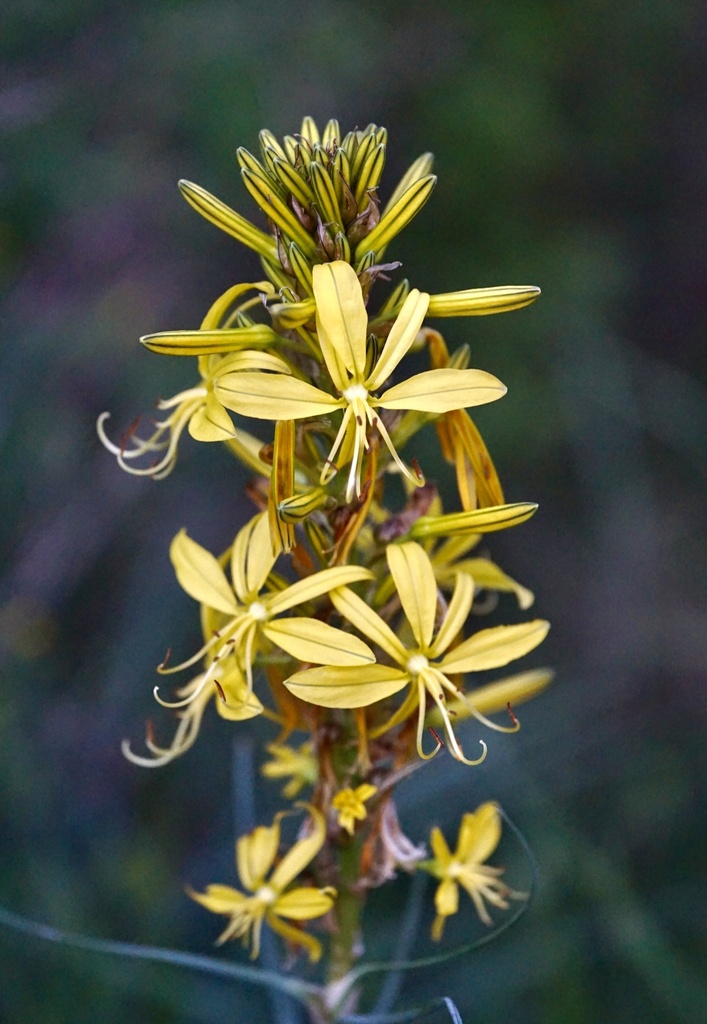
King's-spear
Asphodeline lutea
Asphodeline lutea (king's spear, yellow asphodel) is a perennial plant native to southeastern Europe, northern Africa, the Caucasus and the Levant. It is grown as a landscaping plant.
It has been associated with the Asphodel of the Ancient Greek underworld, but so has the closely related Asphodelus ramosus.
From the article Asphodeline lutea on Wikipedia (CC BY-SA), quoted section by section
Description
Asphodeline lutea reaches 3 to 4 ft (0.9 to 1.2 m) tall and 1 to 2 ft (0.3 to 0.6 m) wide. The grey-green leaves are 1 ft (0.3 m) tall, with the flower stalk growing 3 to 4 ft (0.9 to 1.2 m) bearing a dense raceme of 1 in (2.5 cm) bright yellow flowers.
In human culture
Asphodeline lutea was introduced into the University of Oxford Botanic Garden in 1648, even though it demonstrated no known uses that are typical of a physic garden (plants grown for medicinal use). One of the curators of the garden at the time, John Parkinson, said the plant was "not... used in Physicke for any purpose." The locals in the Mediterranean who were interviewed by Parkinson said the plant had "no... propertie appropriate unto it but knavery," with no explanation of the particular knavery of which the plant was guilty. The description in the Botanic Garden used the old name of Asphodelus lutea.
Wikipedia: “History”
Where it lives
Recorded sightings
—
geo-referenced records in GBIF, from museums, herbaria and field observers.
Drag the globe to turn it. Dots are where records exist, not a range map; darker means more records.
In the stacks
Searching the stacks…
Every page naming Asphodeline lutea in the Biodiversity Heritage Library →
This page is assembled live from iNaturalist, GBIF, Wikipedia, the Source Library and the Internet Archive. It is not yet part of the hand-edited codex. iNaturalist taxon 335852.