- Fungi Including Lichens
- ›Basidiomycete Fungi
- ›Higher Basidiomycetes
- ›Mushrooms, Bracket Fungi, Puffballs, and Allies
- ›Shelf Fungi
- ›Pycnoporellaceae
- ›Pycnoporellus
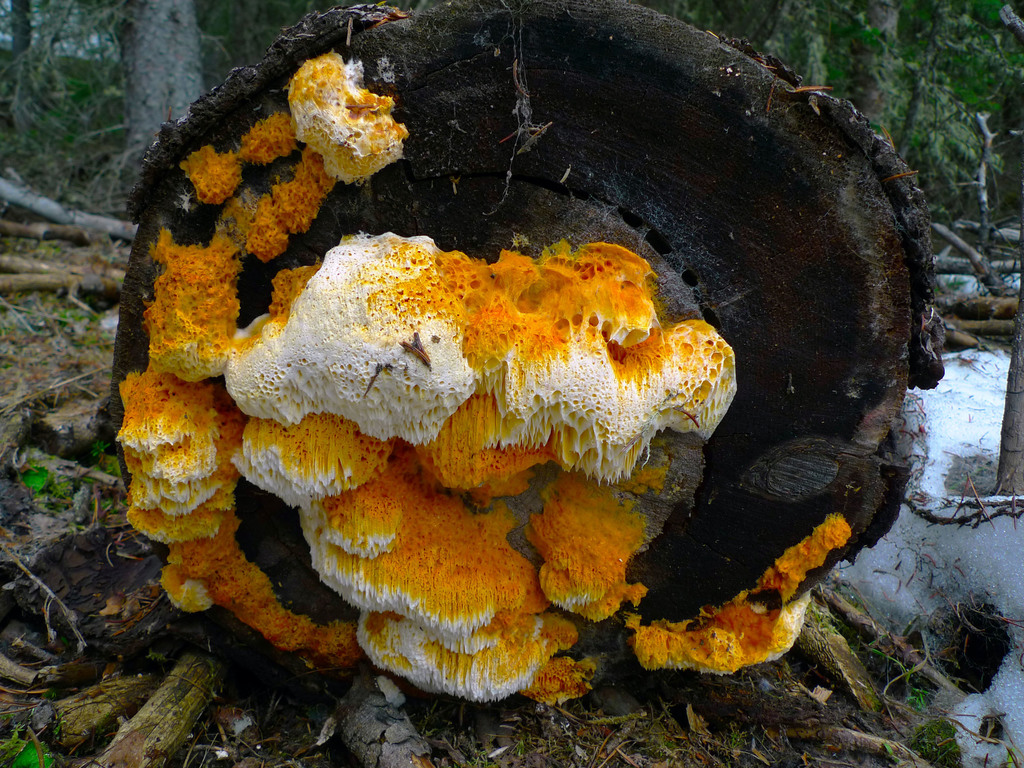
Orange Sponge Polypore
Pycnoporellus alboluteus
Pycnoporellus alboluteus, commonly known as the orange sponge polypore, is a species of polypore fungus in the family Fomitopsidaceae. The soft, spongy orange fruit bodies grow spread out on the surface of fallen logs. Mature specimens have tooth-like or jagged pore edges.
Distributed throughout the boreal conifer zone, the fungus is found in mountainous regions of western North America and in Europe. It causes a brown cubical rot of conifer wood, especially spruce, but also fir and poplar. A snowbank mushroom, it can often be found growing on logs or stumps protruding through melting snow.
From the article Pycnoporellus alboluteus on Wikipedia (CC BY-SA), quoted section by section
Description
The fruit bodies of P. alboluteus are annual, and are resupinate; they can be spread out on the substrate surface for up to 1 m (3+1⁄2 ft). Fresh fruit bodies are bright orange, finely grooved, and have a soft and spongy upper surface. The pore surface is orange with angular pores that are usually larger than 1 mm in diameter. It features thin partitions that split to form a teeth-like layer. The flesh is soft and pale orange, up to 2 mm thick, with a felt-like texture. The tubes are the same color as the pores, and continuous with the flesh, measuring up to 2 cm (3⁄4 in) thick. Bruised pores sometimes turn black. All tissues of the fungus turn bright red if a drop of dilute potassium hydroxide is applied. Fresh fruit bodies retain considerable moisture and can be squeezed of liquid like a sponge. The fruit body can be readily removed in large sheets from the wood it grows on. The edibility of the fruit body is unknown. It has a fragrant odor.
In deposit, the spores are white. The spores are cylindrical, smooth, hyaline (translucent), inamyloid, and measure 9–12 by 3–3.5 μm. Pycnoporellus alboluteus has a monomitic hyphal system, meaning it is made of generative hyphae, which are thin-walled, branched, and narrow. …
Range & habitat
Pycnoporellus alboluteus causes a brown cubical rot on fallen logs of coniferous trees. The fruit bodies usually grow on the underside of the log, and may start developing while still immersed in snow. Although new fruit bodies usually begin growing in the spring, they may persist throughout the year. In Europe, it usually grows on Picea species, but also on Abies. In North America, it also grows on Populus. The fungus has a circumpolar distribution, and is found in the boreal conifer zone, particularly in the montane zone, 2,400–3,000 m (8,000–10,000 ft). In North America, the fruit bodies begin growth under snow in the spring, continuing until midsummer, while in Europe, it is usually encountered in autumn. It is abundant in the Rocky Mountain region of North America, but rare in the eastern United States and Canada. As a timberline fungus subject to high altitudes, the fruit bodies are subjected to bright light, high winds, and low relative humidity, all of which have a drying effect. They counteract these extremes by absorbing water quickly, and drying slowly. In Europe, it is one of 32 threatened species proposed for protection under the Bern Convention. It has been recorded from Czechoslovakia, and Poland, where it is mostly found in old-growth forests. …
Wikipedia: “Ecology, habitat and distribution”
Where it lives
Recorded sightings
—
geo-referenced records in GBIF, from museums, herbaria and field observers.
Drag the globe to turn it. Dots are where records exist, not a range map; darker means more records.
In the stacks
Searching the stacks…
Every page naming Pycnoporellus alboluteus in the Biodiversity Heritage Library →
This page is assembled live from iNaturalist, GBIF, Wikipedia, the Source Library and the Internet Archive. It is not yet part of the hand-edited codex. iNaturalist taxon 335957.