- Plants
- ›Vascular Plants
- ›flowering plants
- ›Dicots
- ›Sunflowers, Bellflowers, Fanflowers, and Allies
- ›Sunflowers, Daisies, Asters, and Allies
- ›Asteroideae
- ›groundsels and allies
- ›Senecioninae
- ›Senecio
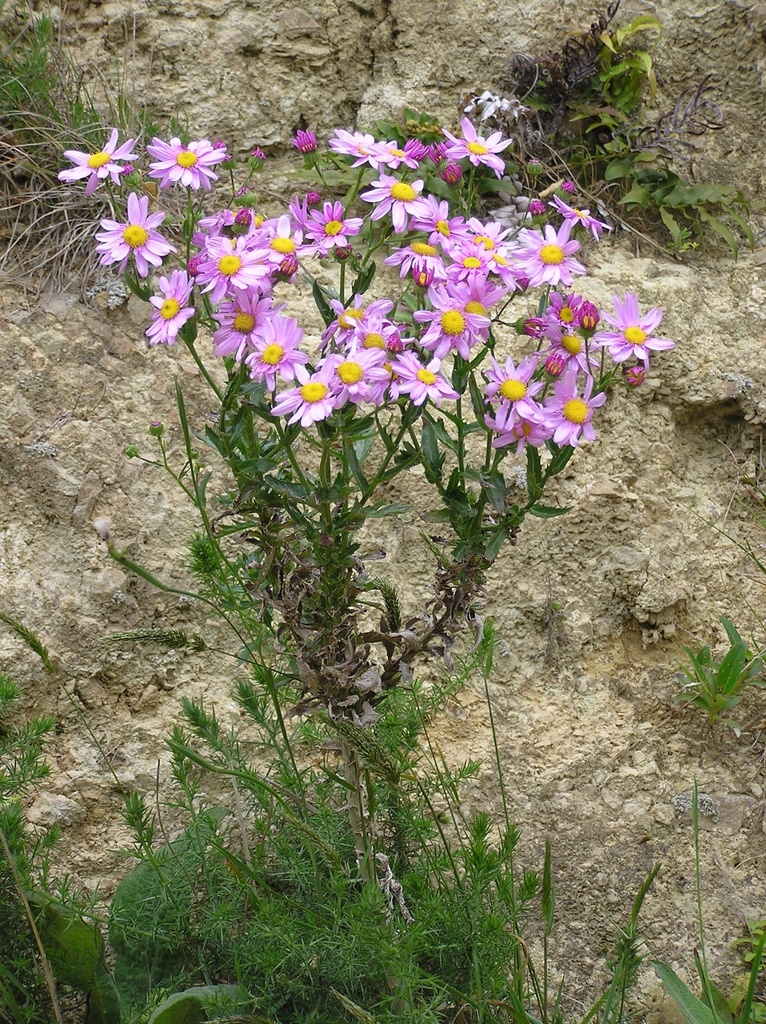
Woad-leaved ragwort
Senecio glastifolius
Senecio glastifolius is a flowering plant found throughout the world and native to South Africa. It has a collection of common names throughout the world. The two common names in New Zealand are pink ragwort and holly-leaved senecio. In the UK the most common names are woad leaved ragwort, holly leaved groundsel, and lilac senecio. In South Africa it is called senecio, waterdissel, and water thistle. In the USA it is referred to as lilac–flowered groundsel. Finally, there is the less common name of purple ragwort.
From the article Senecio glastifolius on Wikipedia (CC BY-SA), quoted section by section
Description
Senecio glastifolius is an upright perennial herbaceous plant in the family Asteraceae. In New Zealand it commonly grows to around 1 meter tall although some individuals in sheltered areas can grow upwards of two meters. The stems of the plant are glabrous (smooth and hairless) and often woody in the lower areas of the plant. The main stem can be 8-12 cm in diameter at the base of larger plants before branching to smaller stems. The stems branch from near the base and are green in colour with red ridges running vertically along the length of the stem. The leaves are arranged alternately along the stems and appear like the leaf of a holly. They are elliptic (oval-shaped) and bright to deep green in colour with large irregular teeth along the margin of the leaf which gives them a prickly texture. The base of leaves are apetiolate (stalkless) at the base and clasping, wrapping partly around the stem especially in young plants. Leaves range from 3-15cm long and 2-3cm wide; leaves lower on the plant are often larger and more serrated compared to upper leaves which are smaller and less toothed. Leaves are located every 1-2 cm along the stem. The flowers are grouped into heads called capitula, similar to the flower of a daisy. …
Range & habitat
Senecio glastifolius is native to South Africa's western and eastern Cape Provinces where it occupies a relatively small coastal range. In addition to its native range, it has been introduced throughout many regions including Australia, British Isles, New Zealand, Maderia, France and the USA. In Australia, S.glastifolius is a listed weed on the National Environmental Alert list. In New Zealand it is banned for sale and propagation and is managed as a pest.
Wikipedia: “Natural global range”
What it does
Senecio glastifolius is regarded as a short-lived perennial herb. Individual plants can live between 3-5 years although some larger plants in sheltered conditions have survived 10 years potentially meaning S.glastifolius can survive a decade. Seeds germinate typically within two weeks. Maximum germination occurs when the temperature is warmer than 25 degrees. Germination success tends to be between 53% and 80% and in New Zealand germination has been observed between February and August. Disturbance from fires followed by rain can increase germination of seedlings. Seeds remain in the soil banks for several years and can be released from dormancy by disturbance such as cultivation or fire. In Western Australia the plants have been observed to grow between March and August like New Zealand. Flowering usually occurs in spring but some plants in New Zealand have been observed to have a second flowering in summer. The capitula of S. glastifolius can produce up to 250 seeds each which are thought to be wind dispersed. Plants after flowering two to three time can become top heavy and break at the stem. Branches can continue to grow after this and there is some evidence of stems lying horizontal and in contact with soil forming new roots.
Wikipedia: “Life cycle/Phenology”
Where it lives
Recorded sightings
—
geo-referenced records in GBIF, from museums, herbaria and field observers.
Drag the globe to turn it. Dots are where records exist, not a range map; darker means more records.
In the stacks
Searching the stacks…
Every page naming Senecio glastifolius in the Biodiversity Heritage Library →
This page is assembled live from iNaturalist, GBIF, Wikipedia, the Source Library and the Internet Archive. It is not yet part of the hand-edited codex. iNaturalist taxon 336367.