- Animals
- ›Molluscs
- ›Gastropods
- ›Caenogastropods
- ›Littorinimorpha
- ›Periwinkle Snails and Allies
- ›Land Winkles
- ›Pomatias
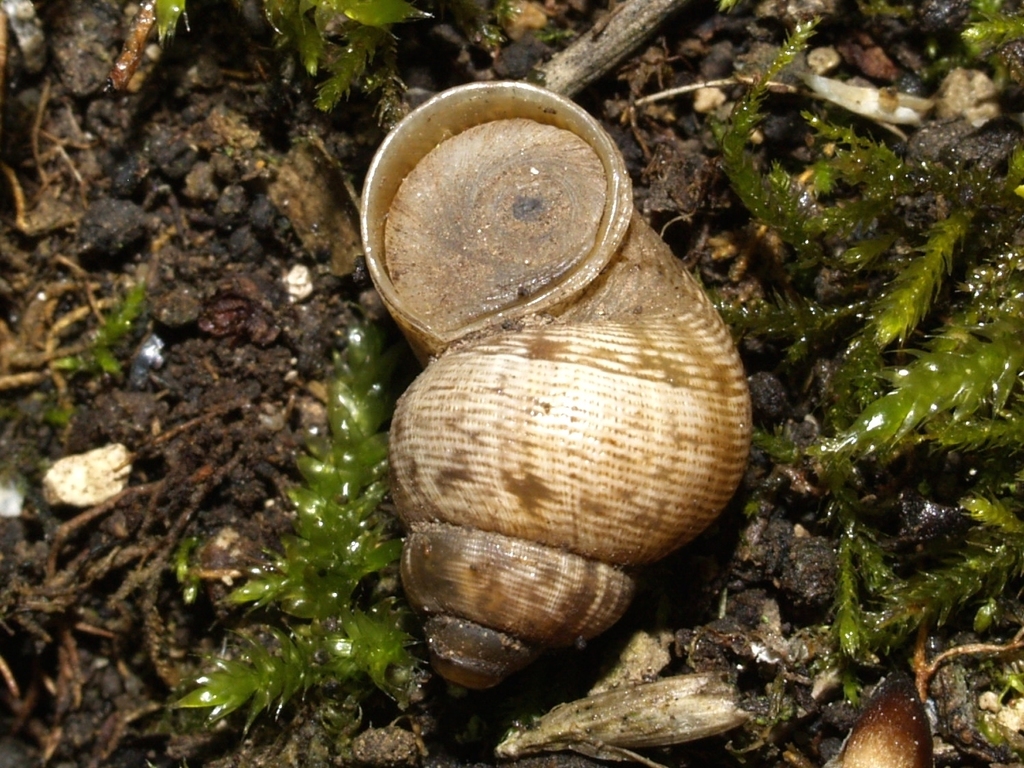
Round-mouthed Snail
Pomatias elegans
Pomatias elegans, commonly known as the round-mouthed snail, is a species of small land snail with an operculum, a terrestrial gastropod mollusk in the family Pomatiidae within the superfamily Littorinoidea, the winkles and their allies.
This species is sometimes called a "land winkle".
From the article Pomatias elegans on Wikipedia (CC BY-SA), quoted section by section
Description
The shell of this species is thick-walled, ovoid and slightly conical. It is composed of 4 ½ - 5 convex spires with the last one as the largest one. The surface of the shell is reticulated with dark spots and discontinued bands of beige and violet colours. The thick and chalky operculum has an eccentric calcified nucleus, and bears a spiral sculpture. The length of the shells varies between 12.5 mm and 15.8 mm and its diameter between 7 mm and 11.5 mm.
The waves of contractions on the surface of the foot are longitudinal, passing from side to side.
Range & habitat
This species is very common in Southern Europe. Its overall distribution extends as far east as Istanbul and across the Bosphorus from there. It is uncommon in Britain and central Europe. Its distribution in North Africa is poorly documented.
Wikipedia: “Distribution”
What it does
This snail lives only in areas where there are high levels of calcium carbonate such as on limestone or chalk rock, and where there is loose and friable soil. This snail is also sometimes found in coastal sand dunes where the sand has many shell fragments mixed in.
Wikipedia: “Ecology”
Where it lives
Recorded sightings
—
geo-referenced records in GBIF, from museums, herbaria and field observers.
Drag the globe to turn it. Dots are where records exist, not a range map; darker means more records.
In the stacks
Searching the stacks…
Every page naming Pomatias elegans in the Biodiversity Heritage Library →
This page is assembled live from iNaturalist, GBIF, Wikipedia, the Source Library and the Internet Archive. It is not yet part of the hand-edited codex. iNaturalist taxon 336731.