- Animals
- ›Molluscs
- ›Gastropods
- ›Heterobranchs
- ›Euthyneura
- ›Tectipleura
- ›Eupulmonata
- ›Common Land Snails and Slugs
- ›Helicina
- ›Helicoidei
- ›Helicoidea
- ›Helix Snails
- ›Helicinae
- ›Helicini
- ›Helix
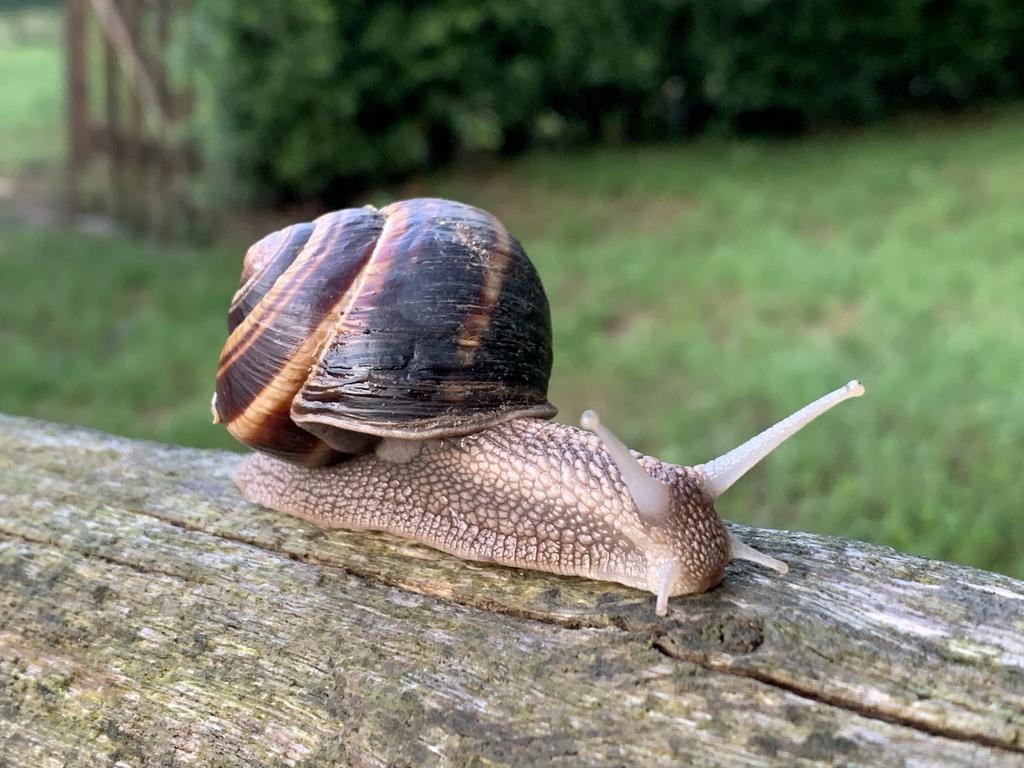
Turkish Snail
Helix lucorum
Helix lucorum, known commonly as the Turkish Snail, is a species of large, edible, air-breathing land snail, a terrestrial pulmonate gastropod mollusk in the family Helicidae, the typical snails.
From the article Helix lucorum on Wikipedia (CC BY-SA), quoted section by section
Description
Adult snails weigh about 20–25 g. The width of the shell is 35–60 mm. The height of the shell is 25–45 mm. This species of snail makes and uses love darts.
Range & habitat
The native distribution is the Caucasus, Anatolia and, arguably, the Balkans. It has also invaded many other regions since ancient times, likely assisted by humans. Eastern native range with main genetic diversity of the species:
Anatolia (Turkey) Georgia Azerbaijan Armenia Northern Iran Balkans:
Albania Bosnia and Herzegovina Bulgaria Croatia Greece Macedonia Serbia Turkey Other countries:
Israel Syria China - invasive Russia - could be native in Caucasus, invasive in some other regions Italy - probably invasive Hungary - probably invasive Romania - probably invasive Ukraine - invasive, in Crimea ("Helix taurica Krynicki, 1833") at least since early 19 century, probably much longer, these populations originated from Anatolia; other colonies of a different lineage also appear since 2000s in mainland part of Southern Ukraine and in Crimea as well Czech Republic - invasive, since 2009, as of 2011 the only locality is Prague-Žižkov Slovakia - invasive, since 2013, as of 2014 the only locality is in Bratislava France - invasive Great Britain - invasive, since 2009, at Wimbledon
Wikipedia: “Distribution”
What it does
The diameter of the egg is 4.4 mm. Juvenile snails that are two to three months old weigh 0.5–0.9 g.
Wikipedia: “Ecology”
Where it lives
Recorded sightings
—
geo-referenced records in GBIF, from museums, herbaria and field observers.
Drag the globe to turn it. Dots are where records exist, not a range map; darker means more records.
In the stacks
Searching the stacks…
Every page naming Helix lucorum in the Biodiversity Heritage Library →
This page is assembled live from iNaturalist, GBIF, Wikipedia, the Source Library and the Internet Archive. It is not yet part of the hand-edited codex. iNaturalist taxon 336841.