- Animals
- ›Arthropods
- ›Hexapods
- ›Insects
- ›Winged and Once-winged Insects
- ›Beetles
- ›Water, Rove, Scarab, Long-horned, Leaf, and Snout Beetles
- ›Cucujiform Beetles
- ›Longhorn Beetles and Allies
- ›Longhorn Beetles
- ›Round-necked Longhorn Beetles
- ›Compsocerini
- ›Rosalia
- ›Rosalia
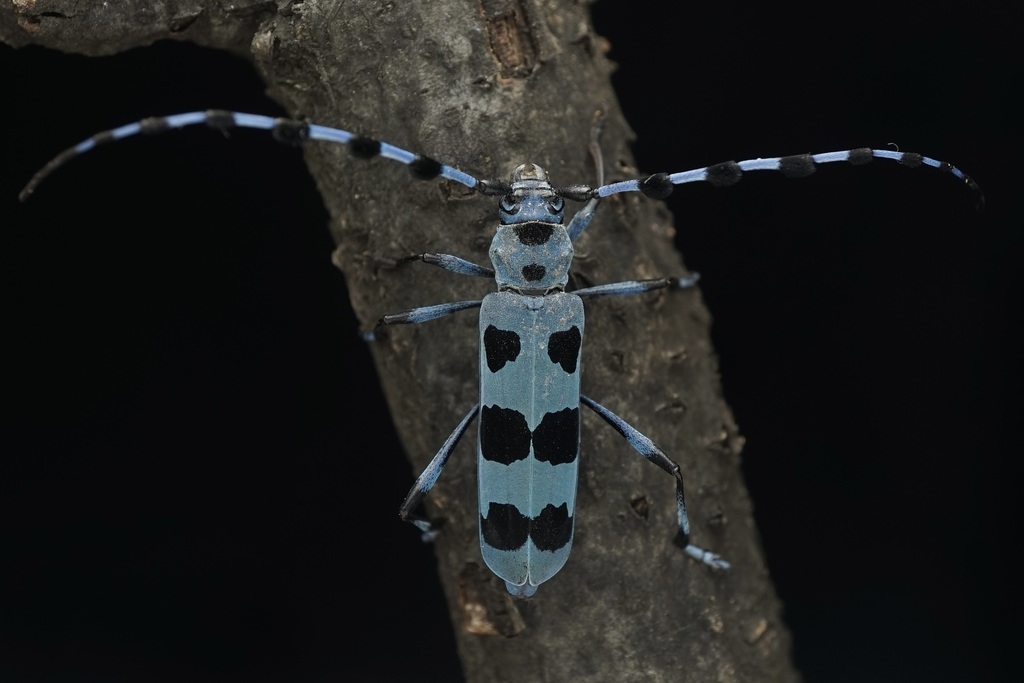
Black-spotted Blue Longicorn
Rosalia batesi
Rosalia batesi is a species of beetle in the family Cerambycidae. It was described by Harold in 1877.
From the article Rosalia batesi on Wikipedia (CC BY-SA), quoted section by section
Description
The beetle is 25 to 28 millimeter long. It is related to the alpine Rosalia longicorn. Compared to the alpine longicorn beetle, it is more narrow and the humps on the sides of the neck shield are much less pronounced. On the neck shield Rosalia batesi has two consecutive black blemishes, of which the back one is either missing or fused with the front one. The elytra carry three black transverse bandages, which lack the bright border of Rosalia alpina. In contrast to this, the arrangement of the black blemishes is also different, a round spot in the front, in the middle a somewhat crooked transverse bandage of two obliquely placed against the tip, at the back a larger spot, which sometimes flows together with the bandage along the elytra seam.
Wikipedia: “Characteristics”
Range & habitat
It is an endemic species of Japan, where it occurs in the mountains, from medium altitudes to the subalpine zone. There are indications that the species has spread to lower regions in recent decades, even to urban areas. The larvae of the species live in hard dry dead wood of numerous deciduous tree species, without special preference of a certain species, are documented willows (Salix), walnut (Juglans), wingnutd (Pterocarya), birch (Betula), hornbeam (Carpinus), beech (Fagus), elm (Ulmus), magnolia (Magnolia), Kuchenbaum (Cercidiphyllum), Ahorn (Acer), oriental raisin tree (Hovenia), Japanese snowbell (Styrax), horse chestnut (Aesculus), Japanese elm Zelkove (Zelkova). Egg-laying takes place on standing dead tree trunks, but also on felled and stored tree trunks and firewood logs, including dechipped trees. The beetles occasionally hatch from firewood or already installed wood. The larvae dig irregular passages into the wood, where they do not avoid the heartwood; in thin trunks, a certain preference of the central sections was even found. The adult beetles occasionally visit flowers and are also found by the juice flow of wounded living trees. During mating, the females specifically seek out males of the species, which they recognize by specific pheromones. Pheromones are released in a special organ at the eighth segment of the abdomen.
Wikipedia: “Distribution and way of life”
Listen
Looking for field recordings…
Where it lives
Recorded sightings
—
geo-referenced records in GBIF, from museums, herbaria and field observers.
Drag the globe to turn it. Dots are where records exist, not a range map; darker means more records.
In the stacks
Searching the stacks…
Every page naming Rosalia batesi in the Biodiversity Heritage Library →
This page is assembled live from iNaturalist, GBIF, Wikipedia, the Source Library and the Internet Archive. It is not yet part of the hand-edited codex. iNaturalist taxon 337092.