- Plants
- ›Vascular Plants
- ›flowering plants
- ›monocots
- ›grasses, sedges, cattails, and allies
- ›Sedges
- ›Cyperoideae
- ›Bolboschoeneae
- ›Bolboschoenus
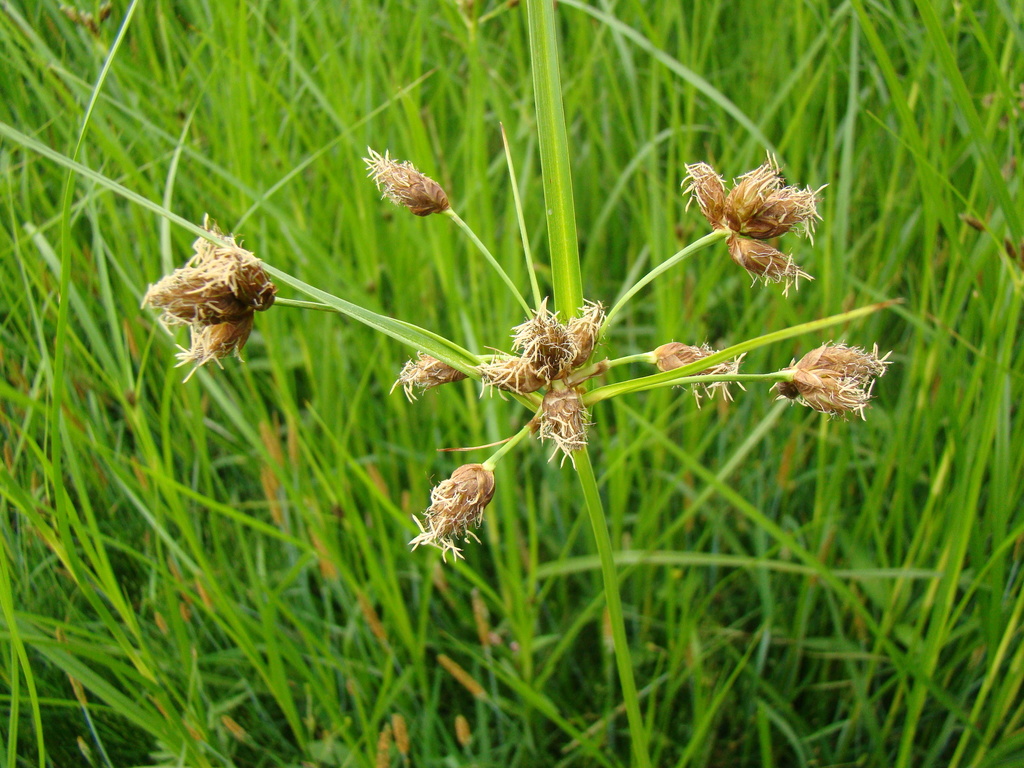
Bolboschoenus yagara
Bolboschoenus yagara is a species of flowering plant in the sedge family Cyperaceae. It is a perennial clonal herb, 0.8 to 1.3 meters (2 ft 7 in to 4 ft 3 in) tall, and develops underground rhizomes that terminate in spherical or ellipsoid tubers that are up to 3–4 centimeters (1.2–1.6 in) in diameter. It is able to propagate asexually through the tubers, as well as sexually by seeds.
From the article Bolboschoenus yagara on Wikipedia (CC BY-SA), quoted section by section
Range & habitat
Bolboschoenus yagara is found in wetlands, swamps, and other wet habitats. Unlike B. maritimus, Bolboschoenus yagara is a glycophyte. In experiments comparing the species to three other Bolboschoenus species (Bolboschoenus maritimus, Bolboschoenus laticarpus, and Bolboschoenus planiculmis), Bolboschoenus yagara was found to be the most sensitive to changes in nutrient supply and salt concentration, where increased concentrations caused a decrease in biomass, shoot number, fertility. In the dormant tuber stage, it is able to survive long-term high water levels. Bolboschoenus yagara is able to survive in both mesotrophic and eutrophic conditions. It is found in littoral habitats on mineral-poor grounds; in Europe its populations are concentrated in several pond basins in Central Europe, with limited frequency in other regions. As a result of this limited range, it is at risk in Europe because of intensive fish pond management. The range of Bolboschoenus yagara overlaps with that of Bolboschoenus planiculmis. Like Bolboschoenus planiculmis, Bolboschoenus yagara is an important part of the migratory habitat for the Siberian crane. …
Wikipedia: “Habitat”
At the table
Bolboschoenus yagara tubers, known as jing sanleng (Mandarin: 荊三稜), are used in traditional Chinese medicine to treat a number of ailments such as hyperemesis gravidarum, amenorrhea, and inflammatory-related conditions. Previous studies have identified a number of metabolites from the tubers of Bolboschoenus yagara that are theorized to have anti-inflammatory, anti-oxidant, and other properties, although these claims are speculative and their effectiveness has not been demonstrated in humans.
== References ==
Wikipedia: “Uses”
Where it lives
Recorded sightings
—
geo-referenced records in GBIF, from museums, herbaria and field observers.
Drag the globe to turn it. Dots are where records exist, not a range map; darker means more records.
In the stacks
Searching the stacks…
Every page naming Bolboschoenus yagara in the Biodiversity Heritage Library →
This page is assembled live from iNaturalist, GBIF, Wikipedia, the Source Library and the Internet Archive. It is not yet part of the hand-edited codex. iNaturalist taxon 337513.