- Plants
- ›Vascular Plants
- ›flowering plants
- ›Dicots
- ›sandalwoods, mistletoes, and allies
- ›balanophora family
- ›Dactylanthus
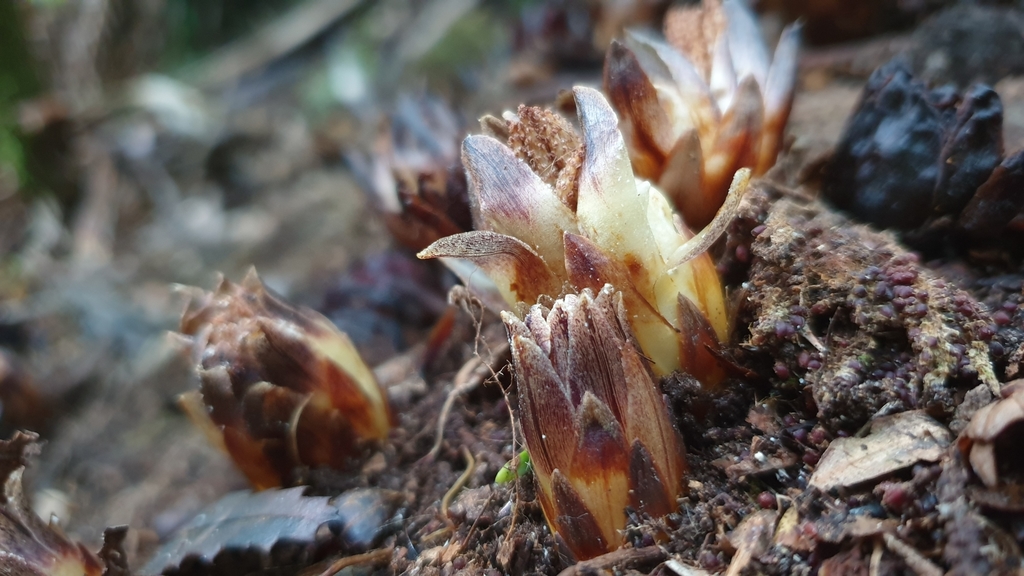
Wood Rose
Dactylanthus taylorii
Dactylanthus taylorii, commonly known in English as wood rose and in Māori as te pua o te rēinga ("flower of the underworld"), is a fully parasitic flowering plant, the only one endemic to New Zealand. The host tree responds to the presence of Dactylanthus by forming a burl-like structure that resembles a fluted wooden rose (hence the common name). When the flowers emerge on the forest floor, they are pollinated by a ground-foraging species of native bat.
From the article Dactylanthus taylorii on Wikipedia (CC BY-SA), quoted section by section
Description
Dactylanthus taylorii is a round, warty, tuber-like stem (up to 50 cm wide) or haustorium with no roots, which draws nutrients from the roots of its host. Its leaves do not photosynthesise, and are reduced to floral bracts. Some plants have been aged in excess of 30 years old. Dactylanthus prefers damp but not waterlogged soil, and is often found at the head of small streams. It parasitises about 30 species of native hardwood trees and shrubs, preferring those growing in secondary forest on the margin of mature podocarp forest. Common hosts include patē/seven-finger (Schefflera digitata), five-finger (Neopanax arboreus), lemonwood (Pittosporum eugenioides), and putaputawētā (Carpodetus serratus).
Range & habitat
Dactylanthus is currently found only in the North Island, although there is evidence from fossil pollen it lived recently in the northern South Island. It ranges from Puketi Forest in Northland through the Coromandel Peninsula as far south as Mt Bruce, and from Mt Taranaki to Te Araroa on the East Coast. In 2025 a remnant population was discovered near Wainuiomata, the first time the species had been observed in the wild in the Wellington region since 1914. It also lives on Little Barrier Island. The plant is cryptic and hence hard to survey. Many sites likely are known only to collectors, as the woody growth has commercial value. In 2020 plants from Pureora Forest were transplanted to Zealandia and Otari-Wilton's Bush reserves in Wellington. Ngā Manu Nature Reserve in Waikanae has two established, flowering sites as well as two sites added in 2021.
Wikipedia: “Distribution”
What it does
Plants are dioecious, either male or female, and only rarely hermaphrodites. They flower between February and May and are primarily pollinated by the native short-tailed bat. Male flowers produce nectar that provides a simple but very sweet fragrance which promotes bat-pollination. Analysis of fossil coprolites suggest the kākāpō (Strigops habroptilus), a flightless nocturnal parrot, was also a pollinator. Pollinated plants produce fruits slightly under 2 mm (0.079 in) long. The nectar exudes a musky smell that resembles mammalian sweat. Introduced mice and rats also pollinate them, although rats tend to destroy them.
Wikipedia: “Reproduction”
Where it lives
Recorded sightings
—
geo-referenced records in GBIF, from museums, herbaria and field observers.
Drag the globe to turn it. Dots are where records exist, not a range map; darker means more records.
In the stacks
Searching the stacks…
Every page naming Dactylanthus taylorii in the Biodiversity Heritage Library →
This page is assembled live from iNaturalist, GBIF, Wikipedia, the Source Library and the Internet Archive. It is not yet part of the hand-edited codex. iNaturalist taxon 337655.