- Plants
- ›Vascular Plants
- ›flowering plants
- ›Dicots
- ›Legumes, Milkworts, and Allies
- ›Legumes
- ›Faboideae
- ›Loteae
- ›Lotus
- ›Pedrosia
- ›Lotus creticus
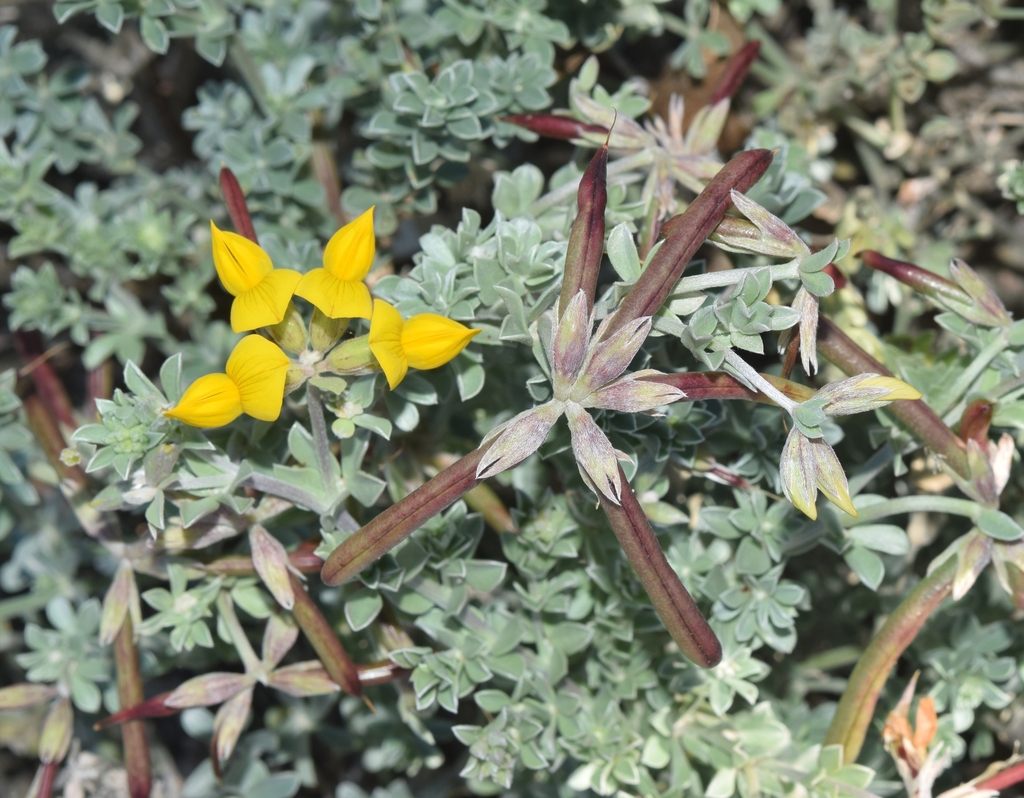
Cretan bird's-foot-trefoil
Lotus creticus
Lotus creticus is a species of perennial herb of the family Fabaceae found in tropical Africa. It is symbiosis-competent and engages in nitrogen-fixing symbiotic interactions with species of the Ensifer genus[3][3]. It comprises three varieties found in the Mediterranean. There is some controversy as to whether each subgroup could be considered the same species but are classically described as being subgroups. Varieties consist of the most commonly cited silky-hairy var. creticus, which is widely distributed in its western part of the coast; the non-silky var. glabrescens, which has a western Mediterranean distribution; and the eastern Mediterranean var. collinus, which is also not silky and can be described by long petioles and peduncles.
From the article Lotus creticus on Wikipedia (CC BY-SA), quoted section by section
Description
Lotus creticus has been described as a perennial herb of 1–2F with diffuse copiously-branched densely grey-silky Appearance. Leaflets are fleshy and oblanceolate-cuneate. Flowers are in umbels with 4–8 on axillary peduncles. Pedicels are described as short and bracts as a compound, equalling or shorter than the calyx. Flowers are corolla yellow and twice the calyx with linear pods linear of 12–18 lines long, turgid with 9–15-seeds per pod.
Wikipedia: “Morphology”
Range & habitat
Lotus creticus is native to the Spanish Mediterranean coast. It can be found in a wide range of habitats ranging from sandy to heavy saline soils and from sea level to high altitudes.
Wikipedia: “Distribution”
What it does
Lotus creticus has been found to engage in nitrogen-fixing symbiosis with Ensifer numidicus.
Wikipedia: “Symbiosis”
Where it lives
Recorded sightings
—
geo-referenced records in GBIF, from museums, herbaria and field observers.
Drag the globe to turn it. Dots are where records exist, not a range map; darker means more records.
In the stacks
Searching the stacks…
Every page naming Lotus creticus in the Biodiversity Heritage Library →
This page is assembled live from iNaturalist, GBIF, Wikipedia, the Source Library and the Internet Archive. It is not yet part of the hand-edited codex. iNaturalist taxon 337708.