- Animals
- ›Arthropods
- ›Hexapods
- ›Insects
- ›Winged and Once-winged Insects
- ›Flies
- ›Brachyceran Flies
- ›Cyclorrhaphan Flies
- ›Schizophoran Flies
- ›Calyptrate Flies
- ›Muscoid Flies
- ›House Flies and Allies
- ›Muscinae
- ›Muscini
- ›Musca
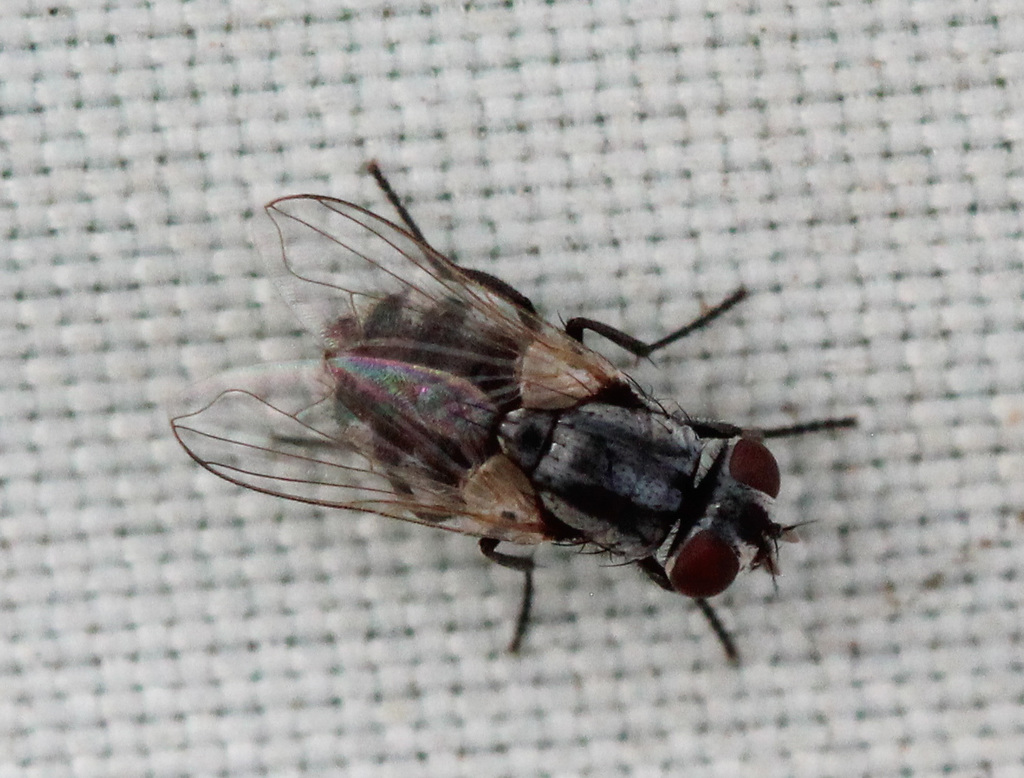
Musca vetustissima
Musca vetustissima, commonly known as the Australian bush fly, is a species of fly found in Australia. It is the specific fly that has given rise to the expression "Aussie salute".
From the article Musca vetustissima on Wikipedia (CC BY-SA), quoted section by section
Description
The Australian bush fly is a muscoid fly that is closely related to the bazaar fly (M. sorbens). The adults are attracted to large mammals for fluid for nourishment and feces for oviposition. A study showed that there is a low survival rate for eggs and larvae of this species in cattle feces because of infrequent rainfall. The study also showed that parasites and predators have caused a low survival rate. According to a study, the Australian bush fly can spread harmful bacteria. The Australian bush fly can also spread the pathogens Salmonella and Shigella. Most of the bacterial populations per fly occurred in a farm environment, while an urban environment was the lowest. A standard composition that contains small amounts of trimethylamine and indole, blended with large amounts of ammonium sulfate and anchovy meal, attracts the Australian bush fly. A wind-oriented trap has been used to catch this species. The number of ovarioles in females probably have to do with how big they are. If females do not obtain enough dietary protein, the maturation of their eggs will stop. This fly likes to crawl on human faces, as well as on the faces of livestock. It also likes to crawl on human and livestock feces, though it seems that it prefers human feces.
What it does
The Australian bush fly breeds in large numbers in dung pads. Larvae have been found in the feces of large mammals. The species continually breeds in subtropical Australia, and migrations help repopulate Australia each spring. In a study, a mixture of levamisole and oxfendazole killed larvae in sheep feces.
Wikipedia: “Life cycle”
Listen
Looking for field recordings…
Where it lives
Recorded sightings
—
geo-referenced records in GBIF, from museums, herbaria and field observers.
Drag the globe to turn it. Dots are where records exist, not a range map; darker means more records.
In the stacks
Searching the stacks…
Every page naming Musca vetustissima in the Biodiversity Heritage Library →
This page is assembled live from iNaturalist, GBIF, Wikipedia, the Source Library and the Internet Archive. It is not yet part of the hand-edited codex. iNaturalist taxon 338075.