- Plants
- ›Vascular Plants
- ›flowering plants
- ›Dicots
- ›myrtles, evening primroses, and allies
- ›myrtle family
- ›Myrtoideae
- ›Syzygieae
- ›Syzygium
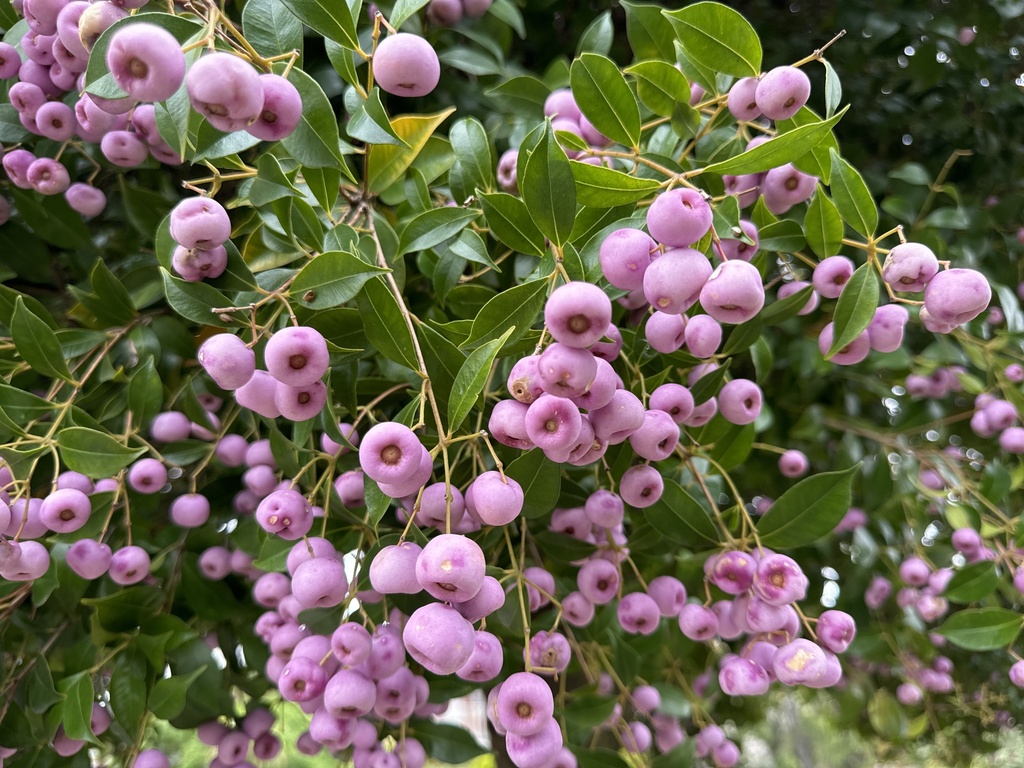
Lilly Pilly
Syzygium smithii
Syzygium smithii (formerly Acmena smithii) is a summer-flowering, winter-fruiting evergreen tree, belonging to the myrtle family Myrtaceae. It shares the common name "lilly pilly" with several other plants, however in New Zealand, it is commonly known as 'monkey apple'. It is planted as shrubs or hedgerows, and features: rough, woody bark; cream and green smooth, waxy leaves; flushes of pink new growth; and white to maroon edible berries. Unpruned, it will grow about 3–5 m (9.8–16.4 ft) tall...
From the article Syzygium smithii on Wikipedia (CC BY-SA), quoted section by section
Description
Syzygium smithii grows as a tree to 20 m (66 ft) high by 5–15 m (16–49 ft) wide, with a trunk attaining a diameter of 70 cm (2.3 ft). The largest tree was recorded at Dingo Creek Flora Reserve, south of Tenterfield, being 30 m (98 ft) tall and a trunk 60 cm (2.0 ft) wide. The trunk is sometimes buttressed. The bark is brown and scaled and flakes off easily. Its dark green shiny leaves are arranged oppositely on the stems, and are lanceolate or ovate and measure 2–10 by 1–3 cm (1–4 by 0.5–1 in). The cream-white flowers appear from October to March, occurring in panicles at the end of small branches. Berries follow on, appearing from May to August, and are oval or globular with a shallow depression at the top. They measure 0.8 to 2 cm in diameter, and range from white to maroon in colour. A distinctive narrow leaved form with thin leaves 3–6 cm long is found along rainforest riverbanks from Sydney northwards through Queensland, (rheophytic race) and a small leaved form (known as the small-leaved race or var. minor) with leaves measuring 1.6–6 cm found in dryer rainforests from Colo Heights near Sydney north to the Bunya Mountains.
Range & habitat
Syzygium smithii is found in rainforest from the Windsor Tablelands in north-east Queensland south through New South Wales and Victoria to Wilsons Promontory. Associated trees species include bangalow palm (Archontophoenix cunninghamiana), ironwood (Backhousia myrtifolia), black wattle (Callicoma serratifolia), sassafras, (Doryphora sassafras), blueberry ash (Elaeocarpus reticulatus), pinkwood (Eucryphia moorei), sweet pittosporum (Pittosporum undulatum) and kanuka (Tristaniopsis laurina). Stunted coastal plants are often associated with coast banksia (Banksia integrifolia).
Wikipedia: “Distribution and habitat”
What it does
The Australian king parrot, crimson rosella, rose-crowned fruit-dove, superb fruit-dove, topknot pigeon, white-headed pigeon, wonga pigeon, satin bowerbird, and pied currawong have all been recorded eating the berries as have brushtail possums and flying foxes. Ringtail possums also eat fresh leaves. In New Zealand, wood pigeons (kererū) eat the fruit and disperse the seeds. The leaf-mining larvae of the moth species Pectinivalva acmenae feed on the leaves. Other moth larvae that feed on the leaves include the species Agriophara horrida, Cryptophasa pultenae and Macarostola formosa. In New Zealand, where it is known as "monkey apple", the species has become naturalised in forest and scrub and has been classified as an "unwanted organism". In the Waikato region, at least, it can outgrow native canopy tree species such as puriri (Vitex lucens) and taraire (Beilschmiedia tarairi), and become the permanent canopy.
Wikipedia: “Ecology”
How it is grown
The species was introduced into cultivation as Eugenia elliptica at the Royal Botanic Gardens Kew by Sir Joseph Banks in 1790. Syzygium smithii is widely grown in cultivation as a specimen tree. Noted American landscape architect Thomas Church used the species in gardens that he created in the San Francisco Bay Area in the 1950s. These were often clipped to shape. The species has also been used as a subject for bonsai. Of the several species grown in cultivation, S. smithii is one of the more resistant to attacks by psyllids. The species can tolerate both full sun and full shade. Established plants withstand dry periods and moderate frost. Syzygium smithii is listed as a fire retardant species by such authorities as Gosford Council NSW, NSW Fire Service and the Country Fire Authority.
Cultivars. A number of forms have been selected for cultivation, including the following:
'Allyn Magic', a compact form of var. minor with greyed-orange new foliage bred by Noel Jupp of East Gresford, New South Wales. 'Elizabeth Isaacs' (also known as 'Variegata'), a slightly smaller cultivar that has new growth flushes with a combination of pink, green, cream and cream-margined leaves. 'Firescreen', a select, fast growing, broad leaf form. Glossy, copper–red new foliage growth is encouraged by a regular prune and feed, maturing to mid green. …
Wikipedia: “Cultivation”
Where it lives
Recorded sightings
—
geo-referenced records in GBIF, from museums, herbaria and field observers.
Drag the globe to turn it. Dots are where records exist, not a range map; darker means more records.
In the stacks
Searching the stacks…
Every page naming Syzygium smithii in the Biodiversity Heritage Library →
This page is assembled live from iNaturalist, GBIF, Wikipedia, the Source Library and the Internet Archive. It is not yet part of the hand-edited codex. iNaturalist taxon 338330.