- Plants
- ›Vascular Plants
- ›flowering plants
- ›Dicots
- ›Mints, Plantains, Olives, and Allies
- ›pedalium family
- ›Harpagophytum
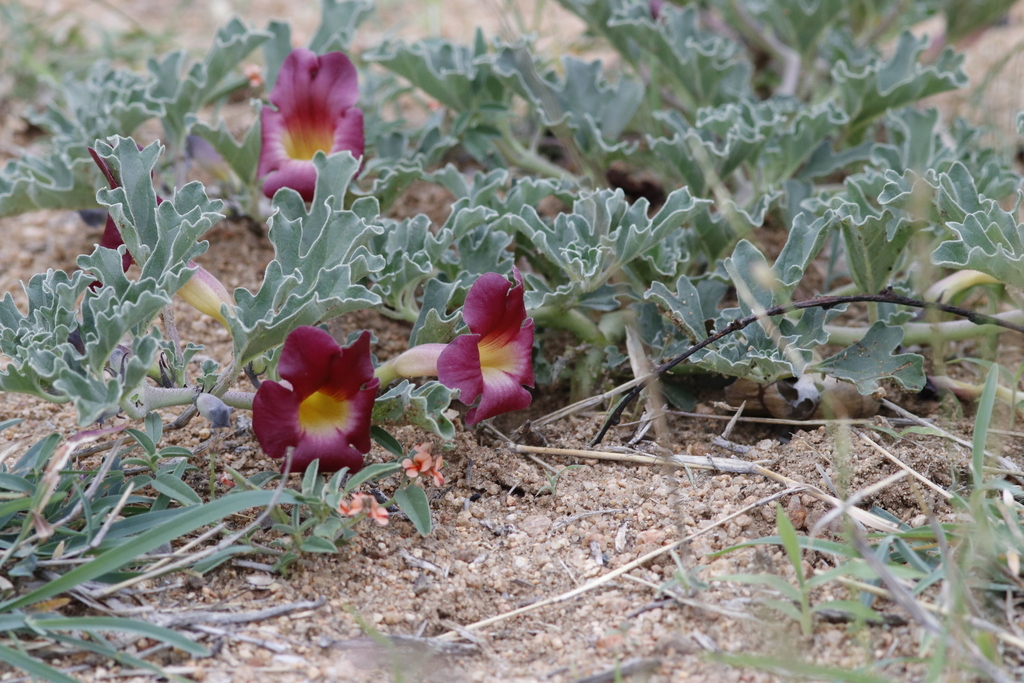
Savanna Devilclaw
Harpagophytum zeyheri
Harpagophytum ( HAR-pə-GOF-it-əm), also called grapple plant, wood spider, and most commonly devil's claw, is a genus of plants in the sesame family, native to southern Africa. Plants of the genus owe their common name "devil's claw" to the peculiar appearance of their hooked fruit. Several species of North American plants in the genus Proboscidea and certain species of Pisonia, however, are also known by this name. Devil's claw's tuberous roots are used in folk medicine to reduce pain.
From the article Harpagophytum on Wikipedia (CC BY-SA), quoted section by section
Range & habitat
Harpagophytum procumbens is mainly found in the eastern and south eastern parts of Namibia, Southern Botswana, and the Kalahari region of the Northern Cape, South Africa. H. zeyheri is found in the northern parts of Namibia (Ovamboland) and southern Angola.
Wikipedia: “Range”
What it does
Harpagophytum procumbens inhabits deep, sandy soils, and occurs in areas with low annual rainfall (150–300 mm/year). It is a perennial, tuberous plant with annually produced creeping stems. The above-ground stems emerge after the first rains and die back during droughts or after frosts. The stems grow from a persistent primary tuber and several secondary tubers (the harvested organs) grow from the primary tuber at the end of fleshy roots. The plant gets its scientific and common names from the hooked spines of its woody capsules (see photo). The mature fruit opens slowly so that, in a given year, only 20-25% of its seeds may establish soil contact. Seeds have a high degree of dormancy. They have a low respiration rate and may remain viable in the seed bank for more than 20 years. The sustainability of the trade in devil's claw has been questioned for several years. The governments of each of the countries in which it occurs (range states; Namibia, Botswana, and South Africa) have developed policies and regulations to protect the species, to determine a sustainable harvest, and to provide for continued livelihoods for the harvesters. At various times, the species has been proposed for protection by the Convention of International Trade in Endangered Species (CITES). …
Wikipedia: “Ecology and management”
In medicine
The ethnobotanical use of devil's claw originated in southern Africa. H. procumbens is one of the floral emblems of Botswana where it is thought to be useful in treating a variety of pain conditions. Preparations of the plant or its extracts, such as harpagoside, are presumed to have uses in folk medicine and phytotherapy as an anti-inflammatory herbal drug or dietary supplement. Although there is no accepted clinical evidence of its efficacy and bioavailability, limited effects were noted for treating lower back pain and osteoarthritis. A 2016 Cochrane review of clinical research noted that devil's claw seems to reduce low back pain more than placebo, although evidence was of moderate quality at best. Further research in effects upon pain and inflammation have been found worth pursuing through 2022.
Wikipedia: “Folk medicine and research”
In human culture
The generic name, Harpagophytum, is derived from the Greek words harpago meaning "hook" and phyton meaning "plant".
Wikipedia: “Etymology”
Where it lives
Recorded sightings
—
geo-referenced records in GBIF, from museums, herbaria and field observers.
Drag the globe to turn it. Dots are where records exist, not a range map; darker means more records.
In the stacks
Searching the stacks…
Every page naming Harpagophytum zeyheri in the Biodiversity Heritage Library →
This page is assembled live from iNaturalist, GBIF, Wikipedia, the Source Library and the Internet Archive. It is not yet part of the hand-edited codex. iNaturalist taxon 338767.