- Plants
- ›Vascular Plants
- ›flowering plants
- ›Dicots
- ›Sunflowers, Bellflowers, Fanflowers, and Allies
- ›Sunflowers, Daisies, Asters, and Allies
- ›Thistles and Allies
- ›Cardueae
- ›Knapweeds and Allies
- ›Rhaponticum
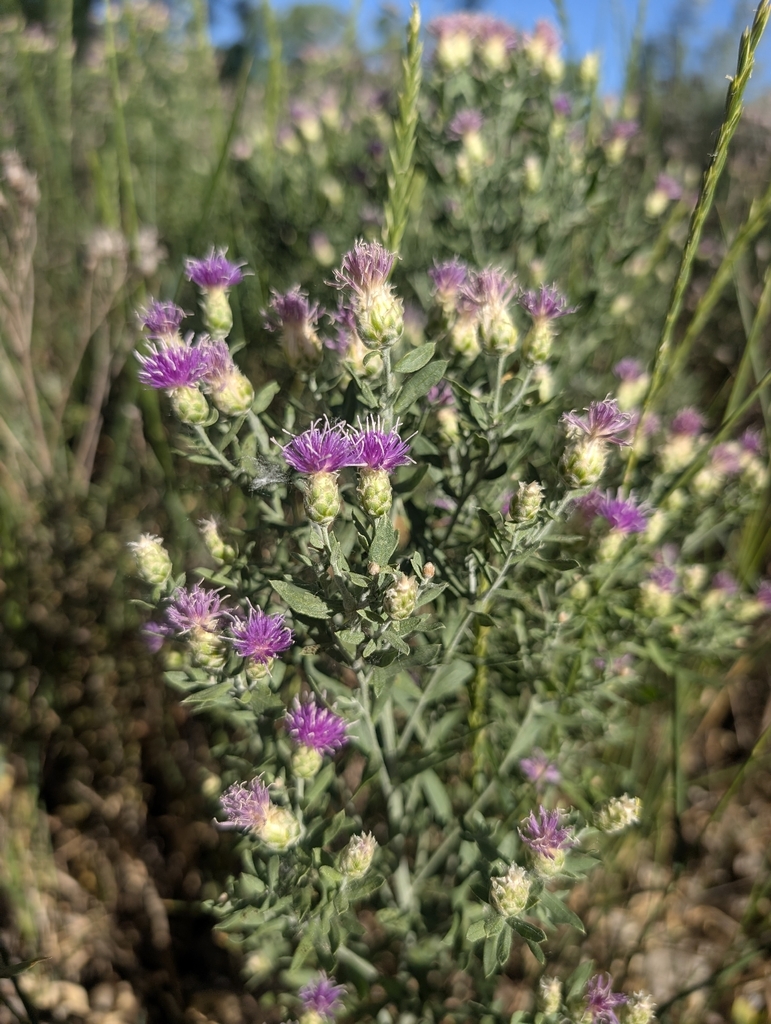
Russian knapweed
Rhaponticum repens
Rhaponticum repens, synonym Acroptilon repens, with the common name Russian knapweed, is a bushy rhizomatous perennial, up to 8 dm tall. Stems and leaves are finely arachnoid-tomentose becoming glabrous and green with age. The rosette leaves are oblanceolate, pinnately lobed to entire, 2–3 cm wide by 3–8 cm long. The lower cauline leaves are smaller, pinnately lobed; the upper leaves become much reduced, sessile, serrate to entire. The heads are numerous terminating the branches. Flowers are pink to...
From the article Rhaponticum repens on Wikipedia (CC BY-SA), quoted section by section
Description
Russian knapweed is a deep-rooted long-lived perennial. Some stands have been in existence for 75 years. It forms dense colonies in cultivated fields, orchards, pastures, and roadsides. The habit grows up to 80 cm (31 in) tall. Stems and leaves are finely arachnoid-tomentose becoming glabrous and green with age. The rosette leaves are oblanceolate, pinnately lobed to entire, 2–3 cm wide by 3–8 cm long. The lower cauline leaves are smaller, pinnately lobed; the upper leaves become much reduced, sessile, serrate to entire. The heads are numerous terminating the branches. Flowers are pink to purplish, the marginal ones not enlarged. The outer and middle involucral bracts are broad, striate, smooth with broadly rounded tips; the inner bracts are narrower with hairy tips. Pappus present with bristles 6–11 mm long. Fruit is a whitish, slightly ridged achene.
Range & habitat
A native to Eurasia, Russian knapweed was introduced into North America in the late 19th century. Absent only from southeastern U.S., it has become widespread in other regions, especially in the western United States.
Wikipedia: “Distribution”
Toxicity
Nigropallidal encephalomalacia, also called chewing disease, a movement disorder similar to Parkinson's disease, is caused in horses ingesting Russian knapweed for prolonged periods. A sesquiterpene lactone, repin, in the plant is likely responsible for this toxicity.
Where it lives
Recorded sightings
—
geo-referenced records in GBIF, from museums, herbaria and field observers.
Drag the globe to turn it. Dots are where records exist, not a range map; darker means more records.
In the stacks
Searching the stacks…
Every page naming Rhaponticum repens in the Biodiversity Heritage Library →
This page is assembled live from iNaturalist, GBIF, Wikipedia, the Source Library and the Internet Archive. It is not yet part of the hand-edited codex. iNaturalist taxon 339502.