On eBird ↗
Surfbird
Live sightings near you, the range map, bar charts of when it is seen, and Macaulay Library photos and recordings.
Surfbird
Calidris virgata
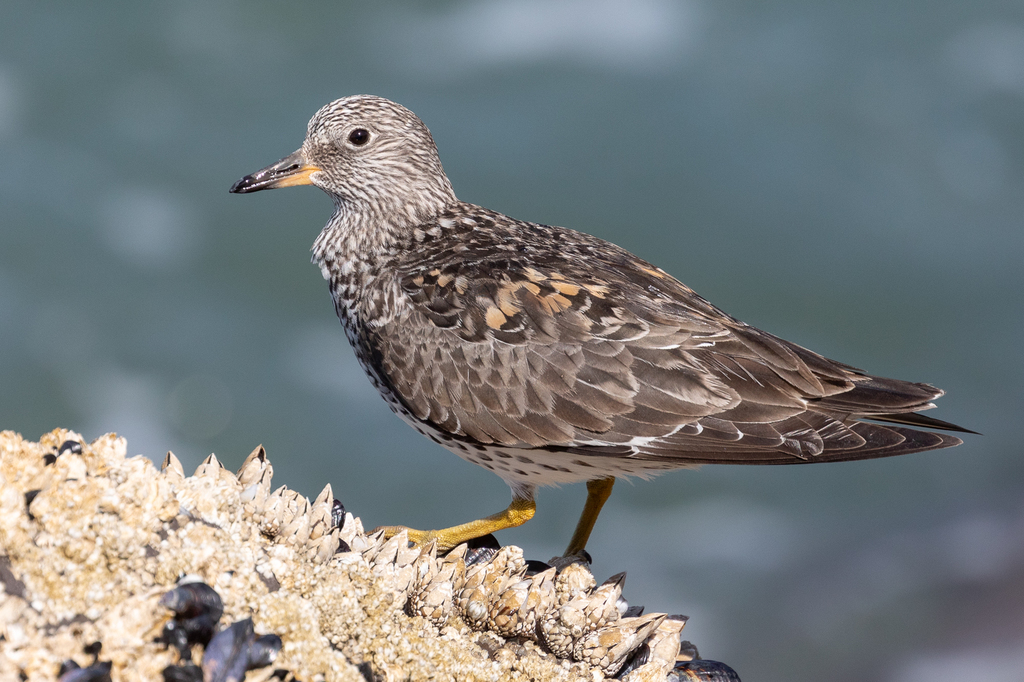
The surfbird (Calidris virgata) is a small stocky wader in the family Scolopacidae. It was once considered to be allied to the turnstones, and placed in the monotypic genus Aphriza, but is now placed in the genus Calidris.
This bird has a short dark bill, yellow legs and a black band at the end of the white rump. In breeding plumage, it has dark streaks on the brownish head and breast with dark spots on its white underparts; the upperparts are dark with flax or sometimes rust colouring on the wings. Birds in winter plumage and immature birds are mainly grey on the upperparts and breast and white on the underparts with streaking.
From the article Surfbird on Wikipedia (CC BY-SA), quoted section by section
Description
The surfbird is a large sandpiper, reminiscent of the turnstones or the great knot. It measures 23 to 26 cm (9.1–10.2 in) and weighs 133–251 g (4.7–8.9 oz). The sexes look the same, but the females are slightly larger than males on average. Surfbirds their breeding plumage from March through August, and have white heads, necks breast and belly which are streaked with black, except for the crown which are rusty. The streaking becomes less prominent lower in the body.
Range & habitat
The surfbird has the longest and narrowest non-breeding distribution of any North American bird, being found from Kodiak Island in Alaska to the Straits of Magellan at the southern tip of South America. Along that range it is rarely found more than a few meters from the shore. During the breeding season it is found on the mountains of Alaska and the western Yukon, from 150–1,800 m (490–5,910 ft). The surfbird starts leaving its breeding grounds from July (the last leaving in October), and begins reaching its main wintering grounds in Chile and Peru in mid August. On its return migration it begins to leave South America in early March. Some birds remain on the wintering grounds year-round. Vagrant birds have been seen in the Falkland Islands, Florida, and Texas. The migration routes are almost entirely coastal, a very small number of birds have been seen inland during migration. Its breeding habitat is alpine tundra, preferably rocky ridges dominated by scree, rock fields, lichens, dwarf shrubs and Dryas (mountain avens), and less commonly in tundra with mosses and sedges. It is generally found away from suitable habitat that is close to forest. In the non breeding season, it is a rocky shore specialist, feeding on rocky shores, reefs, and ledges on the coast. It will feed from the spray zone on the water's edge to just above the tide line. …
Wikipedia: “Distribution and habitat”
What it does
The diet of breeding surfbirds is dominated by insects. On one study examining stomach contents, flies (Diptera), including eggs, pupae and adults, composed 55% of the food taken by surfbirds, and beetles Coleoptera 36%. Other insects taken include moths and butterflies (Lepidoptera) and bees and wasps (Hymenoptera). Seeds and snails are also taken, albeit rarely.
Wikipedia: “Diet and feeding”
Listen
Looking for field recordings…
Where it lives
Recorded sightings
—
geo-referenced records in GBIF, from museums, herbaria and field observers.
Drag the globe to turn it. Dots are where records exist, not a range map; darker means more records.
In the stacks
Searching the stacks…
Every page naming Calidris virgata in the Biodiversity Heritage Library →
This page is assembled live from iNaturalist, GBIF, Wikipedia, the Source Library and the Internet Archive. It is not yet part of the hand-edited codex. iNaturalist taxon 339592.