On eBird ↗
Broad-billed Sandpiper
Live sightings near you, the range map, bar charts of when it is seen, and Macaulay Library photos and recordings.
Broad-billed Sandpiper
Calidris falcinellus
The broad-billed sandpiper (Calidris falcinellus) is a small wader. The scientific specific name falcinellus is the diminutive from Latin falx, falcis, "a small sickle". It was formerly treated in its own monospecific genus Limicola, but this was found to be embedded within the wider genus Calidris, into which it was transferred in 2004.
Within the genus Calidris, the broad-billed sandpiper is most closely related to the sharp-tailed sandpiper (C. acuminata).
From the article Broad-billed sandpiper on Wikipedia (CC BY-SA), quoted section by section
Description
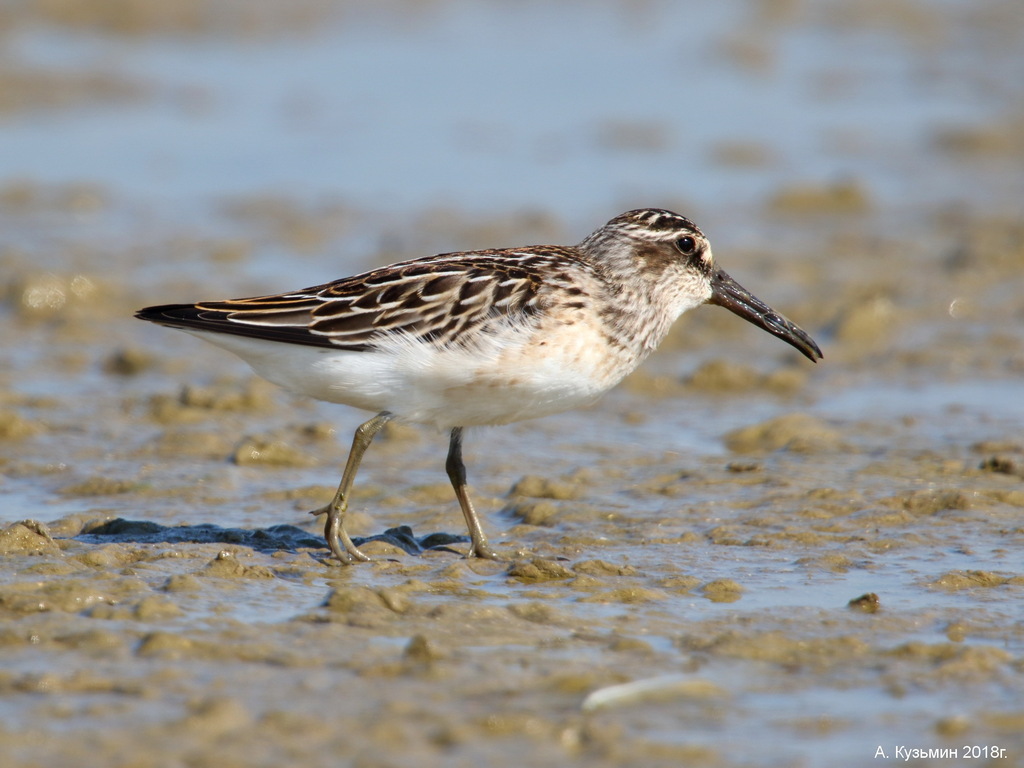
Broad-billed sandpipers are small waders, 16–18 cm long, slightly smaller than the dunlin, but larger than the little stint; it has a longer, straighter bill with the tip distinctly kinked down, and shorter legs than dunlin. The breeding adult has dark brown upperparts patterned with narrow, pale feather fringes, and white underparts with blackish markings on the breast. It has a pale crown stripe, and a distinctive double (split) supercilium. As its English name suggests, the bill is slightly broader than in most other Calidris species, but this "museum" name characteristic is rarely evident in the field. The two subspecies differ in the summer plumage feather fringing, narrow and white in C. f. falcinellus, brighter and rufous-toned in C. f. sibirica. The winter plumage is much paler and greyer above and white below, like a winter dunlin, but retains the distinct head pattern. Juveniles have backs similar to a young dunlin or little stint with pale "tramlines" down the mantle, but the white flanks and belly and brown-streaked breast are distinctive. The contact call is a dry, whistling dree-it, dree-it and a clicking dik dik, similar to the little stint.
Range & habitat
The broad-billed sandpiper is strongly migratory, spending the non-breeding season from easternmost Africa, through south and south-east Asia to Australasia. It is gregarious, and forms flocks with other scolopacid waders, particularly dunlins. Despite its European breeding range, this species is rare on passage in western Europe, due to its south-easterly migration route. This bird's breeding habitat is wet taiga bogs in Arctic northern Scandinavia and Siberia, in two disjunct regions, representing the two subspecies. The male performs an aerial display during courtship. The pairs nest in a ground scrape, laying four eggs. They forage in soft mud on marshes in the summer and on coasts in winter, mainly picking up food by sight. They mostly eat insects and other small invertebrates.
Wikipedia: “Distribution and habitat”
Listen
Looking for field recordings…
Where it lives
Recorded sightings
—
geo-referenced records in GBIF, from museums, herbaria and field observers.
Drag the globe to turn it. Dots are where records exist, not a range map; darker means more records.
In the stacks
Searching the stacks…
Every page naming Calidris falcinellus in the Biodiversity Heritage Library →
This page is assembled live from iNaturalist, GBIF, Wikipedia, the Source Library and the Internet Archive. It is not yet part of the hand-edited codex. iNaturalist taxon 339594.