On eBird ↗
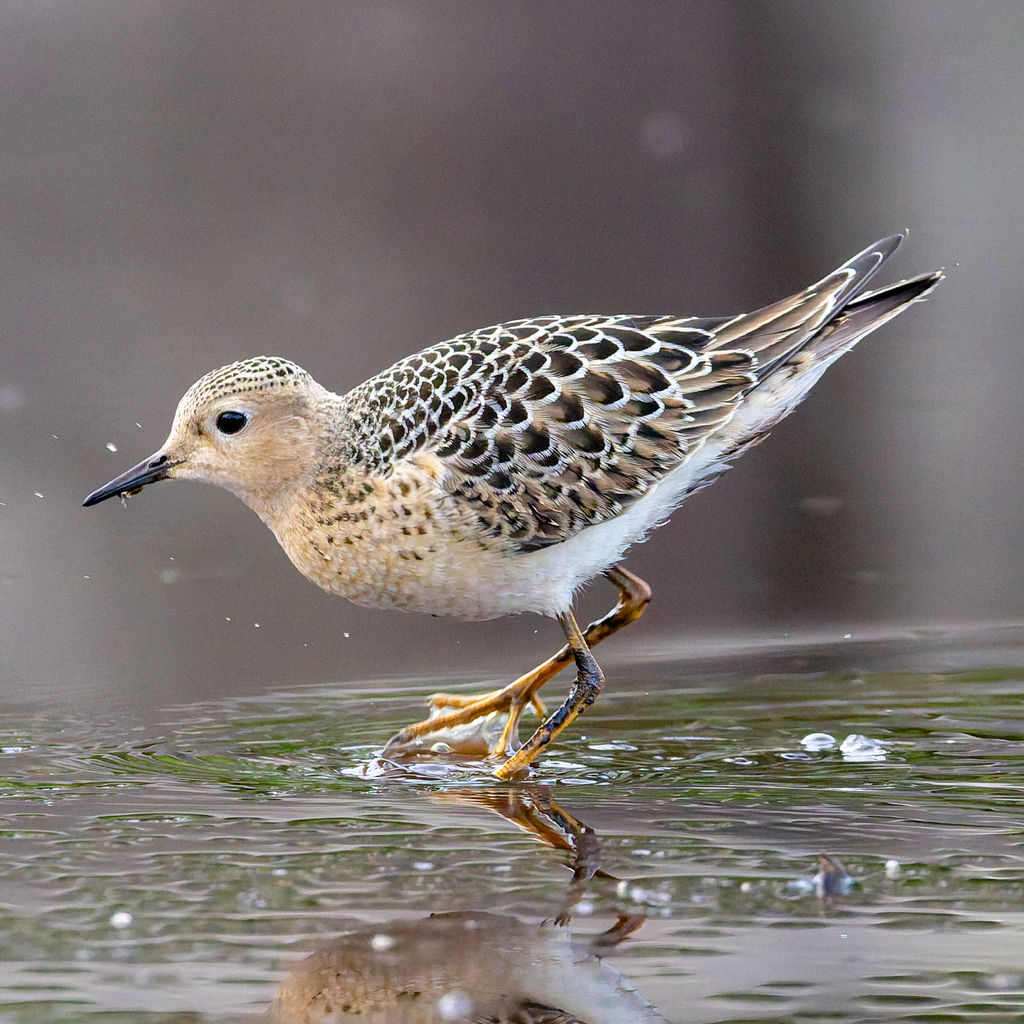
Buff-breasted Sandpiper
Live sightings near you, the range map, bar charts of when it is seen, and Macaulay Library photos and recordings.
Buff-breasted Sandpiper
Calidris subruficollis
The buff-breasted sandpiper (Calidris subruficollis) is a small shorebird. The species name subruficollis is from Latin subrufus, "reddish" (from sub, "somewhat", and rufus, "rufous") and collis, "-necked/-throated" (from collum, "neck"). It is a calidrid sandpiper, notable for its long annual migration, from the arctic region of North America to the pampas region of South America.
From the article Buff-breasted sandpiper on Wikipedia (CC BY-SA), quoted section by section
Description
This species is brown above and has a buff face and underparts in all plumages. It has a short bill and yellow legs. Males are larger than females. Juveniles resemble the adults but may be paler on the rear underparts.
Range & habitat
C. subruficollis breeds in the open arctic tundra of North America and is a very long-distance migrant, spending the non-breeding season mainly in South America, especially in Argentina and Uruguay. It migrates mainly through central North America and is uncommon on the coasts. It occurs as a regular wanderer in Western Europe and is not classed as rare in Great Britain or Ireland, where small flocks have occurred. Only the pectoral sandpiper is a more common American shorebird visitor to Europe. This species nests as far north as Canada including Alaska on the ground, laying four eggs. The male has a display which includes raising the wings to display the white undersides, which is also given on migration, sometimes when no other buff-breasted sandpipers are present. Outside the breeding season, this bird is normally found in short-grass habitats such as airfields or golf courses, rather than near water. These birds pick up food by sight, mainly eating insects and other invertebrates. The buff-breasted sandpipers are known to prey on Bombus polaris, a species of bumblebee found within the Arctic Circle. They will either eat the bees or feed them to their young. They are often very tame. Buff-breasted sandpipers are suspected to have hybridized with the white-rumped or Baird's sandpiper.
In South Asia and Australia. …
Wikipedia: “Distribution and habitat”
Listen
Looking for field recordings…
Where it lives
Recorded sightings
—
geo-referenced records in GBIF, from museums, herbaria and field observers.
Drag the globe to turn it. Dots are where records exist, not a range map; darker means more records.
In the stacks
Searching the stacks…
Every page naming Calidris subruficollis in the Biodiversity Heritage Library →
This page is assembled live from iNaturalist, GBIF, Wikipedia, the Source Library and the Internet Archive. It is not yet part of the hand-edited codex. iNaturalist taxon 339596.