- Animals
- ›Arthropods
- ›Hexapods
- ›Insects
- ›Winged and Once-winged Insects
- ›Ants, Bees, Wasps, and Sawflies
- ›Narrow-waisted Wasps, Ants, and Bees
- ›Ants, Bees, and Stinging Wasps
- ›Vespoid Wasps
- ›Hornets, Paper Wasps, Potter Wasps, and Allies
- ›Paper Wasps
- ›Polistini
- ›Polistes
- ›Polistes
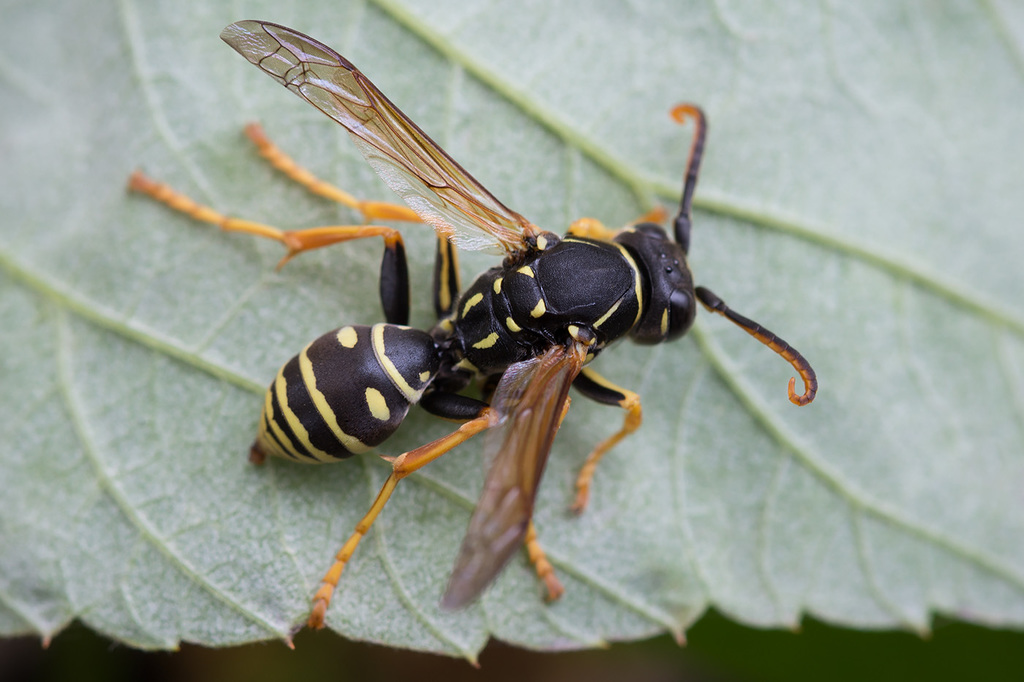
Polistes nimpha
Polistes nimpha is a eusocial paper wasp found all over Europe, with particular sightings in Turkey, Finland, Estonia, and Latvia. It is also found in northern Africa, Pakistan, Iran, India (especially in the northern states of Jammu and Kashmir and Himachal Pradesh), Kazakhstan, Mongolia, and China. The climate in these areas is relatively cold and snowy in the winter, while summers are usually hot and dry, with steppe vegetation. Polistes nimpha colonies are relatively small and easily manipulated.
From the article Polistes nimpha on Wikipedia (CC BY-SA), quoted section by section
Description
The Polistes nimpha is usually more black-patterned compared to Polistes dominula, but it is very difficult to morphologically differentiate between the females of Polistes nimpha, Polistes dominula and Polistes associus. In females, the color of the malar area (between the mandible and compound eye) is yellow and the 6th gastral sternum is black, rarely with a yellowish apical spot. In males, the clypeus (the broad plate at the front of the head) has lateral ridges; dorsal length of apical antennal segment 2.2–2.9 times as long as its maximal width, 1.3–1.5 times as long as fifth antennal segment. In both sexes the apical half of antenna is more or less darkened dorsally. The venom gland of Polistes nimpha has a muscular poison sac in the shape of an oval. The tip of the stinger is curled at the peak towards the middle, and the palps are shorter than the stinger. The terminal palps are covered with substantial feathers.
Nests appearance and materials. The nests are beige and grey with dark grey lines. Their sizes vary, with measurements ranging from 8.5 cm × 9.6 cm (3.3 in × 3.8 in) to 3.8 cm × 5 cm (1.5 in × 2.0 in). The central cells are oriented in relation to the ground morphology. Polistes nimpha usually nest in trees and sometimes in cavities. A nest consists of a single resinous pedicel and a comb not covered by envelope. …
Wikipedia: “Description and identification”
Range & habitat
The species has a transpalearctic range Polistes nimpha prefer low and relatively warm, uncultivated lands. The wasps prefer to nest on plants, under eaves of roofs and buildings, and in closed areas. Colonies with only one female foundress reside on vegetation, while colonies with two or more female foundresses are usually found in covered and sheltered areas.
Wikipedia: “Distribution and habitat”
What it does
Colonies may either be haplometrotic or pleiometrotic. Haplometrotic colonies have a single foundress female, while pleiometrotic colonies have two or more foundress females. The fertile foundresses live through the winter and build a nest in the beginning of May. They raise the first generation of workers, which emerge in the first half of June. Over the summer the colony develops and switches from rearing workers to raising sexual individuals; these sexual individuals include males and future foundresses. In August, there is a mass emergence of the male species, and only after this, do the future foundresses appear. The colony begins to disintegrate in late summer and declines throughout autumn. Once the reproductive individuals mate, the males and workers die. By the end of autumn, only the future foundresses are left to survive the winter and begin the cycle again in May. Polistes colonies found in Turkey are found to be univoltine (have one generation per year). Polistes nimpha colonies are small, averaging less than 100 workers per colony.
Wikipedia: “Life cycle”
Listen
Looking for field recordings…
Where it lives
Recorded sightings
—
geo-referenced records in GBIF, from museums, herbaria and field observers.
Drag the globe to turn it. Dots are where records exist, not a range map; darker means more records.
In the stacks
Searching the stacks…
Every page naming Polistes nimpha in the Biodiversity Heritage Library →
This page is assembled live from iNaturalist, GBIF, Wikipedia, the Source Library and the Internet Archive. It is not yet part of the hand-edited codex. iNaturalist taxon 339925.