- Plants
- ›Vascular Plants
- ›flowering plants
- ›Dicots
- ›myrtles, evening primroses, and allies
- ›bushwillow family
- ›Combretum
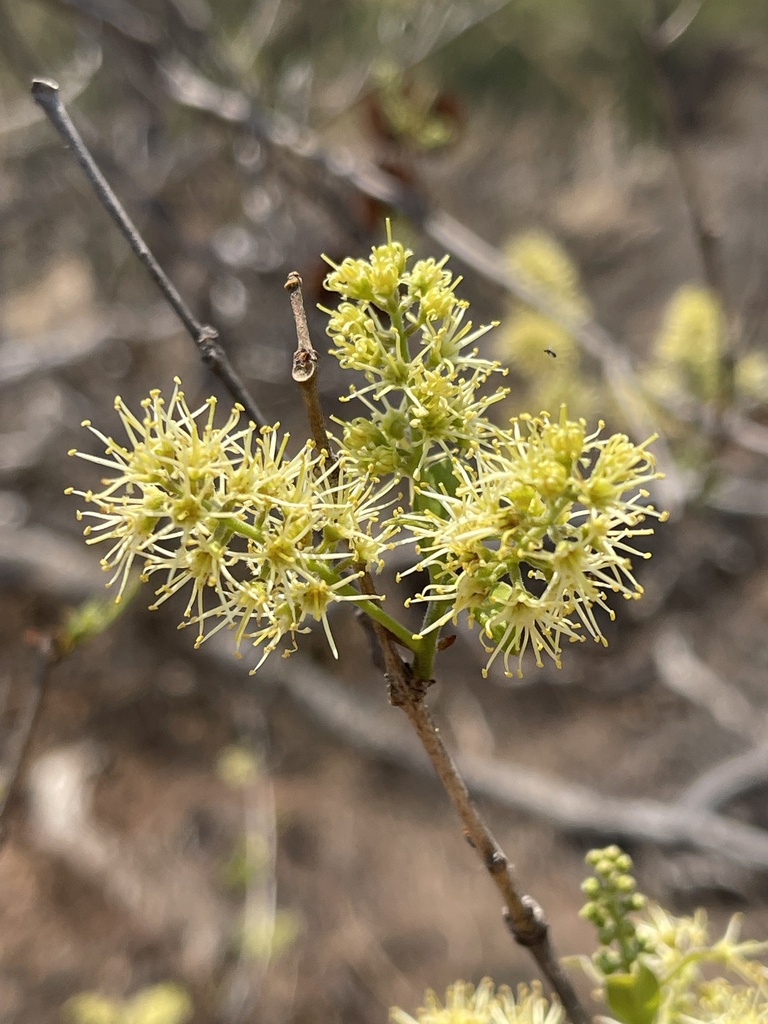
red bushwillow
Combretum apiculatum
Combretum apiculatum is a species of tree in the family Combretaceae known by the common name red bushwillow. It is native to the mesic to semi-arid savanna regions of Africa, southwards of the equator.
From the article Combretum apiculatum on Wikipedia (CC BY-SA), quoted section by section
Description
This is a semi-deciduous tree growing up to 10 meters tall, or sometimes a shrub remaining shorter. It has rough gray-black bark with fissures, and the smaller branches may be woolly in texture. The oppositely arranged leaves are up to 11 to 13 centimeters long. They are hairless or hairy. The tip of the leaf tapers abruptly to a twisted point. The foliage turns reddish or golden in the fall. The spike inflorescences emerge between the leaves and are up to 7 centimeters long. They bear yellow or green flowers with tiny sepals and petals, and with style and stamens about half a centimeter long. The flowers have a strong scent. The reddish, winged fruit is 2 or 3 centimeters long.
Range & habitat
It occurs in South Africa, Eswatini, Botswana, Mozambique, Namibia, Zimbabwe, southern Angola, Zambia, Malawi, southeastern DRC, Tanzania and southern Kenya. This tree occurs in various ecosystems in southern Africa. It is the dominant tree on the savanna in many areas, including regions characterized as lowveld and mopane savanna. It grows alongside other woody vegetation such as common hook thorn (Acacia afra), sicklebush (Dichrostachys cinerea), large sourplum (Ximenia afra), livelong (Lannea discolor), white seringa (Kirkia acuminata), and marula (Sclerocarya afra).
Wikipedia: “Range and habitat”
Where it lives
Recorded sightings
—
geo-referenced records in GBIF, from museums, herbaria and field observers.
Drag the globe to turn it. Dots are where records exist, not a range map; darker means more records.
In the stacks
Searching the stacks…
Every page naming Combretum apiculatum in the Biodiversity Heritage Library →
This page is assembled live from iNaturalist, GBIF, Wikipedia, the Source Library and the Internet Archive. It is not yet part of the hand-edited codex. iNaturalist taxon 340059.