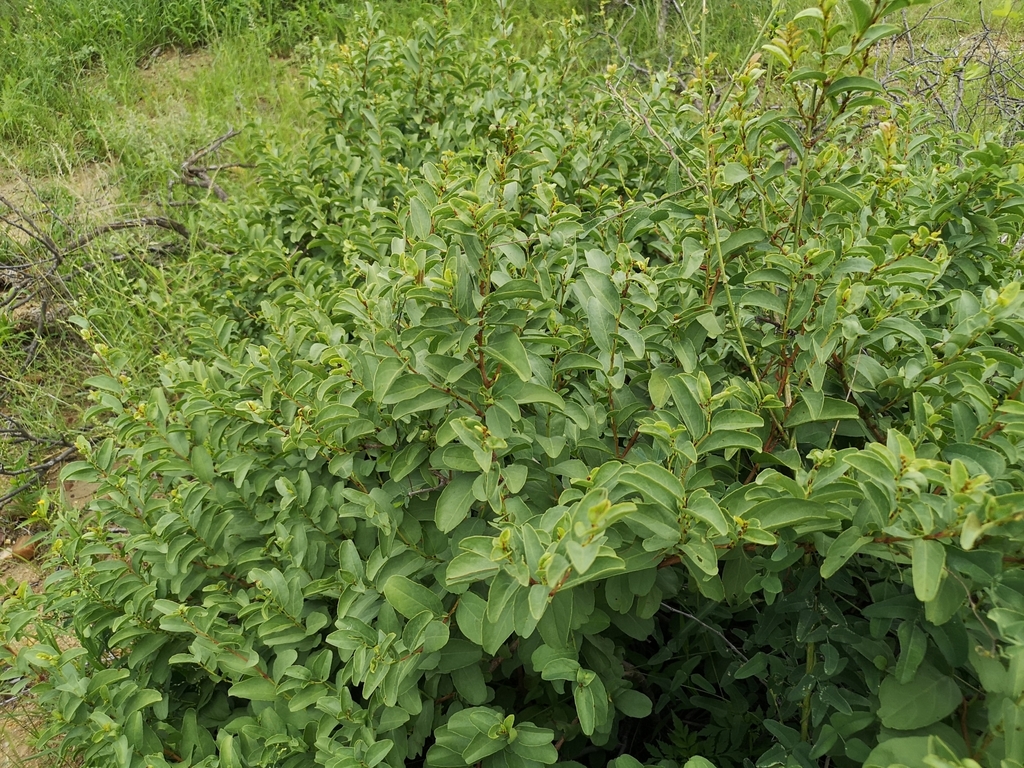
Ivygrape
Cissus cornifolia
Cissus cornifolia is a species of flowering plant in the Vitaceae family. It is an erect or semi-scandent woody shrub up to 3 meters in height, and found from sub-Saharan Africa and Tropical Africa south to Botswana, Mozambique and South Africa. It is one of more than 300 species forming the genus Cissus.
Growing from a large tuberous rootstock and found up to 2000m, in open woodland and grassland, often on granite outcrops, it occasionally develops tendrils. Branch nodes are conspicuously swollen and new parts of the plant have a ferruginous, floccose covering, persisting on the bracts.
From the article Cissus cornifolia on Wikipedia (CC BY-SA), quoted section by section
In medicine
Roots or tubers are powdered or a decoction is prepared and used to treat venereal diseases, naso-pharyngeal infections, fevers and malaria. The plant is traditionally used as a sedative. Tubers and fruits are eaten and used for flavouring in sauces.
Wikipedia: “Pharmacology and ethnic use”
In human culture
The generic name is derived from κισσος or 'kissos', a Greek word for "ivy" - 'cornifolia', having leaves resembling those of Dogwood (Cornus spp.),
Wikipedia: “Etymology”
Where it lives
Recorded sightings
—
geo-referenced records in GBIF, from museums, herbaria and field observers.
Drag the globe to turn it. Dots are where records exist, not a range map; darker means more records.
In the stacks
Searching the stacks…
Every page naming Cissus cornifolia in the Biodiversity Heritage Library →
This page is assembled live from iNaturalist, GBIF, Wikipedia, the Source Library and the Internet Archive. It is not yet part of the hand-edited codex. iNaturalist taxon 340101.