- Plants
- ›Vascular Plants
- ›flowering plants
- ›Dicots
- ›Mints, Plantains, Olives, and Allies
- ›bignonia family
- ›Tecomeae
- ›Stereospermum
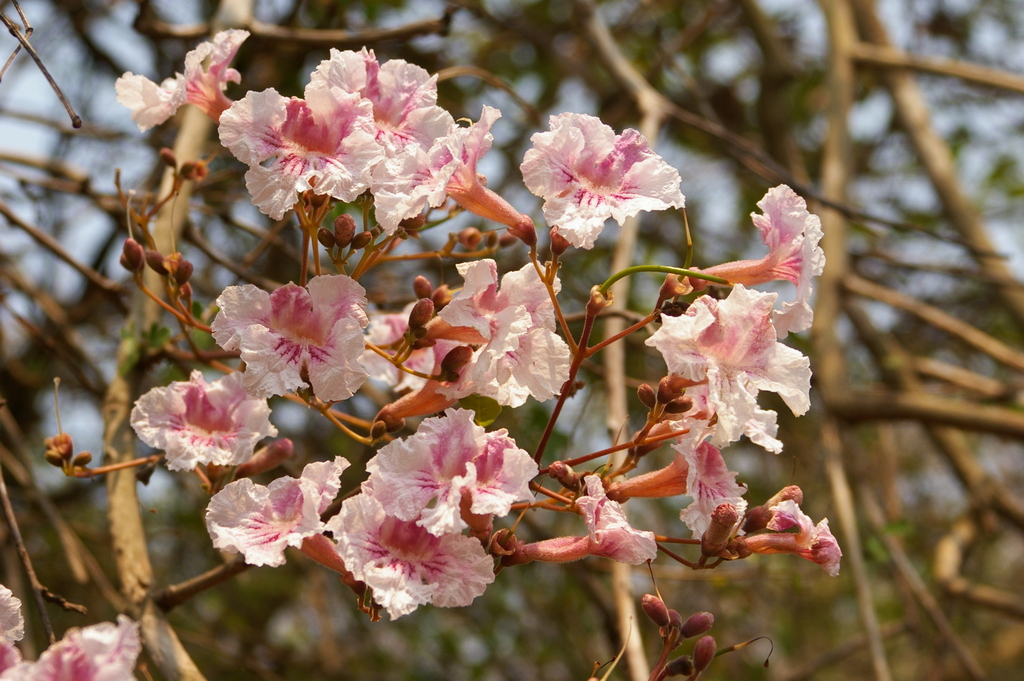
pink-jacaranda
Stereospermum kunthianum
Stereospermum kunthianum is an African deciduous shrub or small tree occurring in the Democratic Republic of Congo, Djibouti, Eritrea, Ethiopia, Kenya, Malawi, Senegal, Somalia, Sudan, Tanzania and Uganda. It is widespread across Africa to the Red Sea, and reaches as far south as Angola, Mozambique, Zambia and Zimbabwe. There are some 30 species with a Central African and Asian distribution.
Growing to 25 cm diameter, it has thin, grey-black bark, smooth or flaking in patches resembling the London plane; the trunk is rarely straight, with twisted branches. Usually 5m tall, but occasionally up to 15m, with abundant, fragrant, precocious, pink or purplish flowers, making the tree a spectacular sight. The alternate leaves are imparipinnately compound and some 25 cm long; leaflets are nearly opposite with one terminal leaflet, and with short, soft hairs, oblong to oblong-elliptic in shape, green and hairless above, yellowish-green with prominent venation below, apex somewhat attenuate, and the base tapering. The leaf margin may be entire or sometimes toothed in coppice shoots, while petiolules are virtually absent. Petioles may be up to 7 cm long, and are caniculate. Immature leaves are occasionally toothed and hairy.
From the article Stereospermum kunthianum on Wikipedia (CC BY-SA), quoted section by section
In medicine
Analysis has shown the presence of sterols, coumarins, higher fatty acids, and the absence of flavones, aglycone and alkaloids. In vitro, extracts from the tree have proven effective against Pseudomonas aeruginosa, Staphylococcus aureus, Escherichia coli, Salmonella spp, Aeromonas hydrophila and Klebsiella spp. Decoctions and infusions of the fruits, bark and roots are used in traditional medicine for pharyngeal affections, leprosy, subcutaneous parasitic infections and other skin afflictions, venereal diseases, diarrhoea, dysentery, and as antiemetics, febrifuges, analgesics, vermifuges, diuretics and laxatives.
Wikipedia: “Phytochemicals”
Where it lives
Recorded sightings
—
geo-referenced records in GBIF, from museums, herbaria and field observers.
Drag the globe to turn it. Dots are where records exist, not a range map; darker means more records.
In the stacks
Searching the stacks…
Every page naming Stereospermum kunthianum in the Biodiversity Heritage Library →
This page is assembled live from iNaturalist, GBIF, Wikipedia, the Source Library and the Internet Archive. It is not yet part of the hand-edited codex. iNaturalist taxon 340263.