- Plants
- ›Vascular Plants
- ›flowering plants
- ›Dicots
- ›Mints, Plantains, Olives, and Allies
- ›stilbe family
- ›Nuxia
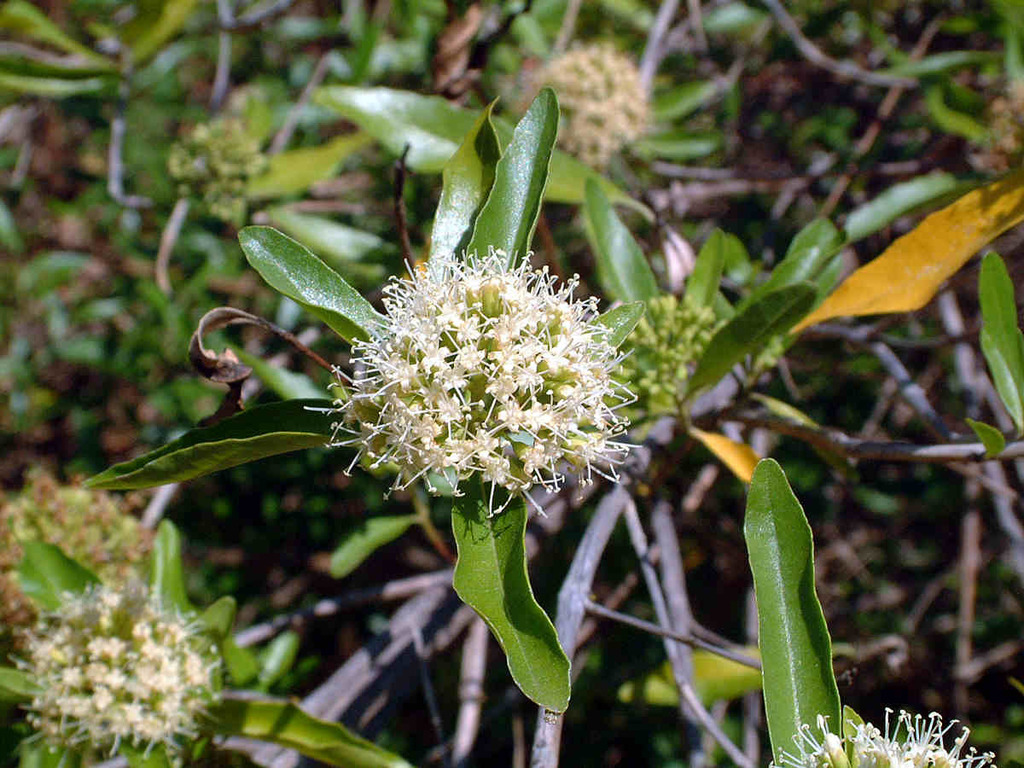
river nuxia
Nuxia oppositifolia
Nuxia oppositifolia, commonly known as water elder or water nuxia, is a species of flowering plant in the family Stilbaceae. It is native to a wide area of Africa, and to the Arabian Peninsula.
Nuxia oppositifolia is a shrub or small tree, with reddish-brown bark, leathery or sub-leathery leaves, and whitish or lilac flowers. The International Union for the Conservation of Nature lists the species as of Least Concern.
From the article Nuxia oppositifolia on Wikipedia (CC BY-SA), quoted section by section
Description
Nuxia oppositifolia is a shrub or small tree that grows 1–15 metres (3.3–49.2 ft). It is often gnarled, and sometimes straggling. The trunk has reddish-brown bark, and is 10–60 centimetres (3.9–23.6 in) in diameter. When dry, the leaves are leathery or subleathery. The leaves are narrowly elliptical. The leaves are 3–13 centimetres (1.2–5.1 in) long, and 0.4–3 centimetres (0.16–1.18 in) wide. The leaves are arranged oppositely, or sometimes alternately. The leaves have 2–12 millimetres (0.079–0.472 in) long stems. The flowers are white, creamy, or lilac in colour, and slightly fragrant. They grow alone, or in groups of up to three. The inflorescence is 1.5–7 centimetres (0.59–2.76 in) long, and 2–8 centimetres (0.79–3.15 in) wide. The calyx is green, 4–5 millimetres (0.16–0.20 in) long, and has cleanly divided lobes. The seeds are 0.5–0.8 millimetres (0.020–0.031 in) long, and 0.15–0.2 millimetres (0.0059–0.0079 in) wide.
Range & habitat
Nuxia oppositifolia is native to the seasonally dry tropical biome of Africa, Madagascar, and the south-west Arabian Peninsula. It is present in Angola, Djibouti, the Democratic Republic of the Congo, Eritrea, Eswatini, Ethiopia, Kenya, Malawi, Mozambique, Namibia, Saudi Arabia, Somalia, Sudan, South Sudan, Tanzania, Uganda, Yemen, Zambia, and Zimbabwe. Within South Africa, it is present in the provinces of KwaZulu-Natal, Limpopo, and Mpumalanga. The species grows in sub-tropical forests, near streams and rivers, in gorges and valleys, and among rocks and reeds. Its estimated extent of occurrence is 12,093,063.67 square kilometres (4,669,157.99 sq mi). It grows at altitudes of 50–1,325 metres (164–4,347 ft).
Wikipedia: “Distribution”
Where it lives
Recorded sightings
—
geo-referenced records in GBIF, from museums, herbaria and field observers.
Drag the globe to turn it. Dots are where records exist, not a range map; darker means more records.
In the stacks
Searching the stacks…
Every page naming Nuxia oppositifolia in the Biodiversity Heritage Library →
This page is assembled live from iNaturalist, GBIF, Wikipedia, the Source Library and the Internet Archive. It is not yet part of the hand-edited codex. iNaturalist taxon 340348.