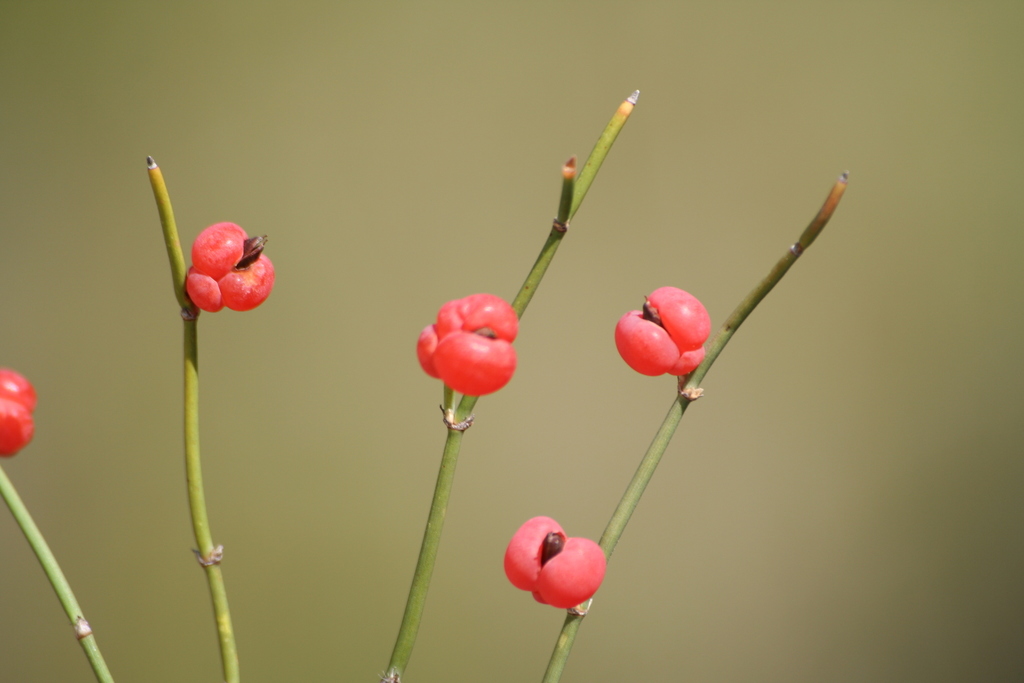
European Ephedra
Ephedra distachya
Ephedra distachya is a shrub in the family Ephedraceae that stands about 25 cm to 50 cm high. The shrub grows in many parts of the world, including southern and central Europe and western and central Asia. Its local names include somlatha. Ephedra distachya lives on grey dunes which are fixed and stable sand dunes that are covered in continuous vegetation.
From the article Ephedra distachya on Wikipedia (CC BY-SA), quoted section by section
At the table
Ephedra distachya is used to relieve acute muscular and rheumatic pains (when it is called teamsters' tea), as a stimulant, and in the cardio tonics in Ayurveda. It is sometimes identified with the legendary drug soma, as described in the Avesta and the Rig Veda, the respective ancient sacred texts of the Zoroastrian and Hindu faiths. Ephedrine, an alkaloid, is obtained from its dried branches and is used as a stimulant, often to control asthma. It was isolated from the plant by Nagayoshi Nagai in 1885. All parts of the plant contain up to 3% ephedrine.
Wikipedia: “Uses”
In human culture
Ephedra is part of a group of plants called ‘gnetophytes’. These plants have hardly changed in the past 100 million years, and are thought to be relics of an ancient flora. The leaves of Ephedra are tiny and scale-like. Gnetophyte leaves evolved independently from leaves in flowering plants. Ephedra produces the alkaloid ephedrine, which has been shown to interfere with insect thermoregulation and may also have effects on insect neurotransmitters. This may be the method by which the plant deters insect herbivores.
Wikipedia: “History”
Where it lives
Recorded sightings
—
geo-referenced records in GBIF, from museums, herbaria and field observers.
Drag the globe to turn it. Dots are where records exist, not a range map; darker means more records.
In the stacks
Searching the stacks…
Every page naming Ephedra distachya in the Biodiversity Heritage Library →
This page is assembled live from iNaturalist, GBIF, Wikipedia, the Source Library and the Internet Archive. It is not yet part of the hand-edited codex. iNaturalist taxon 340431.